

Goodmorning! A new edition of my newsletter. Hope you all like it. Thank you for reading and subscribing it really makes a difference!
🧐Henny Portman’s Blog: managing AI projects requires a two-speed portfolio
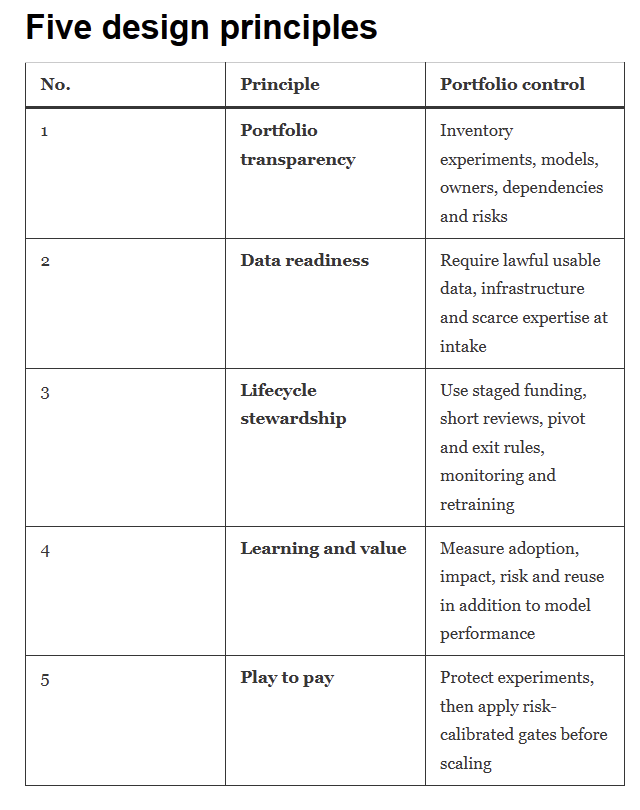
Sometimes I read Henny Portman’s blog. Henny reads a lot, I mean really a lot and he also sends emails a lot 😅. So put on your “consultancy hat” and read a long on this topic of AI experimentation in organisations.
His recent blog post is about that AI projects do not really fit in annual plans.
Basically the blog says there are two “tracks”
A fast track: the fast track is intended for narrow, non-production experiments. It temporarily reduces some compliance and dossier requirements so that teams can test feasibility and learn quickly in a controlled environment.
A heavy track: the heavy track applies to initiatives with greater risk, stronger dependencies or an intention to enter operational use.
The essence in the blog post: permission to experiment is not permission to scale. A successful pilot still has to go through the gate again.
The part I liked most is actually Henny’s own addition. He points out that AI can “reduce the cost and time required to build and test a solution”. So the bottleneck moves. It’s no longer the tech. It’s the organisation: who owns it, who trains the people, which processes need to change, and what has to give way.
I recognise this. You can build a small AI tool in an afternoon now.
Getting a team to actually use it every week, that’s the real project.
The idea itself isn’t new. In the US they’ve been doing this for years under other names. Amazon talks about “two-way doors” (reversible decisions, just go, something I wrote about in this substack a few times as well) versus “one-way doors” (be careful, thing throuhg).
In this model, written on the blog, even the fast track gets formalised. So it is not anymore fast.
Register the experiment, check data readiness, define an exit date. And you can feel where it comes from: most interviewees were European, many German, many from regulated industries as Henny also points out.
I think formalising the light track still slows things down. If a two-week test first needs a form and a sign-off, your fast track has quietly become a medium track.
Still interesting to read and think about for everyone involved in AI and organisations.
Details: https://hennyportman.wordpress.com/2026/10/21/managing-ai-projects-requires-a-two-speed-portfolio/
💡Zyppy: create your brand report (I tried it via a workaround)
Cyrus Shepard Cyrus Shepard (of Zyppy) shared a great idea recently, and probably a great service as well. He even shared the prompts (extra thanks, man!). Read on and I’ll explain.
Zyppy’s idea:
My ideal AI SEO tool isn't a prompt tracker. Instead, it:
1) Tests exactly what AI gets right + wrong about a company's brand facts
2) Measures overall AI recommendation rates for each company/competitor
3) Importantly, crawls and analyzes all pages to recommend specific content changes
The service Zippy explains is letaido.com, that provides exactly the above, but that’s about 99 USD per month. Probably a great service, but just for a test, too expensive for me.
So I figured most of it (maybe not all, but most) should be possible with Claude, since I have a Claude subscription, in combination with a Monid account, which I also have.
For those who don’t know Monid: it’s a great service. It gives you API access to lots of different data sources, like keyword and brand research. You just top up your balance, so there’s no long-term subscription.
I added 10 usd to Monid and got started. I uploaded Zyppy’s sample report as a PDF so Claude could read it more easily, plus the first prompt, which Cyrus made easy to copy-paste. Then I iterated on it a bit. I can say it works really well.
I first did this for my current employer, and that worked really, really well. After the initial prompt you need to answer some follow-up questions to explain your background and challenges. Once you tailor it a bit, you get a great report for your organisation.
I can’t share the one I made for my employer, so I also made one for Mollie, the payment provider. I don’t know much about Mollie, so I only did the generic part, just to give you an idea.
I think this way of working is a great start for brand tracking and improvement, especially for smaller companies or use it, for your (potential) clients. You can easily create a custom brand tracker for (potential) clients and customized with your expertise and niche.
Now checkout the “Mollie brand tracker” that I made with Claude and Monid, I made it sharable via the Claude Artifacts option:➡️➡️➡️ https://claude.ai/artifact/9YBm9iQTREXWWmshe5XxYu
Sample report Zippy: https://my-workspace-public.cyrus-s-agent.letaido.app/ai-brand-report/zyppy
The prompts used: https://my-workspace-public.cyrus-s-agent.letaido.app/ai-brand-intelligence/build-your-own
And monid you can find here: https://www.monid.ai
⛔Joybuy fail: App does not let me order!
WTF Joybuy! I wanted to give Joybuy my money. They wouldn’t let me. Read on!
As I wrote a while ago, Joybuy, JD.com’s European shop, has entered the Netherlands. And as with every new crossborder service, I wanted to try it myself especially as they seem to have very fast and good logistics.
So I filled my cart. Nothing fancy: some water, a shower gel, €23 in total.
That was a few weeks ago. I still haven’t been able to check out and I have tried regularly.
Joybuy forces me into the “select your free article” sheet, some screen they put in between the cart and checkout, a screen you also sometimes get at Temu a bit that style.
Every gift in it is “sold out”, and the button to continue is almost certainly rendered behind my Android navigation bar. So my only way out is the X, which drops you back in the cart. Boom, and that’s a loop, checkout the video. I gave up now.
This is the kind of thing that should never survive long nowadays. It’s very easy to set alerts on conversion drops even per device or category, and to have AI test these kinds of scenarios before customers find them.
I think also, if you do a promo between the cart and the checkout button, monitor that very very clearly and closely.
I guess their “localisation” strategy, as written here in an earlier edition, needs some improvements.😉 (Happy to help, Xie Xie)
📹 Whatnot: the ad that made me open the app again
This is the kind of ad I could have written myself😅. Same energy, same kind of jokes I like.
I’ve been watching live shopping for a long time and have bought a few things that way, mostly when I lived in China. In Europe the options are thinner.
Whatnot is the main place if you want the real livestream shopping experience in an app, real people, real products, real chat, moving fast.
I already had the app on my phone. Then this advertisement showed up in my feed.
A guy (probably a famous one) literally bursting through the wall into a sports-card livestream. I watched it, smiled, and thought: okay, let’s checkout WhatNot again.
The ad doesn’t really explain Whatnot. It just shows the chaos and the fun of being inside one of those streams.
If you’re already a bit familiar with live shopping, it lands, the chaos and fun.
Maybe it also helps, It doesn’t feel like a normal brand ad.
For anyone in e-commerce or digital marketing, it’s worth installing and spending some time s in a few different streams on WhatNot you’ll get inspired.
Also it confirms again, “app engagement campaigns” can work, you just need the right creatives.
Details: https://www.whatnot.com/
PS:
I wrote also on another live stream in the Netherlands from Corendon in this edition.
🇹🇼 Airline branded convenience store in Taipei


Convenience stores in Europe, I don’t really like them especially not AH to go. In Asia however it’s a different story. The Thai ones are good, the Chinese ones a bit better, the Japanese ones are great but the Taiwanese, they are next level.
Just after I visited the “Hello Kitty 7-eleven”I even found a Starlux-branded 7-Eleven in Taipei. Starlux is a premium airline from Taiwan, and together with 7-Eleven they turned a regular convenience store into something that feels more like an airline lounge.
Starlux was started in 2016 by the son of the Evergreen (EVA Air) founder, who left the family business and built his own airline. He even flies the planes himself. Need to try that airline sometime, it seems special.
I didn’t take such great pictures, to be honest but this convenience store is airline branded. It’s a bit like an airline cafe, where you also buy their merchandise and even the same food as they have in flight on the plane.
It doesn’t end there, Starlux sometimes partners with suppliers so they also have limited edition chips there. I didn’t see those myself but the link below shows it.
This isn’t a one-off either. 7-Eleven Taiwan does a lot of these themed stores, from Pokémon and Snoopy to Heineken and even Maserati. Convenience as a brand billboard.
So if you think my pictures are “so so”, then click this link, much better ones there:
https://wizarno.com/7-eleven-starlux-taiwan/
✅Elon Musk explains his 5-step algorithm for solving (engineering) problems

And now for something different. I copy paste these steps here below, because I want to be able to find them back easily. I think these steps can also be used in product management, something I like. So I save it here, to use when I write epic’s for example on improving the app or a commerce platform. This is worth a try!
Step 1: Question the requirements. Make the requirements less dumb. The requirements are always dumb to some degree, no matter how smart the person who gave you those requirements. You have to start there, because otherwise you could get the perfect answer to the wrong question.
Step 2: Try to delete it. Try to delete the part or the process step entirely. If you’re not forced to put back at least 10% of what you delete, you’re not deleting enough. Most people feel like they’ve succeeded if they haven’t been forced to put things back in. But actually they haven’t, they’ve been overly conservative and left things in that shouldn’t be there.”
A small note from my side: Musk is talking about rockets and cars, where deleting means removing a physical part. He also applied it to teams and people.
In product management I’d read it as “delete from the scope”, not delete the team.Step 3: Optimize or simplify. “The most common mistake of smart engineers is to optimize a thing that should not exist. So you don’t optimize until after you’ve tried to delete.”
Step 4: Speed it up. “Any given thing can be done faster than you think. But you shouldn’t speed things up until you’ve tried to delete it and optimize it otherwise, you’re speeding up something that shouldn’t exist.”
Step 5: Automate. “And then the fifth thing is to automate it.” Elon explains why the order matters: “I’ve gone backwards so many times where I’ve automated something, sped it up, simplified it, and then deleted it. I got tired of doing that. So that’s why I have this mantra.”
To make it concrete for more product management kind of things: say the epic is make re-ordering faster in an app.
Question: who asked for a separate favourites page, a previous orders page and a shopping lists page? Often they just grew overtime.
Delete: keep one “my products” list and remove the other two.
Simplify: sort that list by what the customer buys most, with quantities editable in one tap.
Speed up: shorten the path from opening the app to placing the order, say from six taps to two (made-up numbers, but you get the idea).
Automate: only then add a weekly suggested order based on purchase history.
Most teams start at step 5 on top of three overlapping lists, so this framework forces to think different. It’s a bit the same as the Jeff Bezos, future press release maybe, I also liked that idea a lot but the Musk steps go further it seems.
So try asking AI if it can apply this framework to your next workflow, campaign improvement or PRD. I tried it with a few things and it gives new insights, I can promise you that already but I have to try more. That’s why I wrote it here, so I can easily find it back.
PS
This framework is getting new attention this year, partly thanks to The Algorithm, a book by former Tesla president Jon McNeill. The quotes below come from Musk’s 2021 interview with Everyday Astronaut. There is lot’s to be foud of this online. F.e. here https://www.corporate-rebels.com/blog/musks-algorithm-to-cut-bureaucracy
Thanks for reading Crossborder Alex : Global Marketing & E-commerce! Subscribe for free to receive new posts and support my work.
A bit shorter newsletter this week, I am really busy again, many things to do and many ideas in my head for work so I need to write that off myself first, but I hope today’s newsletter was still informative.
Interested in more? Checkout my archive!
Use my vibe coded search engine to find content tailored to you, I improved the search engine a bit. Let me know what you think.
Do you want to support me? Consider taking an American Express Card via this referer URL. It benefits us both and makes it possible for me to travel and share more on this substack. Thank you. American Express is -also in Europe- a great way to get travel perks but you really speed up the points and perks by referals.