

Goodmorning from Shanghai! I am back in my “2nd city” just for a day now and I have missed it. The convenience, the safety, the retail the weather! Good to be back! I hope to share more pictures of the trip later I am now writing the newsletter during breakfast here in Xuhui, central Shanghai.
Thanks for the patience, I was really busy the last two weeks before my holiday at work, that took much of my time, but fun to do, just didn’t had a lot of time for the newsletter.
Let’s dive into the news that took my attention:
🇨🇳 🇳🇱 Joybuy and their localisation in Europe
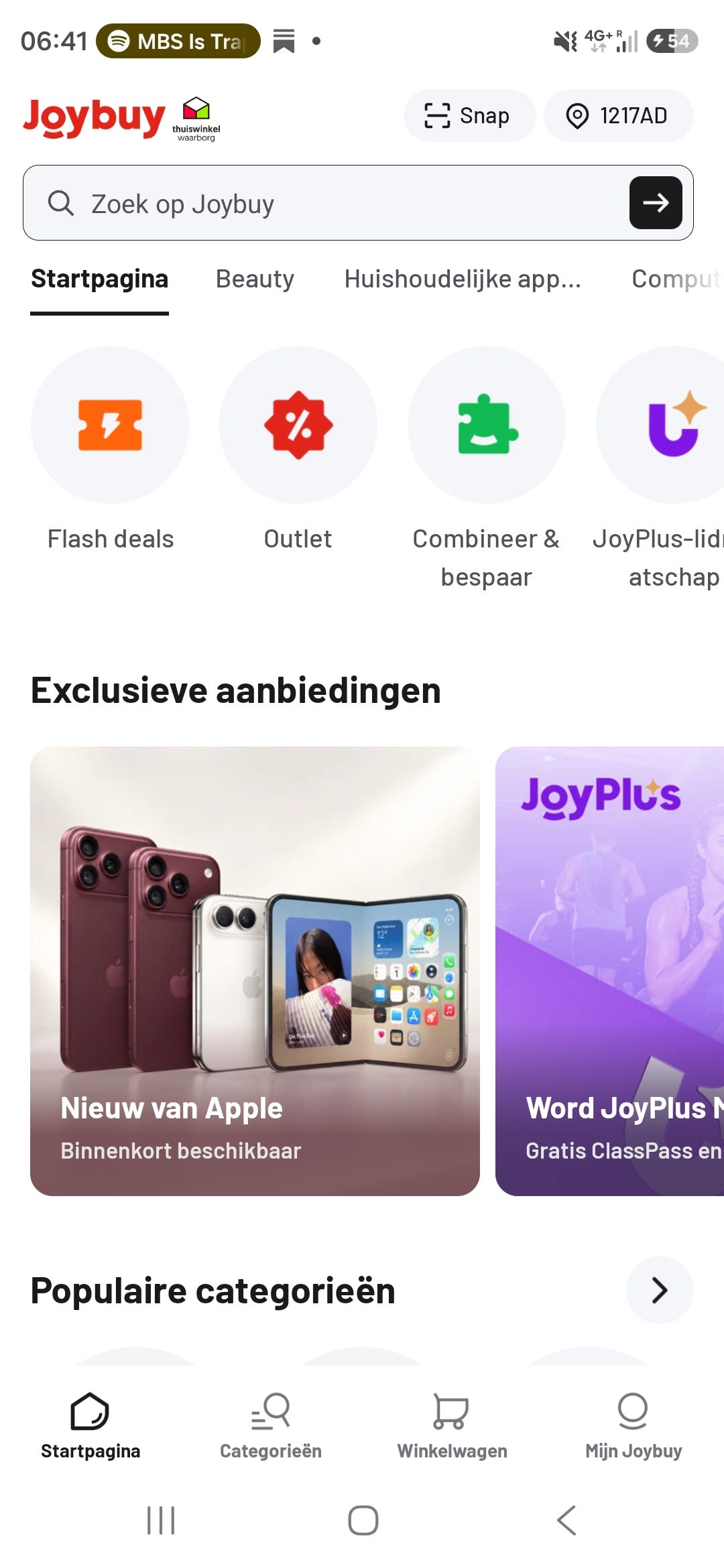
Not a superinteresting or in depth interview. Nevertheless it’s fun to read for us “crossborder” fans.
Fun little one from CMOtalk, Klaas Weima’s marketing podcast on BNR. he spoke to Annemieke Kleij, marketingdirecteur benelux at joybuy JD.com’s european consumer brand, live in the Netherlands since march and now in six European countries. When I lived in China I bought regularly at JD it was known for it’s service and better quality of products then TaoBao.
The interview linked below is in Dutch, but you can translate with your browser.
when joybuy launched in europe, its first customers were largely people with an asian background, buying the asian products they already knew. the recommendation engine did what recommendation engines do: it surfaced what sold. so the homepage filled with asian products and the dutch visitor who landed on it saw nothing for them and left. no purchase, no signal, no correction. the only shoppers still feeding the model were the ones it already fit. the algorithm wasn’t broken. it was working perfectly on a cohort that wasn’t representative of the market they were trying to enter.
Details: https://www.bnr.nl/nieuws/economie/10610104/chinese-webwinkel-joybuy-moest-algoritme-aanpassen-op-europese-consument (Warning Dutch language, use the translate function in your browser)
🧐Where is your audience influenced vs Where do you put your budget?
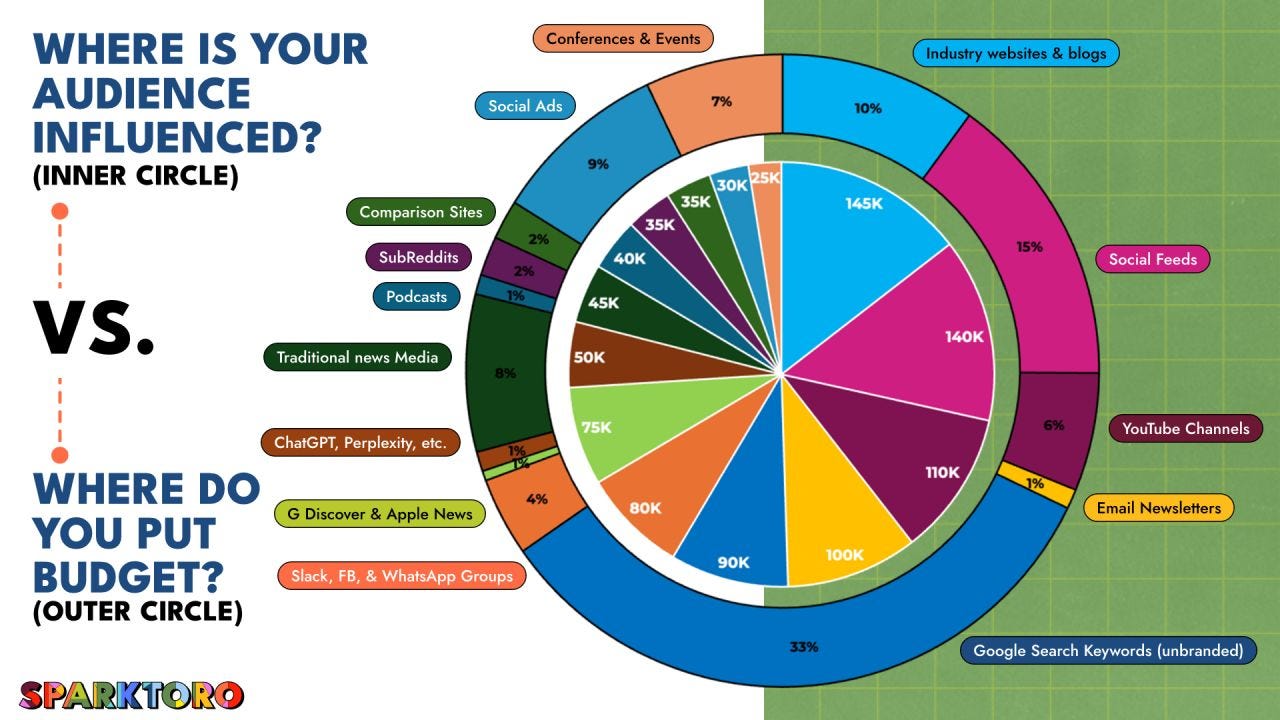
I came along this infographic: Where does our audience actually pay attention, and where does the budget actually go?
Yeah it’s a bit an ad for Sparktoro but nevertheless it’s something I think everyone should be aware of, because it’s a very valid point in my opinion.
You see two circles:
inner circle = where an audience is genuinely influenced
outer circle = where marketing money is actually spent
They don’t line up. Podcasts, Youtube and industry media influence far more people than they get budget. The easy to measure channels get defended every year, the rest quietly gets nothing. Is that always correct?
I think it’s worth drawing both circles for your own audience. And for that you don’t need an agency. Perfect job for your “superusers”, a pool of users you have on speed dial and that you can ask questions. Ask them for example:
Where do you look when you’re choosing a new supplier or product?
What do you read, watch or scroll for your business?
Who or what convinced you the last time you tried something new?
Who else was involved in that decision, and who had the final say?
Details: https://lnkd.in/p/d3H9QZkH
More on superusers in an earlier edition:
🇪🇺 ❌Another mandatory EU label as per 27 september

The EU (promised to regulate less) but is regulating much more and to a very annoying level.
A few editions back I wrote already about the totally idiotic rule that forces many smaller entrepeneurs to stop selling crossborder. Check that edition here.
Now they came up with more rules.
I didn’t even know about this one, untill someone at work from legal department informed me about it and appearantly it was not known so well with many e-commerce professionals as well. I saw many questions about this topic in various app groups I am in and all at the last moment before the law gets into practice.
It’s almost as useless as the “EU Withrawal form” from a few years ago, we all had to implement but not any customer used! And believe me I checked the downloads of that form at my job back then.
Now it’s about a guarantee label.
It consists of two elements:
The “guarantee notice” It’s a “label”. A fixed EU designed label with a big EU logo, reminding consumers they have at least two years of legal guarantee. Mandatory for every B2C seller of physical goods. Digital-only products and pure B2B are out of scope.
Physical store owners have to display it in store as well. (haha) so we get those little EU labels everywhere in physical stores.You need to provide this before the sale and I am pretty sure just as with the EU withdrawal form, it won’t be used.
The second one is the more complicated one, The GARAN label for additional commercial guarantees of more then 2 years, that some manufactureres can give. Shorter guarantees, paid extensions, or guarantees on a single component don't qualify.
The latter is of course much more complicated as it involves PIM systems and product dependend information. If a seller (if you are a marketplace) or supplier does offer the extended guarantee, you have a mandatory obligation to display it (and I think even on the order confirmation page and PDP).
Not easy especially not for smaller sellers to comply to this.
So let me link to a German site that clearly explains how you should embed it online. You can use it to write (with AI) the user story or epic for this topic.
https://ohn.haendlerbund.de/recht/rechtsfragen/gewaehrleistungs-garantielabel-best-practice
🇪🇺 🗑️Removal of product carrousels in EEA countries
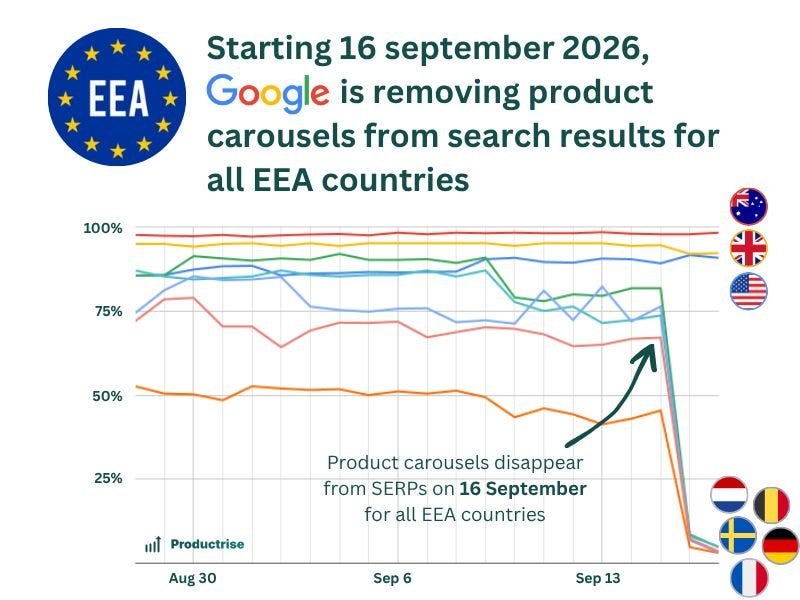
Let’s look at another piece of EU law that I don’t think helps the average user and average smaller shoo owner. This one matters if you sell cross-border, because it changes how you need to optimise per country or region for visibility.
Until last week, as a shop owner you could get free product listings via Google Merchant Center. Free, not paid. you upload a feed and your products show up in the organic shopping blocks, I used it a lot in previous job, I thought it was always fun to optimize for that.
As of 17–18 september that's gone in the European Economic Area (not in Switzerland 👍🇨🇭.
Free product listings and the "popular products" carousels have been removed from Google Search. Some sellers (note this can also be hotel providers f.e.) measured drops of roughly 90 to 100 of those listings.
Google itself calls it the largest reduction in search quality in it’s life time and they also researched that.
So what can you do?
Connect to comparison shopping services (CSS). They’re getting the space now. you’ll pay a margin, which is exactly why I don’t think this is a win for anyone. This will be added in the end to the consumer prices.
Expand to more marketplaces. same logic, spread the risk.
Fix your category pages. Google’s structured-data carousel beta runs on ItemList + product markup on category pages, not on your merchant center feed. That’s a free route that still exists.
Start selling outside the EEA!
Malte here below has lot’s of examples on X. Check that out for more information.


Details here from Google: https://developers.google.com/search/docs/appearance/supplier-unit
😀Random slides and pictures from events


Now a few pictures I found online and some I made myself.
I was at a great “company week” last week in Dusseldorf with also many presentations including from Google. Of course I cannot share the company slides but some of the others I will. Checkout the gallery what you will see:
The real danger is chasing short-term GEO wins that create long-term SEO damage. Self-promotional “best X” listicles, hundreds of comparison and alternative pages, scaled AI content, reciprocal brand mentions, paid mentions, Reddit spam — some of these tactics can influence AI answers in the short term. But once they’re scaled aggressively, they start creating very obvious site-wide patterns, and those patterns can become a quality or spam problem for Google. One useful comparison page is one thing. Turning it into 700 pages is another. Once low-value content becomes a pattern across the domain, it can affect much more than those individual pages.
Think in “systems” to identify patterns e.g. what types of queries are impacted after updates
This is the real price in SEO, Video and Content. This is the US Market Price for top agencies and experts. Nice for a benchmark.
People outside China often assume “search in China = Baidu.” That’s too simple. Baidu is not just a search engine, and several other apps have search volume on a similar scale. Optimizing only for Baidu is not enough.The attached slide (“Every App Has Their User-Intent”) shows monthly active users vs. people who actually search inside each app, plus the dominant intent.
There's no proven playbook anymore for the current marketing reality (ai search, automation, signal loss). So be creative and try things!
Google has leaned on this for years (their own research claims creative is the biggest roi driver after budget); Yeah it works for Google commercially of course but I think it’s really true and even more important these days. Experimentation and creativity can make a difference. Yes this fits 100% in my street so I see the future also as bright.
Outcome based marketing. The idea: stop managing channels and settings, just declare the outcome you want and let google work backwards through media, personalization and measurement. note what sits in the middle of the wheel though: people, process, tech & data. the machine only optimizes toward what you feed it. I think when I project it to my own job humans are still very much needed but it will change. Deep dive more in algorithm’s, deep dive more in creativity, connect people by explaining how it works, and make sure the system is fed the best way.
Treat your product catalog (the full CSV of titles, descriptions, types, tags and spec fields) as one category rather than individual pages. Run an AI prompt on the export to identify the attributes buyers actually compare on, map missing or inconsistent data across SKUs, and standardize the highest-value fields first. A single cleaned-up attribute then multiplies across product feeds, filters, comparison tables, FAQs, schema and internal links automatically generating related-product modules, collection pages and contextual links that strengthen site architecture.
Combine the catalog with customer-service emails and call transcripts so the AI can extract the exact questions people ask and use those real-world details to write the FAQs and comparison tables the catalog data alone would miss, producing structured content that answers the highly specific queries now typed into search and AI tools.We are entering an era of “vibe marketing” Check for yourself how you are going to be part of that. MCP acts as a universal bridge from AI agents to the google ads APIs (no custom glue code), so manual campaign setup and keyword picking disappears and the marketer’s job shifts from button pusher to pilot.
🤩 Wow JEV!
The internet is buzzing on JEV. Something I share here now and I will dive deeper into soon myself.
JEV is a new model from Typesafe AI (founded by ex-openai researcher that isn’t an llm. Instead of generating text token by token, it takes your input and returns a typed decision in a single pass: pick-from-list, true/false, or a score, each with a calibrated confidence number. So how can you use it as an SEO-er?
Well for example as the video I share here above from borjavat but there are countless use cases! The future is bright!
in 45.1 seconds it read all 586 pages on my site and rebuilt the internal link map. 584 links placed, 139 pages it refused to link because nothing honestly fit. total cost $0.21.
Details:
Thanks for reading Crossborder Alex : Global Marketing & E-commerce! Subscribe for free to receive new posts and support my work.
Interested in more? Checkout my archive!
Or use my vibe coded search engine to find content tailored to you, I improved the search engine a bit. Let me know what you think.
Thanks for reading Crossborder Alex : Global Marketing & E-commerce! Subscribe for free to receive new posts and support my work.