

🇳🇱 Shopping Today annual conference : cool slides with AI reports
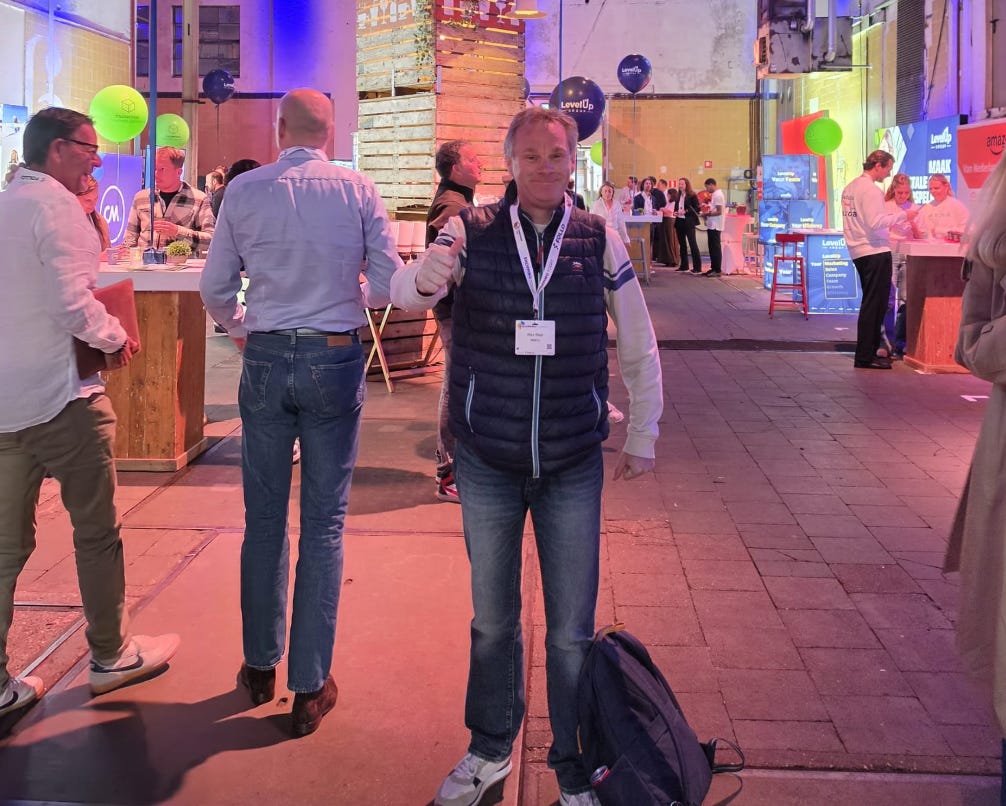
The annual “Shopping Today” conference was again in the Netherlands and as the past 14 or 15 years, I attended as well.
It’s a real large conference with maybe hundreds of speakers and topics. As always it was really well organised. Huge venue many speakers, lot’s of food and even a DJ at the end.
As you can imagine maybe “AI” was the most pronounced word on that conference,
I will share a few slides and presentation higlights but as I covered already many things I heard at this conference in this substack past year, I won’t describe them all, just some slides I found interesting enough to share. As I made many pictures I might leave some materials for next week(s) as well.
Let’s start:
🔍 Follo: SEO and GEO: what if Google no longer exists
I went to a talk from “Follo” an agency specialised in search. I share a few of their slides today, later more.
If interesting get in touch with them! I liked their dashboards a lot. I will try to build some myself and use the ones they presented as an example.
What a "streak" means in AI Search:
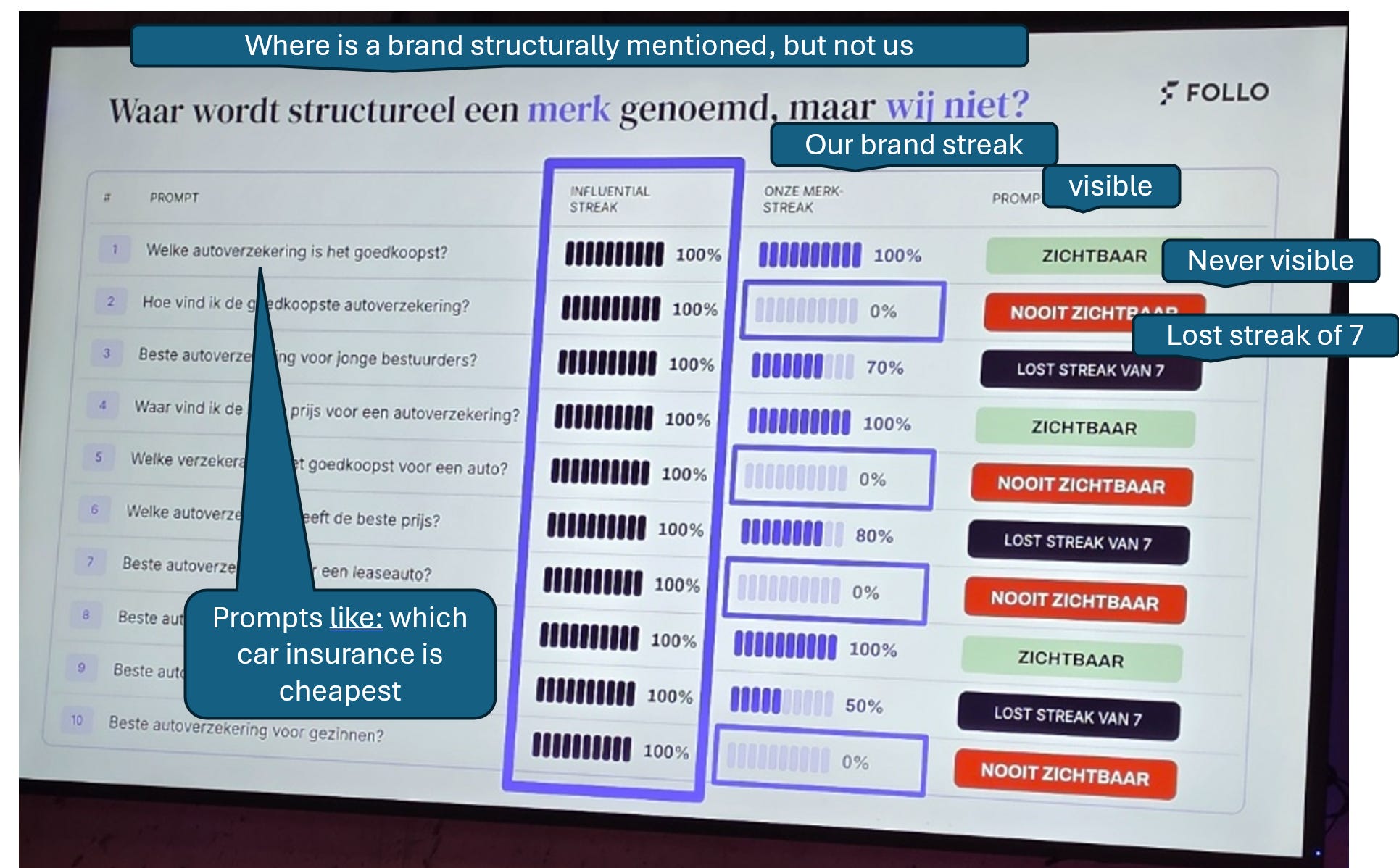
Unlike traditional Google search where rankings are relatively static, AI engine responses) are dynamic and probabilistic. A “streak” measures consistency across a rolling window of automated prompt checks (e.g., 10 daily runs).
An influential streak (100%) means competitor brands appeared in 10 out of 10 checks for a prompt, while “our brand streak” tracks the percentage of those same checks where your brand was recommended.
What the speaker explained: high-level AI visibility metrics (such as a flat 38% overall visibility score) create a dangerous false sense of security.
While a brand's overall average looks unchanged on paper, it may be silently losing a 7-day recommendation streak on its most profitable commercial queries (like "best car insurance for young drivers")
Tracking daily "streaks" allows marketing teams to catch sudden recommendation drops immediately and trigger targeted content fixes before lost AI visibility hits revenue. Smart and useful!
This streak agent looks for needles in the haystack
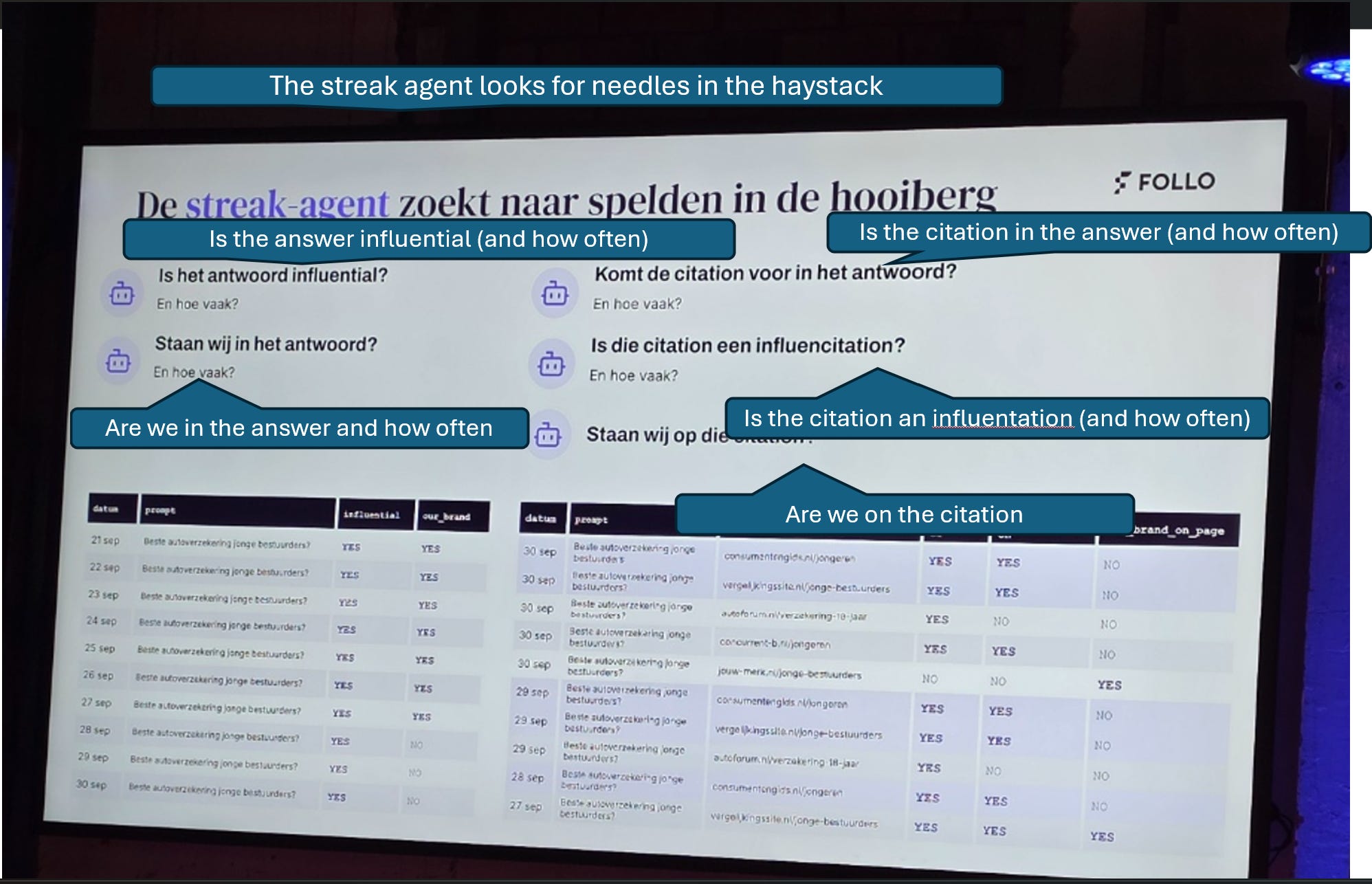
What the slide shows: A granular diagnostic matrix tracking daily prompt checks (21 Sept – 30 Sept in this case) for commercial queries such as *"Best car insurance for young drivers?”.
The “streak agent” automatically evaluates each check across five operational questions:
Is the answer influential? (Does the AI cite specific brand names?)
Are we in the answer? (Is our brand directly mentioned?)
Does the citation appear in the answer text?
Is the citation an “influencitation”? (Is this specific external source driving the AI’s brand recommendation?)
Are we on that citation page? (Does our brand appear on that external cited webpage?)
What the speaker explained: What the speaker explained: Not all citations generated by AI search engines carry equal weight.
Rather than sifting through hundreds of AI search outputs manually, the streak agent isolates the exact "needle in the haystack" root cause behind recommendation drops.
It links the LLM's recommendation directly back to third-party sources (like blogs, forums, or review aggregators).
When an external domain acts as an active influencitation for competitors while your brand is missing from that source page, it gives your team an explicit PR and outreach target to get added to.
I liked this one, very concrete including URL’s.
Prompt with brands, but not our brand
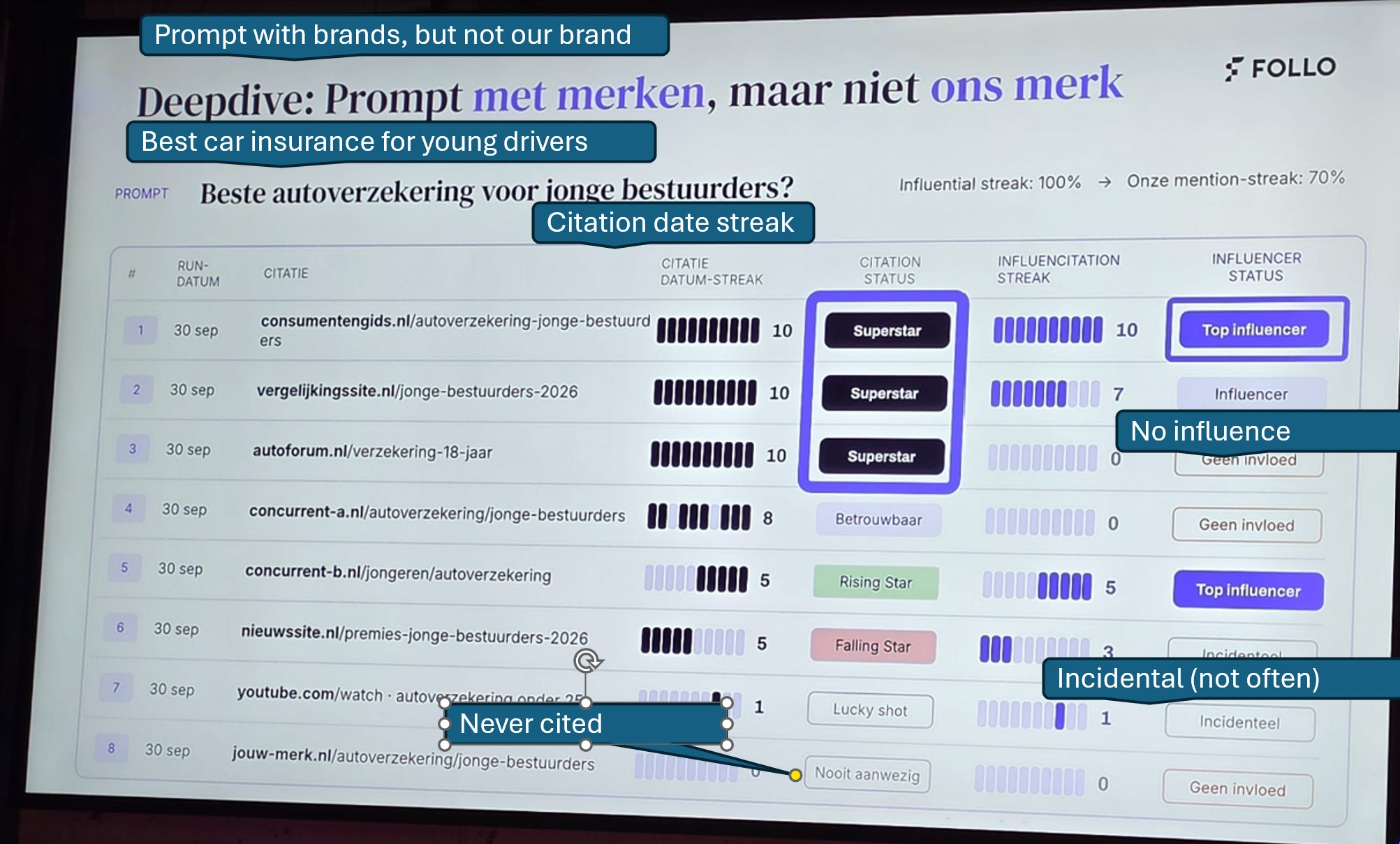
So the definitions seen in this picture:
Superstar: Third-party sources that are consistently cited across automated checks (e.g. 10/10 checks) and heavily influence brand recommendations.
Rising Star: Emerging external domains gaining citation traction across recent checks.
Falling Star / Lucky Shot: Sources losing citation frequency or appearing only sporadically (1–5 checks).
Top Influencer (Influencitation Status): Confirms whether that specific citation actually drives the AI’s brand recommendation, rather than just being a passive link.
What the slide shows: A granular diagnostic table analyzing the commercial prompt “ (Best car insurance for young drivers).
It ranks 8 specific third-party URLs (such as, YouTube, and competitor blogs) by Citation Streak, Citation Status (Superstar, Rising Star, Falling Star, Lucky Shot), Influencitation Streak, and Influencer Status.
More on this topic next week. I have many more slides!
🇳🇱 PIM data some lessons from Sligro and Intergamma
Another session I went to was about PIM and product data.


There was a presentation from Sligro Food Group: Generative AI & Article Data, how Sligro Food grop generates commercial texts with AI.
What the speaker explained: Ronald de Jong outlined Sligro’s commercial operation across 61 self-service wholesale locations, 12 delivery centers, and an active catalog of 60,000 SKUs (including 15,000 private-label items)
Manually writing copy across tens of thousands of products is impossible, making AI-driven commercial text generation a necessity. Sligro targeted commercial copy first because baseline data completion was only 20%.
Starting there delivered immediate SEO/GEO visibility and improved customer experience with minimal compliance risk.
I thought this guys job title “commercial product owner” is cool. Why? PIM and product data used to be treated as static IT infrastructure. A Commercial Product Owner treats product data as an active revenue driver rather than a back-office maintenance job. So the guy must know about SEO, business cases, added value, product feeds etc.
I understood that instead of trying to fix all data at once, a commercial PO evaluates AI use cases through an ROI lens asking where automated content creates direct customer value.
Some of Sligro’s learnings:
Sligro’s key realization was that a single “master prompt” for 60,000 SKUs is impossible. Product data and commercial tone vary drastically depending on what you are selling:
Prompts per category (product group level):
Wine & Spirits: Buyers expect a rich narrative details about the vineyard/winery, geographical region, grape variety, aroma profile, and food pairing suggestions.
Kitchen Appliances (e.g., Deep Fryer / Friteuse): Buyers do not care about a storytelling backstory or where the appliance was manufactured; they need functional specifications like wattage, oil capacity, temperature controls, and cleaning features.
Prompts within a category (subcategory / [product Level):
As featured on Sligro’s Lessons Learned slide: even products inside the same category need different prompting logic.
A basic house-blend cooking wine requires a concise, functional description, whereas a high-end, exclusive vintage requires an evocative, premium storytelling prompt.
They quickly discovered that prompt writing is a distinct, specialized skill set. To avoid inconsistent output, I understood Sligro transitioned from ad-hoc prompt writing to establishing a dedicated central AI team that builds, tests, and maintains category-specific prompts across the organization.
Some of Intergamma’s ’s learnings:
Then Intergamma, another company did an update. Patrick (Head of Data Management at Intergamma) pointed out that organizations often focus prematurely on flashy customer-facing AI features. However, if incoming backend data is flawed, AI simply accelerates errors ("garbage in, garbage out"). True customer value requires securing supplier data collection and quality controls upfront before initiating AI enrichment.
To prove why backend data governance is essential, Intergamma audited nearly 5,000 supplier-submitted product dimensions. Nearly half contained significant errors. In retail and DIY, inaccurate dimensions lead to warehouse and store fitting issues, wrong shipping calculations, and returns, showing that raw vendor data cannot be fed directly into automated systems without automated checks. They tried to solve this problem with AI and did so quite succesfully.
Intergamma solved the supplier dimension failure by letting AI validate data contextually. Rather than viewing a single measurement attribute in isolation, the AI cross-checks whether a reported dimension makes logical sense when compared against the product description, title, and category definitions. This automated validation layer screens vendor data at ingestion, stopping errors from propagating into warehouse and store logistics systems
Beyond data accuracy, Intergamma faced a massive data collection challenge driven by new EU regulations, yes again EU regulations.
To collect required product safety compliance data (GPSR) from hundreds of vendors, Intergamma tested traditional outreach against an AI chat client.
While mass emails were ignored and manual outreach hit an “operational wall,” the AI assistant provided personalized, interactive chat environments where suppliers could easily supply and validate data in real time.
So that’s nice and better I think a shift away from rigid portals and smartsheets.
Modern AI onboarding portals allow suppliers to submit information in whatever format or channel they already use, whether via email, SFTP, web upload, or API[.
The AI handles the heavy lifting or conversion on the backend by extracting unstructured content, running automated quality checks, and interacting with suppliers directly to resolve missing fields. I know from personal experience supplier data can be really limited so giving them an option to send in data in whatever way they like, will help a lot, I think.
🇹🇼 Now some more on Taiwan: 17 live streaming DOOH ads


What I noticed while walking in Taipe Subway was this DOOH screen. So I dove into it, as it is really different from what we have in the West.
These are ads for 17LIVE, a livestreaming app founded in Taiwan.
”Top liver" refers to the platform's highest-ranked streamers ("livers"), and the rankings are driven largely by how many virtual gifts fans send them. putting top streamers on station pillars is a status reward: it turns an in-app leaderboard into public, real-world fame. For a European audience the interesting angle is that this gifting/tipping economy is far more mainstream in Taiwan and Japan than it is in the West.
I’ve asked Mathew Ryan the Taiwan expert, I met in Taiwan. Do check out his profile if you want more information about Taiwan’s commerce and as Matthew says:
For European marketers that’s the real lesson: in Taiwan, Influencers are a sales channel, not a brand awareness line item.
Matthew Ryan, Taipei-based PR and communications specialist, 13 years in Taiwan, fluent in Mandarin. cloudberrycomms.com
Checkout 17 live: https://17.live/
🇹🇼 Customer first: temporary rush hour coffee stand in Taipe


Just wanted to share one more really nice “service concept” I noticed. Imagine you are in a hurry and you are tired, you just woke up. You are in the subway, and when you get out you want directly a coffee. Normally spoken you need to walk then to a coffeeshop inside or outside a station, stand in line, maybe a short detour.
Now that’s not the case here in Taipe main station in the morning. I noticed that the nearby coffeeshop in collaboration with the Metro company has setup a temporary stand just outside the exit gates. You can pre-order and pickup or they have some standard cofffees on that table also. More public transport companies can learn from that!
Now isn’t that service?
If you want to read more about my experiences in Taiwan, checkout the previous edition:

🛎️Small correction/addition edition 155 JD 101 Home Care
Small correction from edition 155: I mixed up two JD stores in Shanghai. Qibao is JD MALL, their existing experience mall format.
The real new thing is 101HOME in Jing An, and I happened to visit in its opening week as well.
I updated the post in edition 155 with what makes 101HOME different, Worth a second look if you read it the first time. The 101 home concept is really different. Re-check my previous updated edition⬇️⬇️⬇️⬇️
Global Digital Marketing & Retail by Alex 155

I’m currently traveling in Asia, so I wanted to share a few retail trends and store formats I’ve spotted along the way.
🇨🇳 Crossborder Alex took a robotaxi in Shanghai
Just sharing a short video and some pictures of me taking a robotaxi in Shanghai. There are many YouTube videos on this to be found, but I just wanted to share here also some UX, some screens, what you see in the car, real nice UX it even has a live feed before you stepout to watch out for traffic.
Its a real fun experience and I can really imagine we all use robotaxi’s in the near future.


Thanks for reading Crossborder Alex : Global Marketing & E-commerce! Subscribe for free to receive new posts and support my work.
Interested in more? Checkout my archive!
Or use my vibe coded search engine to find content tailored to you, I improved the search engine a bit. Let me know what you think.