

Good morning!! A new edition of my newsletter. This week with an update from Taiwan, where I currently am, and some other interesting developments in the world of e-commerce and phygital. At the end of today’s newsletter, Matthew Ryan a marketing expert in Taiwan, shares why Taiwan should never be treated as part of a China strategy.
🏬Digital intelligence for the physical store
Look at that. This is something we could have seen coming👀.
It’s there now:
Physical shelf optimization with AI and that’s all possible with existing camera’s in store(s) as Cactus says on their X account:
We can measure what part of the shelf gets customer attention without any additional hardware. Just your normal CCTV camera’s and a digital twin made with the phone in your pocket.
Checkout their full slide deck: https://pulse.auki.com/decks/cactus#/0 , but I think slide 7 is the best one.
This development makes optimizing shelves and customer experience much cheaper and accessible and what if this is combined with “retail media” so advertisers can see impact of their ads also with “shelf attention” too.
Not sure at all if this is allowed in the EU but if it is, I think it can have many advantages, not only for business, but also for consumers and their in store experiences.
🇮🇳 Indian developers made it: order food, don’t pay! but get dopamine
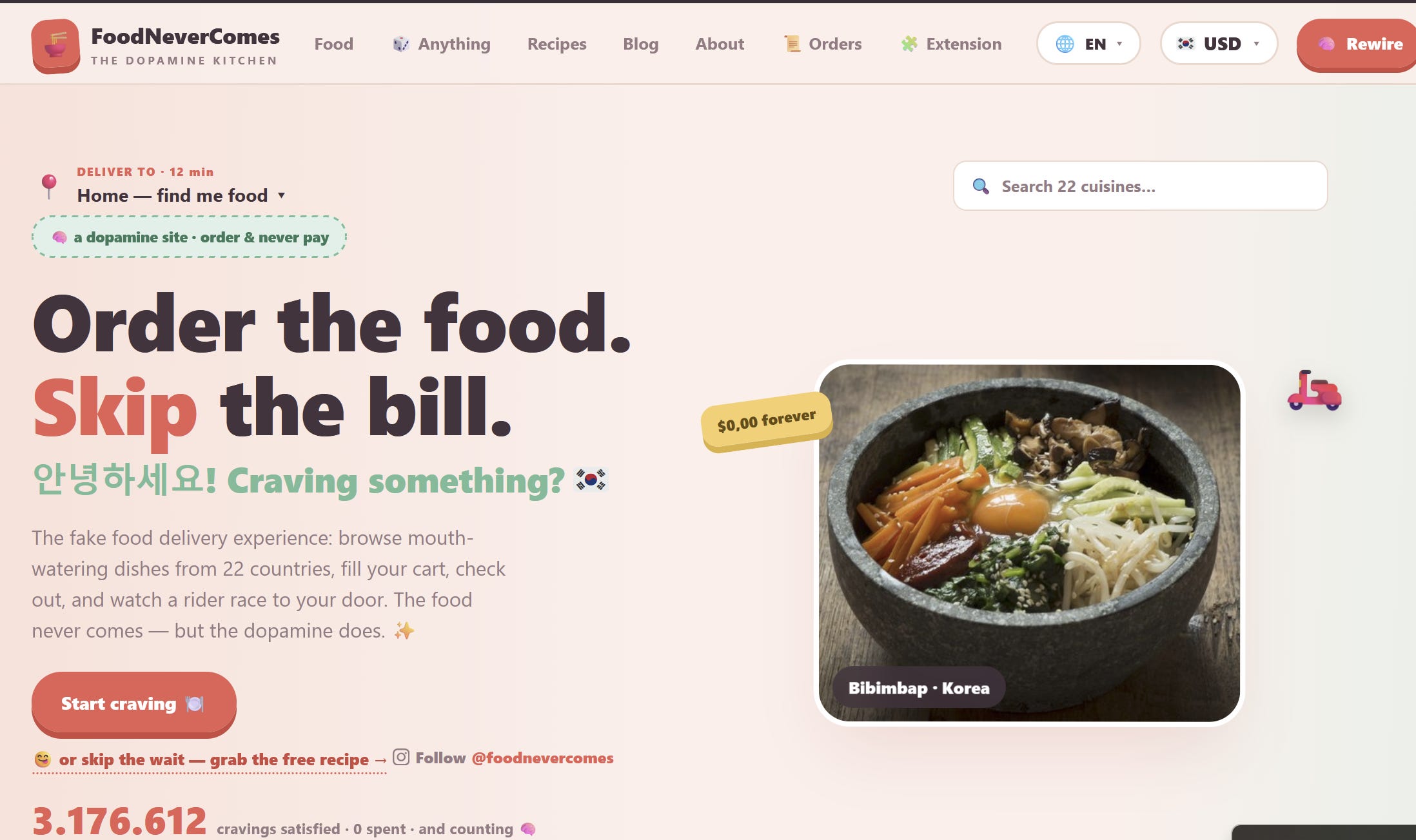
I will travel to India in december. Looking very much forward to it. So I am reading more and more about India and It’s a good thing they have “Dopamine sites”, I might try it 😅 when I am over there.
So a dopamine site is basically a website where you place a fake order, just to get the dopamine of ordering.
Checkout the fake order site, and I have to say, really nicely done:
This trend started in South Korea, but the site adapts to wherever you are. Indian visitors get a “Namaste”, prices in rupees and a photo of butter chicken. So yes, I can already practice my Indian food orders before I land 😄
You can also select Dutch food, you get erwtsensoep so that’s correct although the image with it not, it does not look like erwtensoep, but most images are correct.
The developers (Purvansh Parmar and Anshul Sharma) say the website has attracted more than 2.7m visitors since its launch in June a citation from the linked article:
FoodNeverComes belongs to a new internet genre: “dopamine sites”, which recreate the rituals of consumption without the consumption. There are fake shopping sites, fake delivery services and even fake holidays.
The genre took off in South Korea and has since travelled well beyond, spawning a growing crop of sites - Dopamine Shop or Fakehaul, for example - that mimic everything from food delivery and shopping to travel.
They even go beyond the order itself: you get a fake AI call from the delivery driver, telling you that he is outside your building but cannot find your street or door 😄 Boom, there goes the dopamine.
And there is actually something to learn here for us e-commerce fans. Dopamine is released when you’re looking forward to something, not when you get it. So the waiting part (order tracking, “your driver is on the way”) isn’t just logistics, it’s part of the product. Think about that next time you craft a product journey.
Maybe it’s an idea that every online store creates a “dopamine” version of it, it will be much easier to check order confirmation pages and checkout funnels 😉
Oh wait, I shouldn’t write that so clearly: before you know it, it’s an EU law that every E-commerce platform needs a dopamine version, to protect consumers from overspending 🙈
Details:
https://www.bbc.co.uk/news/articles/cwn741v5rdpxo
Or direct fake order here: https://foodnevercomes.com/
🆒 MadewithJEV: great use cases to pick
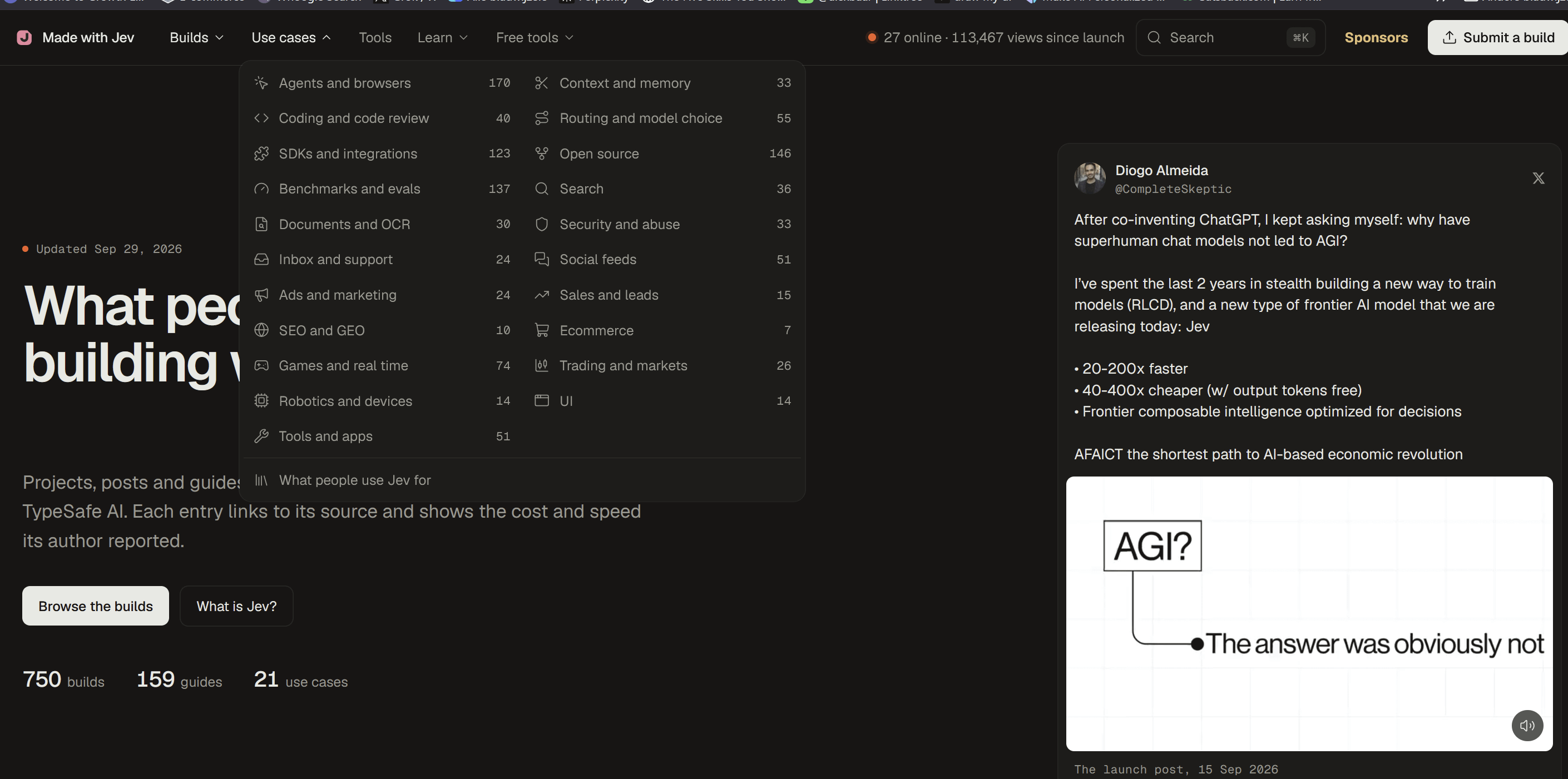
I’m fascinated by the endless use cases of JEV, typesafe’s AI’s new “decision model”
It doesn’t write text, it picks, scores and classifies, super fast and super cheap.
Every day I think of a few new use cases, but i simply lack the time to build them myself (so far only a few small concepts).
That’s where this site helps: lots and lots of jev builds in one place, and for a good part of them you can grab the github repo and start from there or alternatively just checkout all the X examples that are linked via this website. Take for example this SEO use case:
Ian Nuttall built a free internal linking tool with Jev doing the classifying and the link selection. It takes up to 500 pages and hands back a CSV or JSON you pass to an LLM to implement.
You can test it for free for 100 pages, I did, it works very well.
Based on the output it gave I made an even better variant with Claude and the JEV connector (via MONID) for personal use.
So that’s also how you can use this library of use cases improve existing products.
Do check because there is much more then just SEO in the library of this website.
https://madewithjev.com/builds/internal-link-tool
PS: there’s also an open-weights alternative called laya that you can run on your own hardware. haven’t tried it yet so not sure about the quality but it’s good there is an open weight variant: https://flowtivity.ai/blog/laya-open-source-jev-alternative/
Some observations from Taiwan
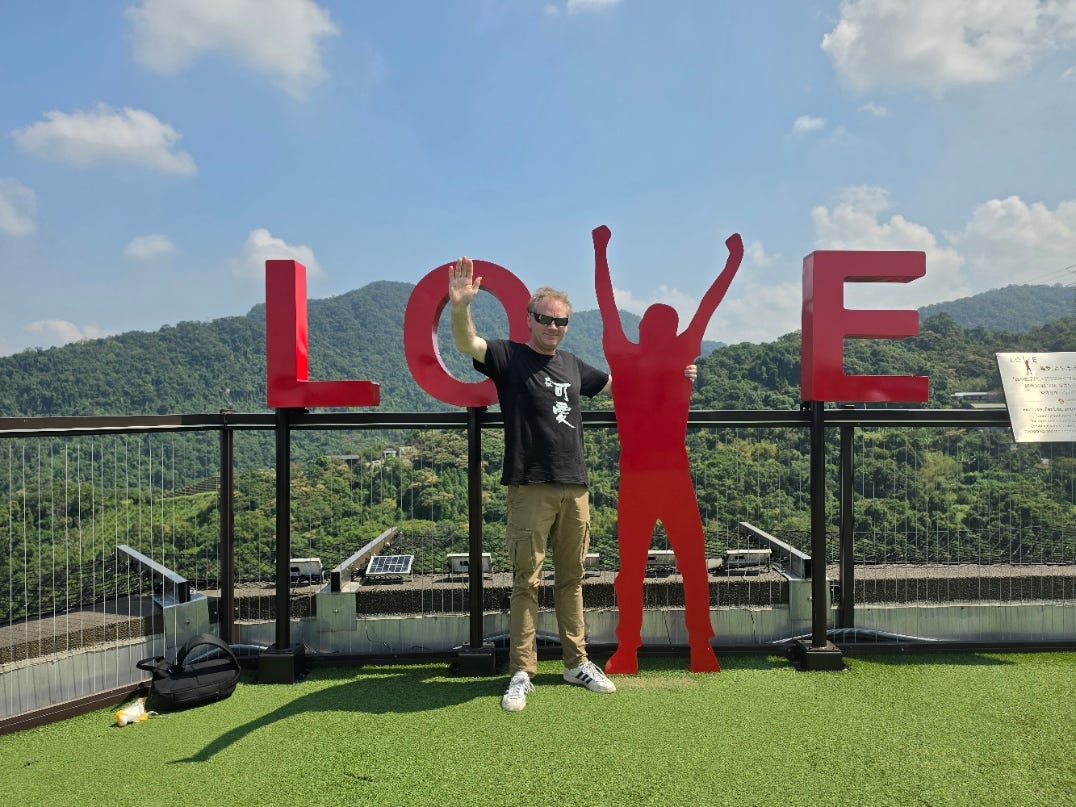
Let’s write a bit about Taiwan. It’s very different here then in Shanghai or Hong Kong, the two cities I was before arriving here, totally different vibe. I took some pictures from retail and I had a short talk with a real nice guy, a fellow substacker, who lives here already 13 years, Matthew Ryan. I summarize it all below:
Taiwan looks a lot less modern and flashy than Shanghai, and it has much less energy than Hong Kong. but it has other things. The cost of living is relatively low, salaries aren’t bad, and people save a lot. Did you know, adjusted for purchasing power, Taiwan is one of the richest places in Asia, and around top 10 in the world? Not Singapore level, but higher than Hong Kong and Japan. Very interesting thanks for the insights Matthew!
At the same time Taiwan is also aging, you see a lot of elderly people on the streets and in the shops and in the bus or MTR, really a lot, I even noticed.
That brings me to the first remarkable thing I wanted to share:
PX Market. It’s a supermarket chain here in Taiwan but the special thing is that they cater especially to the elderly even people with dementia. Did you know, 517 PX mart stores have been certified as dementia-friendly by the government?
Their staff is trained to signal problems older people can have while shopping, some of their stores have “resting areas”and signposting (like price labels) have large fonts. They've added handrails, brighter lighting and lower fridge shelves.


There’s a lot to be found on the web on this topic, about this although mostly in Mandarin but now with AI if you are interested easy to translate.
In Taiwan you can also shop 24 hours a day, and I don’t mean online shopping in this case. Some larger supermarkets, like the former Carrefour (since July 2026 it’s called Prosperity Plaza, after Taiwanese owner Uni-President took over the brand), are open 24/7. I haven’t seen that anywhere else at this scale, except maybe in Singapore. The store looked really nice and is packed with customer friendly services: toilets, WiFi, phone charging, an ATM, parcel service, photo printing and even a little café. Check out the so friendly sign that invites people in because of the heat!
I did find the self checkout a bit strange though, needed to scan the article and then place it in the 2nd place before I could do the checkout. Seems to me not so efficient if you have a lot’s of items.


Now on to online. As Matthew explained to me in a little freelancer cafe in the center of Taipe, Taiwan (and Taipei especially) has such a high retail density that E-commerce took off less than in other countries in the region. It's so easy to find a store with what you need that you often don't bother ordering online. Really I will share pictures later, there are countless stores everywhere you never have to walk far to get a product you need here in Taipe.
Did you know, Taiwan has around 13,700 convenience stores, one for every 1,700 people. That's more than Japan and Thailand, and only South Korea has more.
But a lot is happening in e-commerce too, just in a different way. Most people pick up their online orders at a convenience store, and many even pay for them there in cash. Like in Japan, the convenience store is where you do everything: pay your bills, collect your parcel, buy train tickets, even return library books.
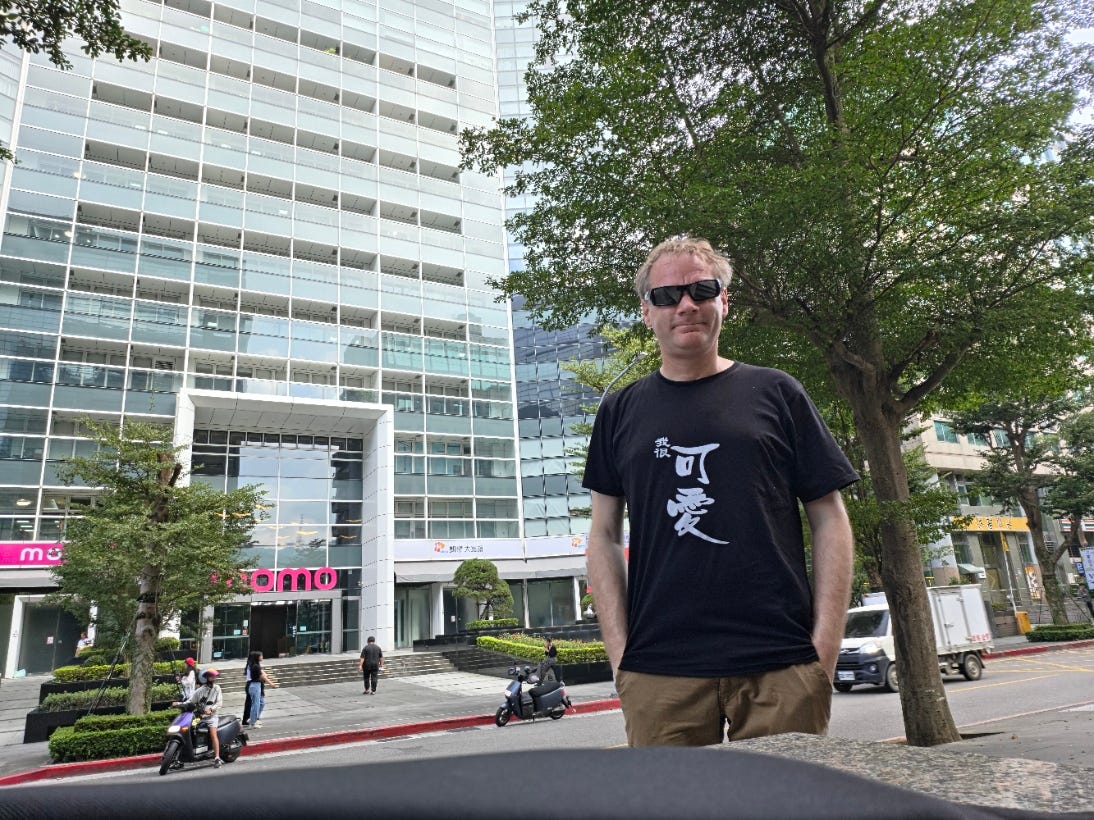
One of Taiwan’s biggest local e-commerce players is Momo check out: https://www.momoshop.com.tw
Momo is owned by the Fubon group, started out as a TV shopping channel in 2005, and is now Taiwan’s largest online retailer, with revenue of over US$3.5 billion. You can’t really order there as a tourist, so I didn’t unfortunately, but I did visit their headquarters euh well I passed it, that’s a better way of writing :).
From the outside it looked a bit smaller and quieter than Naver in South Korea, where I was a year ago, but it’s always nice to see how a local giant is doing and situating.
In this case in a business district in between banks, a corporate environment.
According to Matthew, Momo is doing fine, but competition is fierce. Shopee, from Singapore, is now the biggest platform in Taiwan, and wins customers with low prices and free delivery. Even Momo’s chairman admitted they underestimated them. And then there’s Coupang from South Korea, which entered Taiwan a few years ago with super-fast delivery and an aggressive price war. So Momo is squeezed from two sides. I'm very curious how that plays out, because Coupang's strategy goes against Taiwan's pickup culture with their home delivery, and funny enough,
Shopee itself is now replacing the convenience store pickup with its own orange pickup lockers, more than 3,000 of them already and I happen to pass one the other day and took a picture:
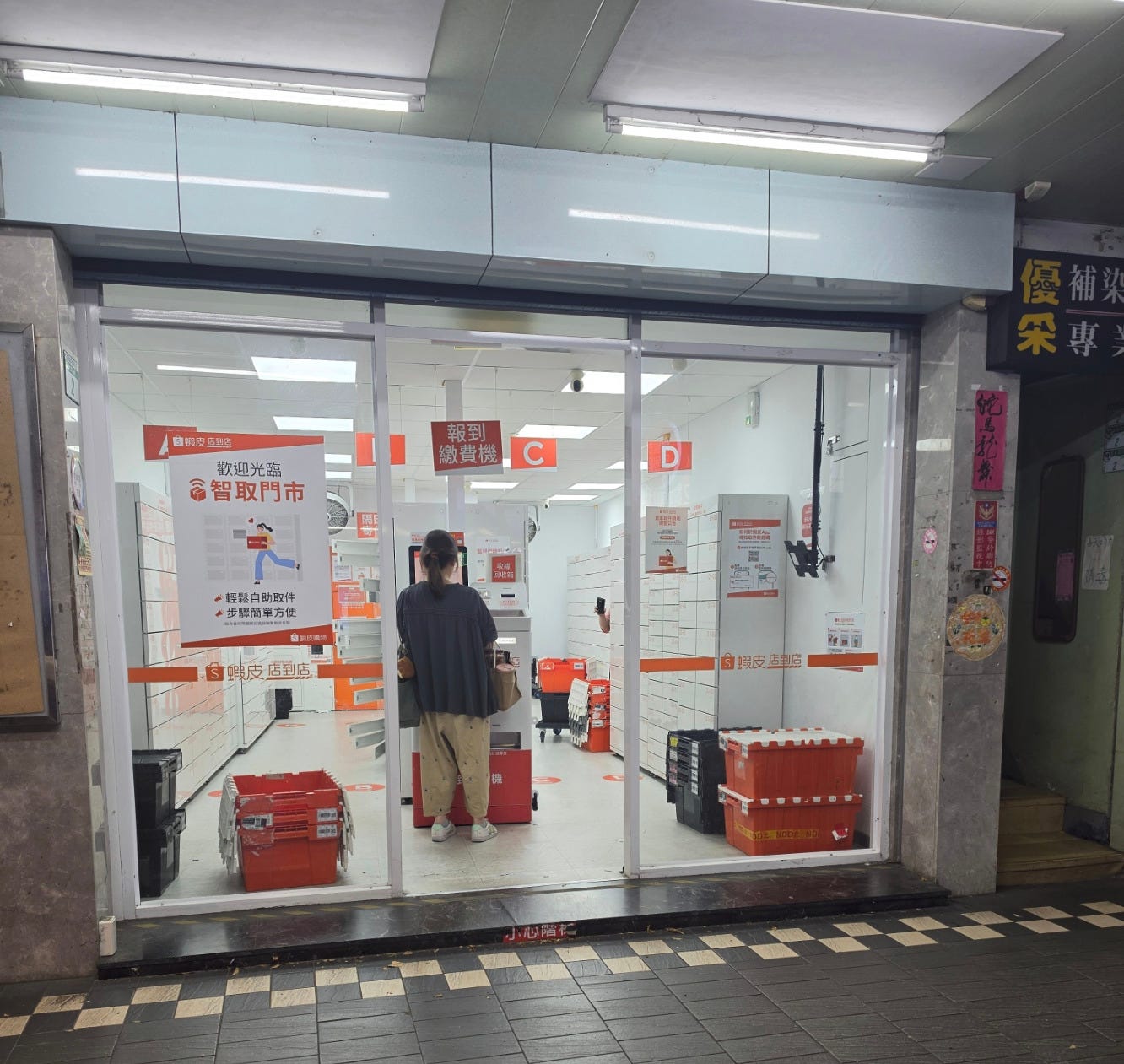
Both South Korea and Taiwan have an extremely high density of convenience stores, so in the end I think it comes down to culture: do people want it at their door, or at home?
Read more on Coupang and their Taiwan ambitions here.
And now something different, I also saw quite a few QR codes with “AI” on it in the public domain, I tested a few:


Overall, it’s very nice that they do not force you in an app download, it’s all web based direct use.
The one from the bus company, was quite nicely done. However I do not see the exact added value as all info I need I can find on Google Maps in a better way.
I understand the concept but Google Maps (and Gemini) helped me a lot in finding sightseeing spots and going around Taipe. Besides that when I voice asked it “which bus to the airport” it didn’t even return asked me which airport (there are two here in Taipe)
However they made it nice with an animation and you can talk to the AI, it’s all voice driven. I saw two people scan it from the bus stop.The one from the beer bar, that one was actually helpful, it was trained on local data and assortment. As I didn’t understand the girl behind the bar because of the language barrier this QR code helped me finding the beer I wanted. This is something I do see value in. It’s trained on local data the assortment of the restaurant and probably in addition also their services. The translation is a bit poor though. But I can imagine that this AI service can help in Horeca like bars or restaurants, or even in retail stores when they are connected to the PIM systems, an AI that helps you decide when f.e. there is no human available. This is something a public LLM cannot always do I see here added value.
The one from the MTR (Metro) says “AI customer service”. For this one, I also do not really see the added value you can ask everything also to Claude, or Geminini or other LLM’s also things about “lost wallet” or directions and things like that.
Expert insight on Taiwan digital strategy:
So let’s end the Taiwan topic for this week with an insight from Matthew, the fellow substacker I met in Taipe. I asked him what the biggest mistake is that foreign brands make when entering Taiwan. His answer:
One of the biggest mistakes overseas brands make when entering Taiwan is treating it as part of a greater China strategy and assuming that campaigns and tactics used in China will transfer easily. Taiwanese consumers are highly sensitive to this and can quickly tell when a brand has not developed its products or marketing with Taiwan in mind. The most obvious mistakes include using simplified Chinese or mainland Chinese terminology, but imagery, messaging and even product lines can also cause rejection.
Taiwan may appear similar to China in some ways, but its history, culture and consumer sensibilities are very different. Taiwan has been strongly influenced by Japan and has a much longer and deeper relationship with Western culture than even China’s most international cities. Brands therefore need to treat Taiwan as a distinct market rather than simply localizing their China strategy.
Influencer marketing is also critical for new brands entering the market. Taiwan retail is very much influencer and celebrity driven and brands need to have an influencer strategy that covers all of the customer bases. Particularly important and almost unique to Taiwan, Meta’s Threads is a crucial influencer and social platform. Taiwan is the second-largest Threads market in the world after the US and it is particularly popular with Gen Z consumers.
Matthew Ryan, Taipei-based PR and communications specialist, 13 years in Taiwan, fluent in Mandarin. cloudberrycomms.com
➡Actuel customer journey for purchase of a TV
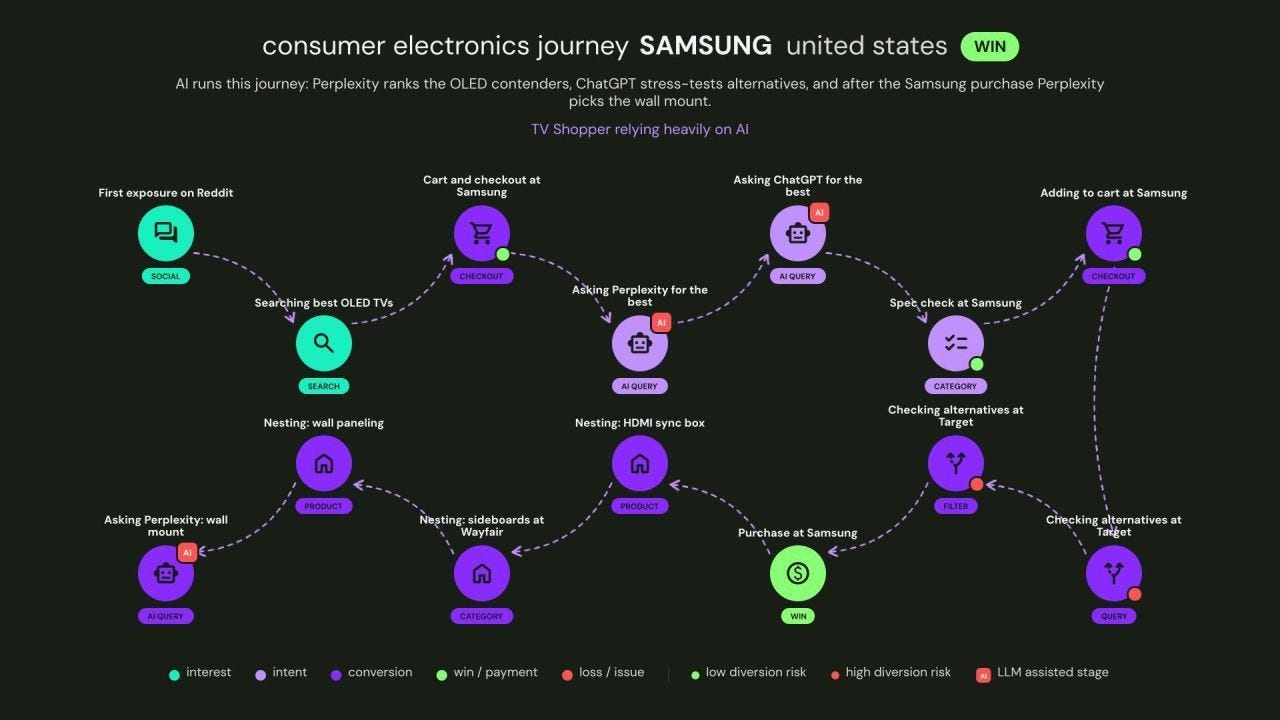
This is a nice one as well to realize and visualize the new type of customer journey’s. It’s no different then I have written here on substack many times before, but this is a nice visualisation I think, that’s why I share it. In many organisations these type of visuals help to understand stakeholders what is happening or explaining a use case.
The purchases of this TV is still an easy one. Imagine a B2B purchase that takes months. A restaurant owner looking for a new combi steamer or new delivery service, he checks prices online, asks their account manager, flips through the folder, visits the store, watches a YouTube demo, asks chatgpt which one fits a small kitchen, talks to a fellow chef, and orders online three weeks later. or in the store. or via the account manager after all. Good luck giving that sale to one channel.
The of showing this visual isn’t that everyone goes to Reddit. For the next person it’s YouTube, a review site or a colleague. The point is that attribution has become so much harder. So also the way you setup your visibility and focus on the different marketing channels should change. That’s what I try to write here about already for a long time. This is another confirmation why I think in the AI age marketing and e-commerce departments need more and more generalists with visibility expertise and knowledge of (agentic) AI. All good for us and the readers of this substack!
Thanks for reading Crossborder Alex : Global Marketing & E-commerce! Subscribe for free to receive new posts and support my work.
Interested in more? Checkout my archive!
Or use my vibe coded search engine to find content tailored to you, I improved the search engine a bit. Let me know what you think.