

Goodmorning!! A new week, new newsletter of everything that got my attention last week. Soon the seminar season starts again and I hope to visit a few and share pictures here. End of september I travel to Asia again and share also my findings here. For now checkout today’s newsletter!
🤖The AI knows why you saw an ad, what about the advertiser?
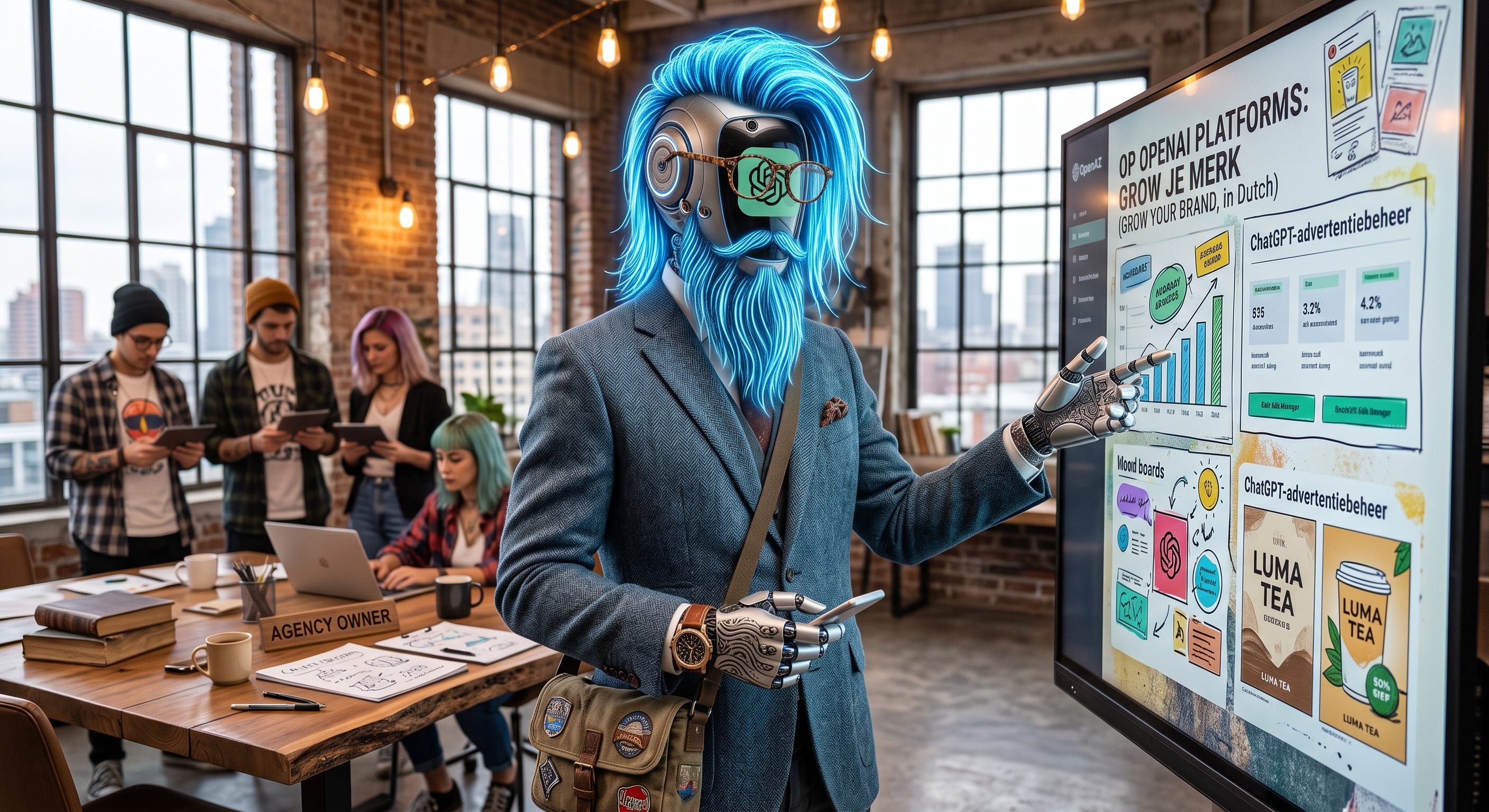
Interesting take and something to think about for every (to be) LLM advertiser in this article I link below. It’s about advertising via LLM”s like ChatGPT.
My take after reading the article linked below: build your ai visibility first, including your recommendation rate. But I want to push my own thought even further:
You can’t be excluded from an ad placement because the model already recommends you (at least I could not find anything on that) that setting doesn’t exist, and i don’t think it’s coming, at least not in this shape. The ChatGPT ad system is deliberately disconnected from the answer, that’s the whole trust story which makes sense.
Which means building organically doesn’t protect you from paying for demand you own. Does it not do the opposite then? The stronger you are organically in a category, the more of your paid impressions land in conversations you’d have won anyway? I think so, yes but….I guess building organically first is not about savings. it’s that your organic baseline is the only control condition you will probably get. I think AB testing on LLM’s is very difficult or maybe not even possible given the constantly changing outputs for the same input.
Maybe you can try then after building organically, to put budget where the models don’t mention you, not where they do.
An ad in territory where the model doesn’t name you isn’t only chasing a sale. it builds the brand, people see the brand, they go look it up, they ask about it by name in the same model getting your organic results, so paid in the right place feeds the organic side back.
I think that’s maybe a way to think about it.
Interesting citations from the article linked below:
”If conversational advertising can demonstrate a materially better outcome because it understands the customer better, it earns a premium. Otherwise we are simply creating another media format with a more sophisticated story around it”
Did the AI interaction change the consumer’s decision or merely capture an existing one?
If the model already recommends you , the ad is buying demand you owned, not new demand.
Search showed the query. Social showed the audience, conversational AI may know the reasoning.
🗒️Note: ChatGPT is is coming to Europe this month, NL & Belgium specifically. So if you would like to know how it currently works (spoiler very limited) checkout this video from this guy who looks like he is hypnotizing you😅
🇨🇳 Ashley: AI replaces tasks, not jobs.
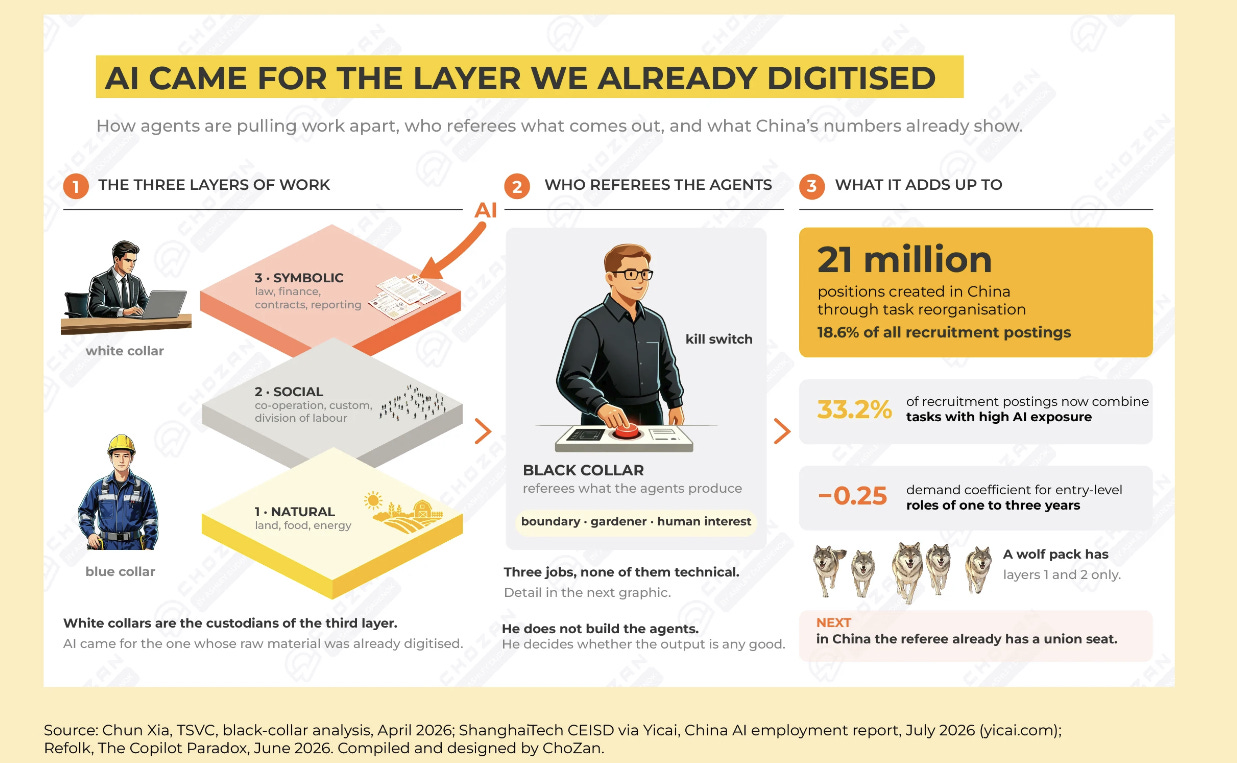
Now I like to share a piece of my favorite China influencer, Ashley!
China sometimes uses a different sequence for the same problems that we have in the West, and that's interesting, I think. Ashley writes on the reshaping of the labor market, with a deep dive on delivery drivers and the algorithms that manage them.
But before that she explains how AI is changing work. She explains the "black collar worker": the person who no longer does the task, but owns the outcome of a system that does the task.
What the black-collar worker is responsible for
Setting the boundary. Deciding what an AI agent is allowed to do, where it has to stop, and who has the authority to switch it off.
Keeping the system healthy. One person will soon run dozens of agents, and agents will create more agents inside their own workflows. Somebody has to prune that, the way a gardener prunes a garden, or it grows into a mess nobody can see into.
Representing the people affected. Noticing when the system starts serving itself rather than the customers or the staff it was built for.
AI is not replacing jobs. It is replacing tasks. The person stays. What they spend their day doing changes.
As I wrote in the introduction maybe China runs often a differen sequence, Let it run first, regulate after. I personally saw it when I was living in Shanghai, with the shared bikes: everybody dumped bikes on the street, it gets completely out of hand, bikes piled up everywhere, and only then come the rules. Fleet caps, permits, maintenance duties etc. It’s all cleaned up now, euh well mostly.
The algorithm story is the same sequence, one industry later. Platforms have been managing millions of riders by algorithm for years and nobody was allowed to look inside. Now the correction comes, and it comes fast.
China issued central guidelines for workers in “new forms of employment”: delivery riders, ride-hailing drivers, livestream sellers, logistics workers on apps like Meituan, Didi, Ele.me and JD. Platforms have to take union or worker-representative opinions into account when they design the algorithms that decide task assignment, piece rates, commission, pay, working hours and penalties. If a union asks to negotiate, the platform has to agree, and hand over the information needed for it.
I think the Western conversation is stuck on “will AI take my job”. China skipped that question and went straight to “who gets to see the algorithm and argue with it”.
Details: https://newsletter.chozan.co/emails/webview/1405776/195684070359827865
🗜️Zippy’s AI visibility basics article
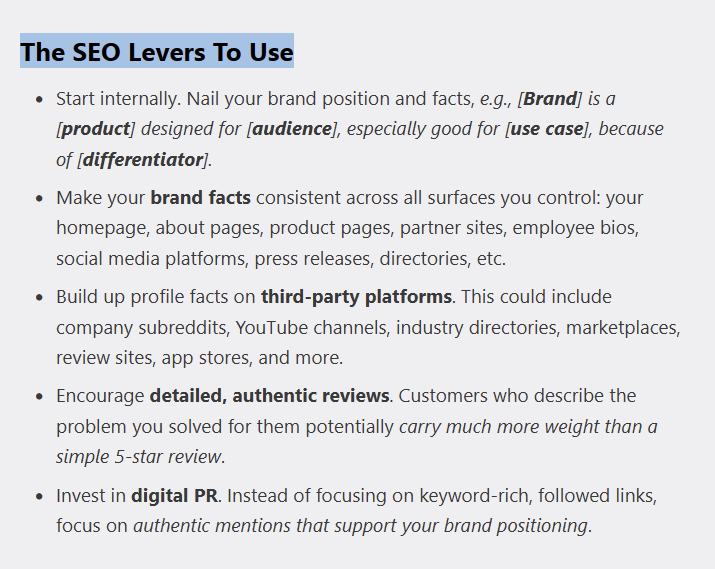
A new post from Zippy!! One of the great SEO influencers I follow. Great post from Zippy here on substack, and I highlight the screenshot above as it is useful for everyone.
Start internally with this. Many organisations are really not ready with this (especially the “because of [differentation]” part, I think.
Start internally. Nail your brand position and facts, e.g., [Brand] is a [product] designed for [audience], especially good for [use case], because of [differentiator].
Much more details in the post from Zippy highhly recommended check it out below:

➡️12 Proven Static Ad Formats a framework
I like to watch videos on how to optimize for ad algorithms, and i like people who use creativity to hit their ad goals people who dig into all the possibilities instead of being boxed in by the brand police.
This is one of those videos. it gives you frameworks and ideas you can use in your own campaigns, and on top of that it’s a nice example of using AI in ad generation and ad research. I made notes while watching and let AI clean them up. those notes are at the bottom of this piece, unedited, because that’s how I use them later for example when creating briefings at work.
First, my own take on it. link to the video and the source are at the bottom, as always.
Most of this advice in the video is written for smaller or medium sized company’s I think. So it’s easy to test and try all these formats withouth being flown back by many stakeholders. But I think agility is learnable for larger organisations, and the payoff isn’t only performance. every raw customer quote and every meme that lands tells you something about what actually resonates with people, your customers or propsects, and that loops straight back into brand.
Yeah and now I just shake it out of my sleeve this sentence: Creative freedom is no risk its an opportunity. 😅.
The easy start: comparison ads, press hits and testimonials. those get through the brand police most likely without a fight. testimonials especially, Raw, unedited customer quotes beat anything an agency writes. Scrape your own socials, reviews and customer service tickets to find them and go test. So maybe not every format is suitable for every organisation but you can try and test things that’s my main message and some of the formats are low risk. Just try.
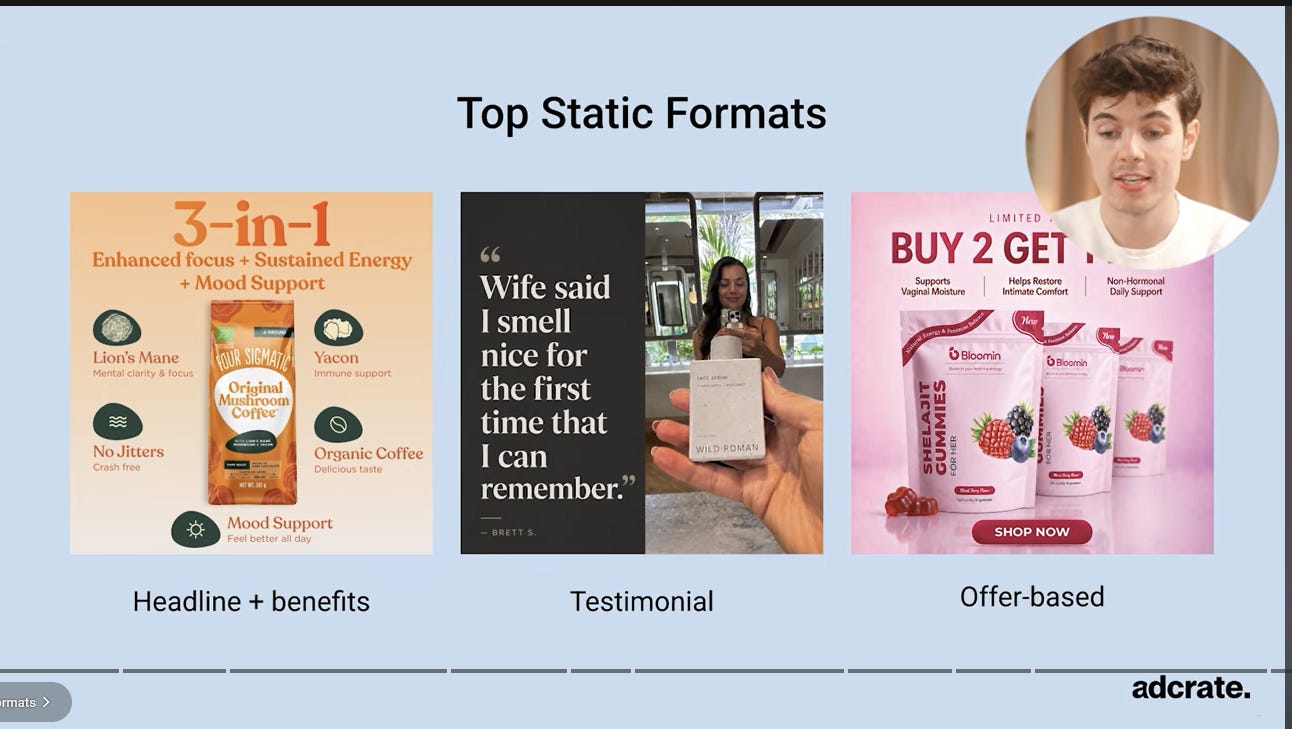
Here are my notes after watching the video (AI refined):
12 Proven Static Ad Formats:
Don’t reinvent the wheel. 95%+ of winning static creative comes down to these core formats (prioritized by effectiveness):
Headline + Benefits: Direct product image flanked by value props. The headline is the ad.
Testimonials: Raw customer quotes (unedited and un-paraphrased) convert best because it’s a customer talking to a customer.
Offer-Based: Direct promo/discount hooks tailored for retargeting and bottom-of-funnel (BOF).
Persona-Based: Hyper-targeted messaging tailored to a single specific buyer type.
Collection Ads: Ideal for multi-SKU brands to scoop up BOF intent.
Comparison Ads: Before/After, Us vs. Them, or transformation timelines.
Publication & Press Hits: Borrowed authority (articles, media badges, reviews).
Native Ads / Advertorials: Looks like organic content; drives curiosity off-platform.
Apology & Gimmick Ads: Openly addressing inventory/demand issues to spark curiosity.
Post-It Note Ads: Simple, high-contrast text on a handwritten-style note.
Meme Ads: Contextual social humor adapted for a product hook.
Persona-Based Advertising & Full-Funnel Matching
Speak to ONE person: Stop chasing broad appeal in the feed. Zero in on a single persona’s specific pain point.
Match the funnel: Align the exact ad hook directly to a dedicated landing page (e.g., an ad targeting “girlies who feel puffy for no reason” going to a specific page on gut health). Great example in the video of this with stats.
The cold scroll rule: Prospects look for any reason to skip your ad. Assume no one knows or cares about your brand on top-of-funnel (TOF) statics.
Copywriting & AI Automation (MCPs & Workflow)
Customers are your copywriters: Scrape ad comments, customer reviews, support tickets, and Reddit for emotional verbatim phrases.
Reverse-engineer winners: Identify top-performing static formats in your niche by sorting Meta Ad Library entries by impression volume.
AI via MCP integration: Use Claude Code paired with the Parker MCP (to find winning ad inspiration by impressions) and Higgsfield MCP (to auto-generate visual statics) to build swipe files and spot whitespace in ad accounts.
Clarity vs. Curiosity: Decide where the sale happens:
High Clarity: Top-of-funnel static ads (clear value, immediate context).
High Curiosity: Native ads driving to advertorial landing pages. Don’t get stuck in the middle.
Design & Visual Hierarchy Principles
Statics have hooks too—your visual hierarchy controls what the viewer reads first:
3 levers of control: Adjust Sizing, Contrast, and Whitespace to force the eye to land on the primary hook first.
Make the invisible visible: Use AI image generation to visually represent internal or abstract feelings (e.g., illustrating nerve pain as needles in a foot).
Atypical text placement: Place copy where it creates pattern interruption—written on the body, on a fogged bathroom mirror, or on product packaging rather than standard overlay banners.
Source:
PS also liked the tool he showed called: “parker AI” Too expensive for me, but very nicely done. I think it can be valuable for organisations, or to create your own version of it with AI.
🇪🇺 EUrope’s new packaging rules big fail for crossborder e-commerce

Sad story again. EUrope is again disadvantaging cross border e-commerce and this time it affects mostly the smaller sellers (unfortunately). I think it’s a serious mistake, it blocks smaller sellers from growing into “big sellers”. Still this is something you need to take note of it if you are considering selling in Europe (or selling within Europe).
From 12 August 2026, sellers who ship packaged goods directly to end customers in another Member State generally need registration under national extended producer responsibility schemes and, in practice, an authorised representative in each destination country. There is no meaningful volume threshold. One parcel can trigger the obligation. Costs of several hundred euros per country per year quickly erase the margins on low-volume sales.
And it’s happening now:
A Pokémon-card seller known as AlphaOmegaZ temporarily closed his shop on one platform because he could not selectively exclude countries.
André Preidel, who repairs and sells Game Boys and turns over roughly €10–15,000 a month (about a fifth from other EU countries), is stopping foreign shipping.
The Leipzig fashion label Herr Ganze, with around €50,000 annual turnover, is likewise withdrawing from cross-border sales. Other micro-shops, including Swiss sellers, have announced they will no longer ship into the EU.
Sources:
https://www.heise.de/en/news/Packaging-regulation-and-online-shops-Land-in-sight-11414310.html
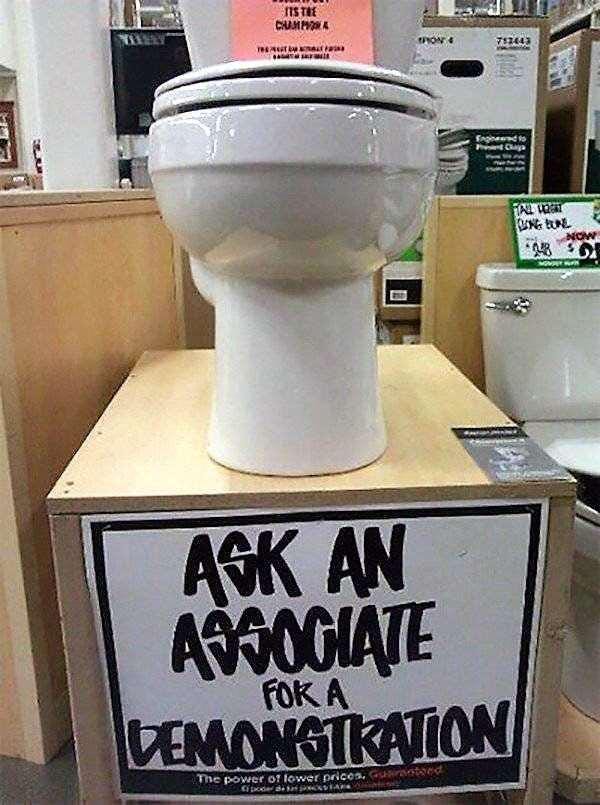
😅 Time for a laugh: “I just gave a demo, can you wait another 30 minutes for after my lunch break?”😅
Thanks for reading Crossborder Alex : Global Marketing & E-commerce! Subscribe for free to receive new posts and support my work.
Interested in more? Checkout my archive!
Or use my vibe coded search engine to find content tailored to you, I improved the search engine a bit. Let me know what you think.