

Goodmorning! A new edition of my newsletter. Soon I have a congress again with maybe some interesting takeouts (although you never know) and my trip to Istanbul is coming! For autumn I am thinking of China and then 2 weeks in India!
For now let’s see what’s going on in the digital world.
🔍Google report on AI mode: go read!
I am a little late with this newsletter, I had a busy 2 weeks. But this is an important report from google on ow people (in the US) use AI Mode.
Just like the “agile manifesto or conditions” :
Individuals and interactions over processes and tools
Working deliverables over comprehensive documentation
Customer collaboration over contract negotiation
Responding to change over following a plan
There are also some SEO manifesto or conditions:
From keywords to prompts, tasks and constraints
From rankings to presence, citations and representation accuracy
From single queries to follow-up journeys
From content-only optimization to entity, product, local and feed-level readiness
From observed traffic to a more nuanced view of visibility and influence
For SEOs and marketers, the practical next step isn’t to replace SEO fundamentals. It’s to expand how we research, optimize and measure:
As Aleyda says:
Searches are longer and more conversational.
Follow-up behavior matters. (Follow-up queries grew 40%+ on average per month. Brand visibility can't be analyzed only at the first prompt anymore: a brand might be mentioned, dropped, compared, misrepresented or never cited across the journey.)
AI Mode is being used to decide, not only to discover. (The top retail attributes people look for: price, location, color, brand, availability, size, material, style, type, quality.)
Local and availability intent is very visible. (Follow-up store queries include "near me", "in stock", "replacement parts", "car dealerships with financing".)
AI Mode is becoming a task layer, not only an answer layer. (Planning queries grew 80% faster than AI Mode queries overall. The opportunity is to be included in plans, shortlists, comparisons and workflows, not only ranked for individual queries.)
I think all very nice topics to work on. Lot’s of possibilities and you can really take advantage early I think.
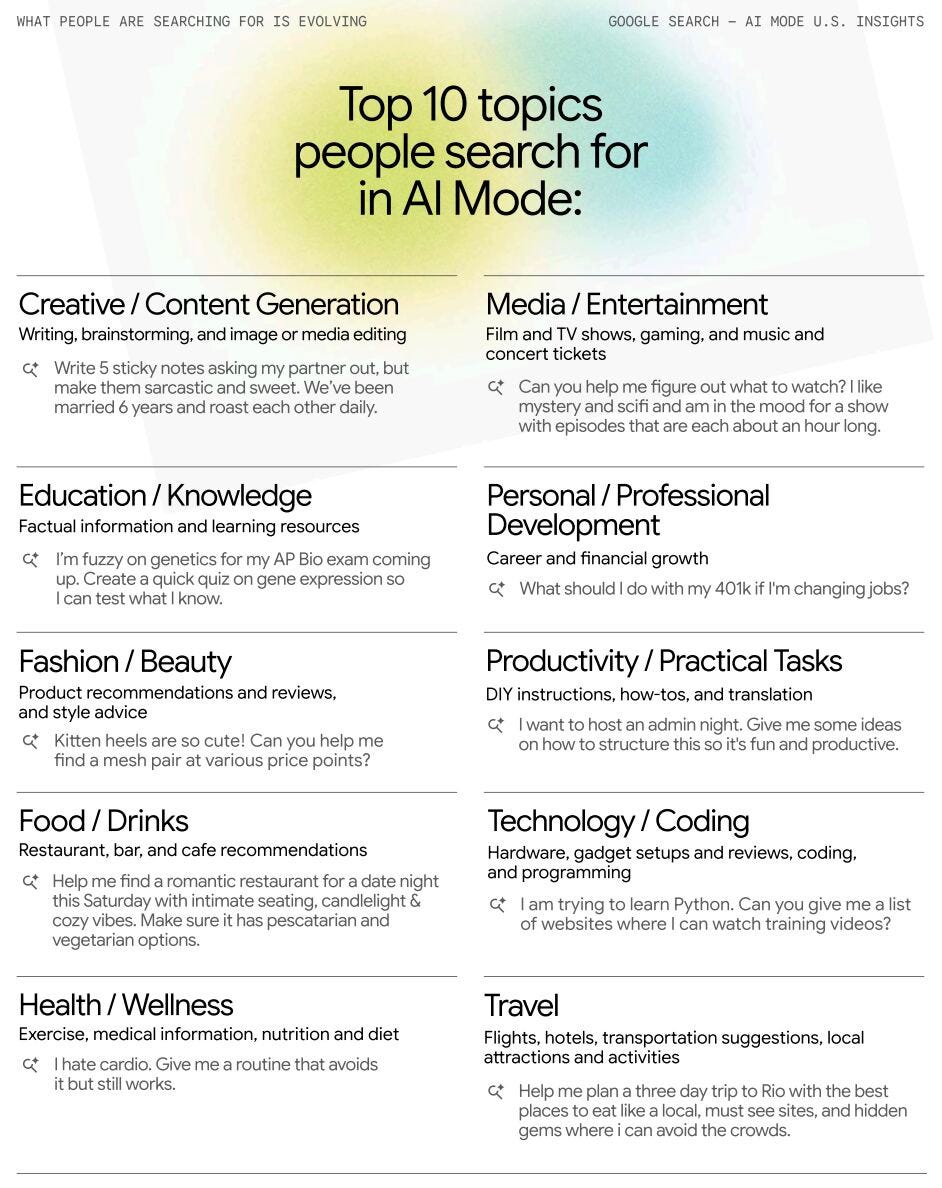
Report directly: https://storage.googleapis.com/gweb-uniblog-publish-prod/documents/AI-Mode-US-Insights.pdf
Bonus: Google just announced “search profiles” for publishers and creators.
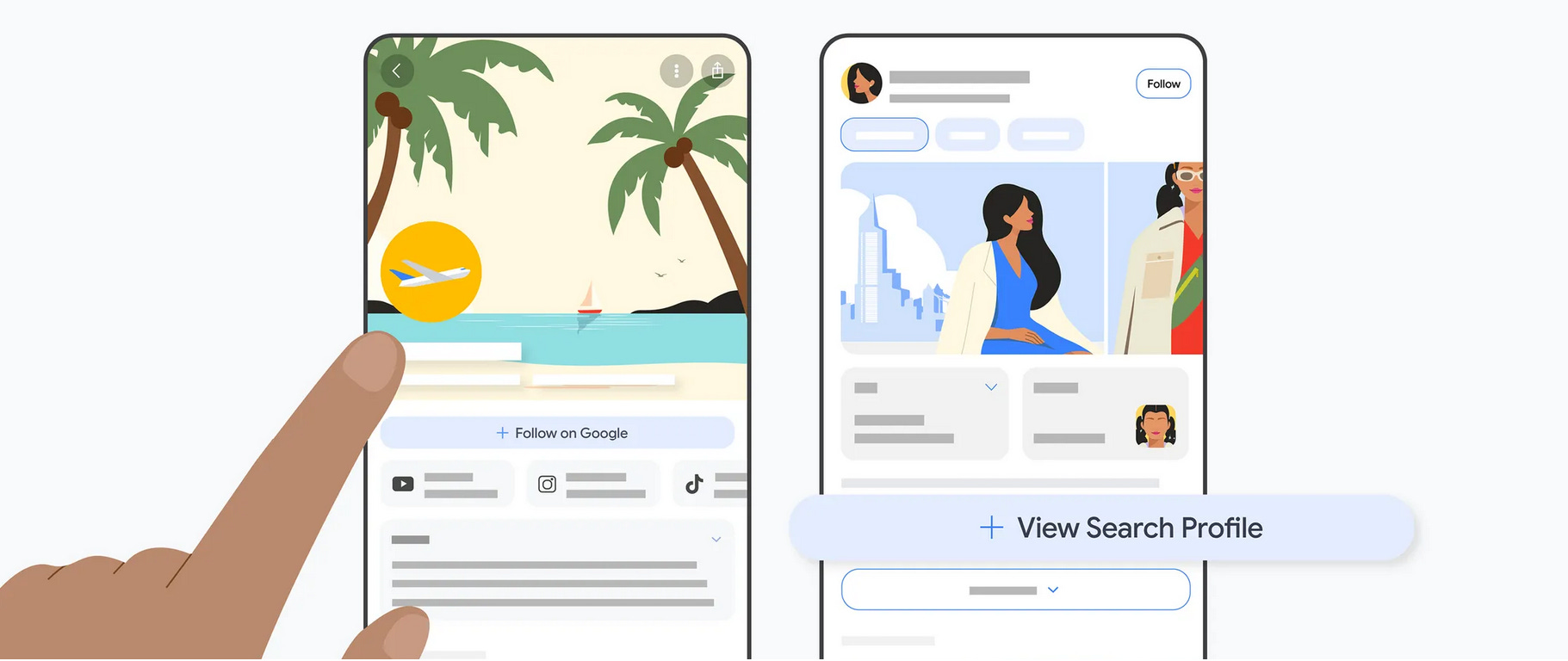
We're launching Search profiles, a new way for publishers and creators to shape their presence on Search. Search profiles are a dedicated, shareable space to highlight content across platforms, and help audiences find accurate, up-to-date information about sources on Search.
Smart move, for now US only but keep a tracker on it, might be useful!
https://blog.google/products-and-platforms/products/search/a-new-profile-to-help-publishers-and-creators-highlight-their-work-on-search/
🦜Category Pirates: synthetic customers the biggest unlock the experience market has ever had?
I am digging into “superusers” already for a while, I think very important for product management, but also beyond that.
Now “category pirates” has a piece on “synthetic customers” in their latest video (meaning AI persona’s of your customers).
The video explaines how to use them in an organisation. Very nice! I clipped the part of the video on those syntethic customers, but in essence:
Move beyond traditional market research: Historically, market research has focused on reports rather than reality and is often not respected within an organisation. To be effective, the synthetic customer must be taken out of the market research department and integrated directly into business functions. They pirates explain on how to use synthetic customers across departments.
Embed in all departments: Synthetic customers should live within every function, Sales, Marketing, Product Development, and Finance, because the people in these roles are the ones with the actual questions. This allows for "war gaming" and "steelmanning" decisions, where different departments use their synthetic customers to duke out ideas and find the best answer. With todays technology those different syntethic customers can also discuss with each other (especially important for the board roam syntethic customer)
The trap of mass commoditisation: Most AI (LLMs) are trained on public data, leading to a "reversion to the mean" where everyone gets the same average results. To avoid this, businesses must use proprietary data and train their synthetic customers on superconsumers (jaja, that’s my thing) rather than the "average" buyer. So if you setup a synthetic customer in your company it’s very important to think through which customer data sets to use.
So don’t aim for the "Fat Part" of the bell curve: Most companies use synthetic customers to simulate the average person (the middle of the bell curve), which only serves to scale mediocrity and "optimize the average into the ground.The bridge strategy (supers and non-consumers): The most effective way to use this technology is to instrument your business for your “supers” first. The ideal sequence is:
Run AI on the superconsumer side to understand what the trendsetters want.
Run AI on the non-consumer side to understand why people aren’t buying.
Connect the two: When you find the bridge between a super and a non-consumer, you naturally capture the “middle” of the market.
The “Super of one is a super of nine” principle: If you use synthetic customers to understand your supers’ behaviors in other categories, your cost of customer acquisition can effectively drop to zero. Very smart, I hadn’t think of it this way. So let’s make it concrete imagine you own a high-end retail shop specializing in technical mountaineering gear. Traditionally, to find new customers, you might buy expensive ads for the keyword “hiking boots”. But now you discover what your superusers are also obsessed with in other categories (in this example maybe high end espresso machines. If you know that you can setup partnerships for example or you can approach them on ad level’s where you do not reach them “cold”.
Boardroom Application: Even the CEO and the board of directors should have their own synthetic customer to stay on top of the business and simulate high-level strategy. Here questions might be like: if Sales, Marketing, and Finance all have their own synthetic customers providing different answers, the CEO uses their own version to "steelman" the various arguments and find the most robust strategic path or they discuss impact on competitors moves.
I think very very useful! Full video here. Thanks Category Pirates 🏴☠️ !
Would be so cool to work on a project like this and learn from it!
Oh yeah before I forget, do read to the bottom of this substack newsletter as I write about TOBII eyetracking. What if you can feed in those details of those tests you do, also in your synthetic persona’s wouldn’t that add value for many retail brands?
🇮🇳 India hit peak ad. A satirist made a video about it
I plan to go to India somewhere later this year, and I read more and more about it. So interesting all, so many things happening there, I think it’s also an advertising heaven haha, so many ads everywhere!
I found this one video that went viral over there, and it’s really creative.
Picture cricket in India as roughly what football (soccer) is to Brazil, the NFL Super Bowl is to the US, or the Champions League final is to Europe, except all year round. The Indian Premier League (IPL) is the country’s biggest cultural event, watched by hundreds of millions, and the most expensive ad real estate on the planet outside the Super Bowl.
An Indian satirist, a former ad-man, posted a short video mocking how saturated IPL broadcasts have become. In his fake commentary, every action is sponsored: the bowler is “Eveready to bowl, polishing the Surf Excel white ball to Vim brightness.” A batsman doesn’t just play a shot, he plays a “Tata Nexon smooth drive.” When a player gets out, he heads to “Naukri.com” to find a new job.
Now, I am absolutely NOT sportive and I do not understand cricket, but I do understand his point. You can only stuff so many ads into a broadcast before people stop watching the cricket and start mocking the brands. Creative and fun way to make that point!
🇸🇪 Tobii Eye-tracking just got cheaper, very cool!

I knew TOBII, read some cases about it a year or so ago. Forgot about it, but now I found they innovated.
Tobii bought a startup called Sticky back in 2017, added mobile webcam testing in 2021, and has been quietly rolling out updates since.
What is new now, is how accessible it's become. This is of course not a sponsored post, I just find this service cool, and I like it that these things become much more accessible. They can boost crossborder e-commerce and user experiences.
Read on for details:
Until recently, eye-tracking studies meant lab equipment, recruited participants in a room, and a budget of €20,000+ per study. Only Unilever, P&G and the global agencies played. Today, with Tobii Sticky, you run a study online: participants use their own laptop or phone webcam at home, the platform tracks where their eyes go on screen, and you get heatmaps and attention scores back in days, not months. Pricing starts at a few hundred euros per test.
Just a simple use case: imagine you're a local Indonesian based skincare brand competing with larger brands like Wardah and Mustika Ratu on Shopee Indonesia or in a physical store. You can now upload three packaging designs or simulate them sitting on an retail shelf surrounded by competitors and find out within a week whether your pack actually grabs the eye in a crowded retail aisle, or which design draws attention to your hero claim.
The same setup works the other way around: a Dutch or German brand entering Indonesia can test the localized pack on a simulated Jakarta shelf before printing 50,000 units.
Another use case OOH: Webcam testing won’t measure real-world walk-by attention. For that you still need wearable glasses and field studies. But you can simulate it: upload a photo of your billboard placed on a major Jakartan road and test whether people’s eyes find your brand within the first 2 seconds before scrolling past. It’s not perfect, but it’s better than guessing. I think so useful before you start expensive campaigns!
Built on the Tobii Nexus technology, the Webcam eye tracking for research-solution has been validated by researchers at Uppsala University in Sweden, who found that its performance is suitable for many adult paradigms that use Areas of interest (AOI)-based attention measures, such as preferential-looking tasks.
https://www.tobii.com/products/software/consumer-research-software/sticky
🇵🇭 Jollibee's: humanity, baked into the culture in an age of AI
A few years ago I went to the Philippines and I made a video there on what I saw in retail (mostly Metro Manila). Of course I had to add Jollibee, the fast food restaurant chain that has expanded everywhere Filipinos live around the world. I was triggered by an article in Campaign Asia while browsing this week. Unfortunately it's behind a paywall, and a very shitty one. I tried to sign up but they made it so time consuming I quit.
This is the URL that triggered me (well not the URL but the headline) Jollibee is designing humanity into its operations in an AI age.
And that is interesting. So I searched a bit more if I could find more details, I found a few, I copy paste it here below:
The real competitive advantage increasingly comes from the things that still feel deeply human:
• empathy
• memory
• care
• judgment
• shared experience
• emotional connection
At Jollibee Group, we spend a lot of time thinking about how we design humanity into systems, culture, experiences, and operations, not as a rejection of AI, but as a complement to it.
AI can generate content.
Humans still generate meaning.His motto "generate a culture that gives people permission to choose humanity over haste" Example he gave: a staff member stopping during a busy shift to help a family take a photo the kind of moment AI can't script
The business case: emotional connection drives loyalty, willingness to pay, and repeat purchase even when cheaper options exist
Maybe a topic more companies should think and discuss about. 🧐
😂Listing failure! This bag is so mini, even the model is scaled down😂
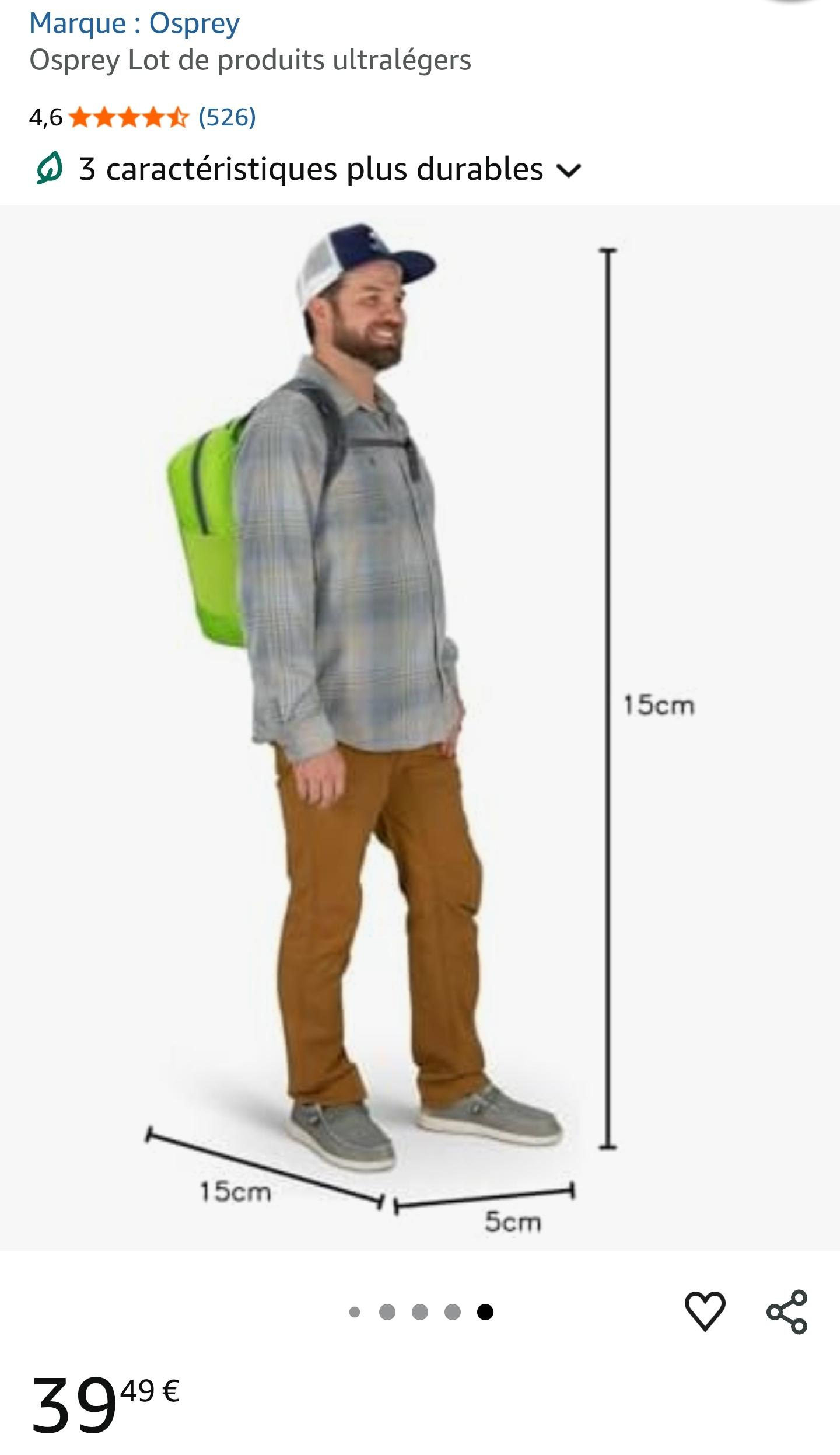
Hahaha, this is a feature amazon just recently started rolling out where they take an image from the listing and throw the product dimensions onto it without any consideration of what the image actually is. 😂.
Hahah : So if the man is 15 cm tall…. That makes the bag….5cmX2cmX3cm approximately!
Always keep checking your listings!
Thanks for reading Crossborder Alex : Global Marketing & E-commerce! Subscribe for free to receive new posts and support my work.
Interested in more? Checkout my archive!
Or use my vibe coded search engine to find content tailored to you, I improved the search engine a bit. Let me know what you think.