

Goodmorning everyone! A new edition and I think a valuable one! Read on!
🇩🇪 Zalando’s new AI agent shops on other websites for you
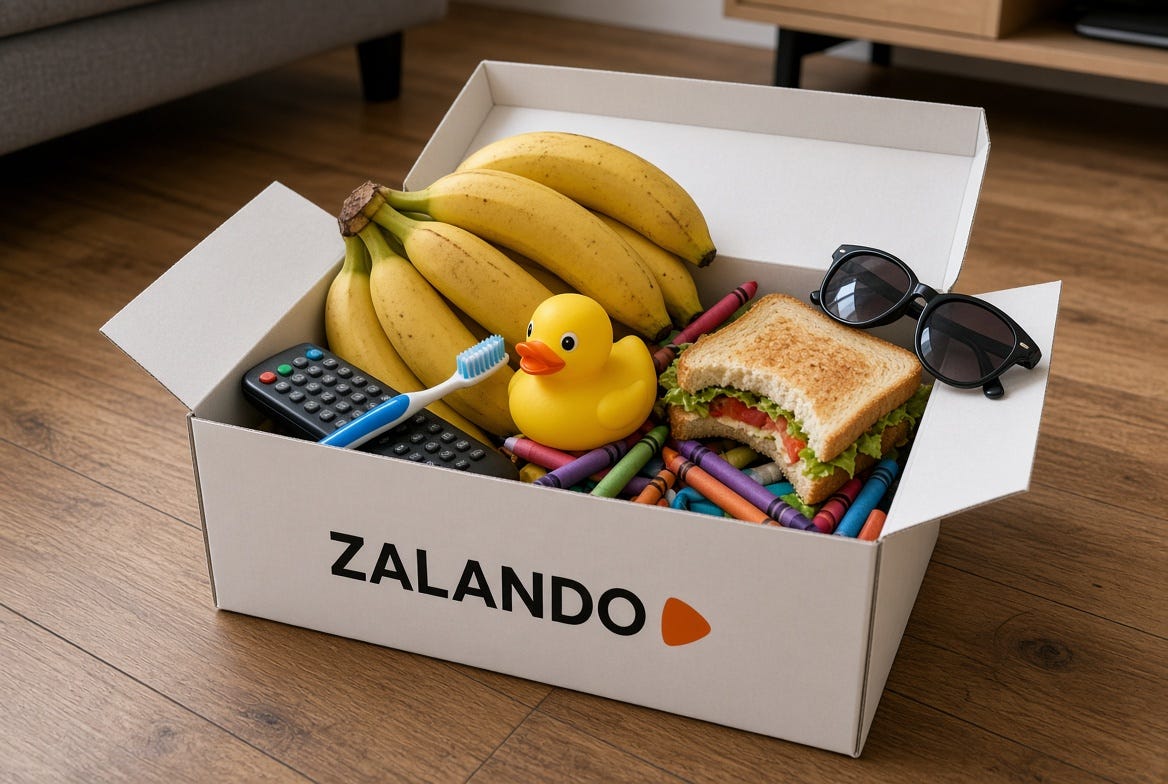
Now this I find interesting: Zalando Extended. Announced with Zalando’s Q3 results on 3 November. Zalando’s own AI agent will buy products on other retailers’ sites for the customer, without them leaving the Zalando app. 😮
It’s a near copy of Amazon’s “Buy for Me” from 2025, I wrote on that a few times also. I read that pilot from Amazon, had some mixed results. For example, there was pushback from brands who suddenly found their products listed on Amazon without being asked. So I guess Zalando learned from that and gives it a try in version 1.2 so to say.
Zalando's story to partner shops: reach Zalando customers without complex integrations or changes to your logistics. And of course you can advertise on Zalando through their retail media business.
So retail media becomes a second way for Zalando to earn from this. Smart move!🤓
What I find also interesting: Zalando is doing two things. They're building their own front door, but they're also plugging into Google's Gemini and testing ads in ChatGPT.
They want to be the place you start shopping, and still be there when you start somewhere else in this case on external AI chatbots.
I think a very valid strategy to follow and I like it that a European company is so innovative and trying these things.
Curious how this plays out in B2B too. Who owns the start of the journey there? Many opportunities.
Details: https://stellagent.ai/insights/zalando-ai-shopping-agent-extended-checkout
and:
https://marketing4ecommerce.net/en/zalando-extended-artificial-intelligence-marketplace/
🆒 Your amazon listing has two readers now

Kudo’s to Guillome Jacobs for this great breakdown of an Amazon product listing (and I think you can use this logic for many more PDP’s).
He breaks down that an AI agent and a human do not look at the same things at a PDP. Alexa for shopping (that hardly works in the EU but in the US much better) reads every word before a shopper even gets there compared to a human who often just skims.
Check out the GIF for details or Guillome’s linkedin post. But some essentials:
Main image: white background, product fills ~85% of the frame. this is what wins the click.
Images + video: show the size in hand and what’s in the box, then write those facts in the text too. the ai reads text before images.
Bullets: answer one shopper question per bullet. the ai quotes them back.
Reviews: if 3+ reviewers raise the same complaint, answer it in your copy. otherwise the ai quotes the reviews.
Hidden search terms: under 250 bytes, no repeats. shoppers never see them, amazon still reads them.
Details:https://lnkd.in/p/dBshK7Fu
🇯🇵 Japan’s software problem (hook to Rakuten)
I stumbled upon this video a few days ago. It really fits the crossborder and cultural differences topic I think. Somehow it also connects to Germany in my opinion. Take a look at this video above.
In both countries, economic success was built on avoiding defects in hardware, whether automotive or industrial machines. A mistake in hardware can have huge consequences. With building software it’s different, you should have a different mindset. When that zero-defect mindset is forced onto software development, it collides directly with “fail fast, ship an MVP, iterate in production.”
Releasing imperfect code is culturally viewed as unprofessional rather than a normal feedback loop in Japan. In the video it’s perfectly explained.
Now you would say, but Japan has Rakuten. I thought about that too, and I even used it a few times just to see how it works. but maybe Rakuten maybe proves the exact same point: it’s international, not global.
Rakuten bought local marketplaces in the US, UK, Germany and France, rebranded them into Rakuten en and tried to run them its way. One by one they closed.
For sure Amazon did a lot of the damage, but I am pretty sure the brand and UX also had a large part in it.
What Rakuten still runs abroad is mostly the stuff it bought and left alone, like Kobo, and Viber.
Its home marketplace works brilliantly in Japan, where dense pages and exhaustive details signal trust and low risk.
It’s a great reminder for cross-border e-commerce: you can export hardware with a zero-defect mindset, but software and UX have to adapt to local consumer psychology.
🇳🇱 Emerce E-day: the delegate Economy


Another short summary of a presentation I went to at Emerce E-day last week. I think it can be useful.
More talks from Emerce E-day you can find in my post from last week:

This talk was from “empathylab” I forgot who presented it, but it was in English so I took some pictures.
The talk was based at a simple idea: your customer is starting to send an agent ahead, and that agent decides before the human ever sees you. Yes also for store visits!
The main message: if an agent can’t find you, you’re not even in the game. product data, feeds, AI search, everyone is on it. by the end of the year that’s simply the minimum.
Being trusted is your licence to win. will the agent recommend you, act for her, and come back for “my usual”? they called that moment the zero moment of trust, a nice twist on google’s zero moment of truth from 2011, I remember that book. It was a hype back them.Trust is earned over many orders and lost in one. “reorder my usual dishwasher tablets”, and the lemon version shows up. out of stock after the agent already said yes, a wrong price between feed and checkout, nobody owning the return. 4 in 5 won’t come back after one bad AI-found experience.
The comparison with Amazon was a good one. if you sell on Amazon and you deliver late, cancel too often or get too many complaints, Amazon punishes you. You lose the buy box, get warnings, and in the worst case your account gets suspended. believe me I know, been there. It’s shit, but at least you know something is wrong and you can fix it. Agents look at the same criteria, but their penalty is silence. you just stop showing up, and you might not even notice why.
So I think another reason to build key metrics into your daily operations, the way Amazon sellers already do. Think of order defect rate (Amazon wants it under 1%), late shipments and cancellations. If you only start tracking them once sales drop, you’re too late.
The strategic frame was wall, toll or gate. Amazon builds a wall (keep agents out), reddit and publishers set up a toll (pay for our data), Walmart builds a gate (let agents in on your terms). For most brands best choice will be a gate, open with clear rules. and it’s a commercial choice, not an it setting.
Pick the products where you compete on price, and win the rest on things an agent can check, like stock, delivery, returns and the same story in every channel.
Make the “best deal” bigger than price. In the talk’s example, the shoe agent filtered on wide fit, made in Europe and ready by Saturday, not only on €150. Publish delivery date, stock per store, return terms and warranty as structured data an agent can read. Cheapest but delivered next week often loses to €3 more and delivered tomorrow.
Walmart’s gate is a nice blueprint for others maybe. Let agents in, but on your terms. In this case every agent gets its own profile, so the customer sees exactly what each agent bought. She(human) sets the limits: a spending cap, or she approves every order herself.
The agent never touches card data, payment stays with Walmart. If the agent orders the wrong thing, normal returns still apply. Agents that break the rules get blocked, because Walmart wrote terms for agents, not just for people. Cool right?
Yes, there’s a lot of tech behind this: agent logins, payment tokens, limits, bot detection. but the choices behind it are commercial. which agents do you allow? which products? Who pays when an agent messes up?
Nice talk and I think some of my readers can use the slide examples either for themselves or for (potential) customers as it has nice frameworks.
🧐 Validate or stress test a (software) product idea in 2026 (and why the PRD isn’t enough anymore)
Try this:
Now this is cool and we can thank Paweł Huryn for it:
THANK YOU PAWEL (again)
For years, the Product Requirements Document (or PRD) was the sacred artifact.
Every product owner knows it.
You spent days (sometimes weeks) writing it. To be honest I thought it was also fun to do, writing a PRD, but it took a lot of time.
Aligning with stakeholders. Making versions (hated that part). Storing it in Confluence or Notion. Then the developers opened it, squinted, asked three clarifying questions, and mostly built what they already had in mind.
Paweł Huryn just open-sourced something that feels like the next step or at least the direction a collection of ~45 agent skills called product-engineering.
Thanks man for making that free!
It turns your coding agent into a product partner: first it helps you decide what to build, then it builds it, with checks along the way so nothing ships on hope.
What I like most is that it’s not a document you hand off and forget. It’s a living artifact. The proposal sits next to the code and gets updated when things change. Rejected ideas are written down too. So anyone on the team, not just the person who wrote it, can see the route a product took and why.
And that’s not all you get the key screens and even a checklist of what’s still open. .
Is it for everyone? If you already ship with coding agents, it’s more useful. For non-digital or hybrid ideas, the discovery part still travels very well (where I currently use it for mostly), but the shipping part is software-only.
My advice: just try it. Even if you never write a line of code, it’s one of the best ways I’ve seen to stress-test an idea. You describe what you have, and you get back research with sources, who it’s really for, where you stand out and the open questions you hadn’t thought of yet. That alone is worth the 15 minutes.
It’s very easy and works with Claude, you connect the skill and go for it. No this doesn’t work with Copilot. (haha).
Github: https://github.com/phuryn/product-engineering
You can also see the artifact I made from just an idea I described in the prompt, in this case a “task app for shop owners” but you can put any idea in it. See the link:
https://claude.ai/artifact/1EYQktTmQWHVQszjzyTirs#recommendation
Thanks for reading Crossborder Alex : Global Marketing & E-commerce! Subscribe for free to receive new posts and support my work. See you again in the next edition I hope. Thanks for supporting it really matters a lot to me!
Interested in more? Checkout my archive!
Use my vibe coded search engine to find content tailored to you, I improved the search engine a bit.
Do you want to support me? Consider taking an American Express Card via this referer URL. It benefits us both and makes it possible for me to travel and share more on this substack. Thank you. American Express is -also in Europe- a great way to get travel perks but you really speed up the points and perks by referals.