
🔍 AI Search Strategy Playbook (including global data) → must read

New great slide deck from Alayda. Really really useful, although nothing new for readers of my substack. This deck though integrates many things and you can easily build a strategy with it, I think, for yourself or your clients. I tested it, with a good LLM, good MD files and then uploading this deck, it will really save you time and you get a good quality strategy out of it.
All slides are great (really) but for me what stood out:
The 2026 search reality: “The great decoupling”
The Zero-Click Boom: In the first four months of 2026, a massive 68.01% of Google searches in the US ended without a single click. This rapid rise is heavily driven by AI Overviews (now appearing on 20%+ of searches), which slash CTR by nearly 60% when present.
The Global Zero-Click Breakdown: This isn’t just a US phenomenon. The zero-click rate spans key markets:
UK: 69.5% (Highest zero-click rate with only 30.5% clicking)
US: 68.0%
France: 65.3%
Canada: 63.8%
Italy: 63.4%
Germany: 62.1%
Build a “Minimum viable” prompt library
The Blueprint: stop optimizing for random keywords. Build a structured library mapping 30 to 50 commercially relevant prompts.
Benchmark your AI Presence KPIs (use those for some new KPI”s and start measuring)
Prompt Coverage: Are you appearing where you need to be? (Low score = visibility/distribution gap)
Recommendation Rate: Are you actively endorsed or just listed in passing? (Low score = trust or differentiation gap)
Linked Citation Rate: Are you given a direct click path to your site? (Low score = technical page-structure gap)
Comparative Win Rate: Are you framed as the superior option in shortlists? (Low score = positioning/proof gap)
Representation Accuracy: Is the AI describing your entity, audience, and specs correctly? (Low score = consistency issues)
Shift Content to “topical completeness”
Graph over keywords: AI platforms need entire topic graphs to confidently recommend you under strict filters.
Think hyper-local & off-site
Global defaults lose: AI search models heavily favor local infrastructure over massive global platforms in international markets. For instance, in the Netherlands, local champion bol.com commands a dominant 17.9% share of all e-commerce AI search clicks.
The off site trust gate: Growing your brand authority outside of your own domain is mandatory. Your roadmap to anchoring AI trust relies on third-party verification:
Yo can find the full deck here: https://speakerdeck.com/aleyda/the-winning-global-ai-search-strategy-playbook
🇰🇷 Starbucks campaign failure South Korea

Now also a story on AI and human collaboration that didn’t go so well:
In mid May 2026, Starbucks Korea launched a “Tank Day” promotion for a new line of large tumblers. The name was meant to highlight the “spacious volume” of the product. The campaign dropped on May 18 the anniversary of the 1980 Gwangju democratization movement, when the military used tanks to suppress protesters. To make matters worse, the materials included the phrase “hit the desk,” which directly echoes the 1987 police cover up of a tortured student activist’s death.
What started as a routine merch push or campaign, exploded into a national scandal. Customers smashed tumblers on camera, gift voucher rankings collapsed, refunds were demanded en masse, the CEO was fired, the chairman had to bow in public apology, and police opened a criminal investigation.
The root cause? A junior marketing team used AI to brainstorm ideas, then pushed the concept through four levels of approval with zero objections. Legal review was bypassed, key people signed off without even opening the attachments, and internal chats later showed genuine confusion about why people were upset.
Now the author that wrote about all of this on LinkedIN draws these conclusions:
Algorithmic fluency is not cultural intelligence. You can hire the most data-literate marketing team in the world and still be illiterate in the place that matters most: the historical memory of the people you serve.
I agree. Tools are only as good as the humans steering them. AI is fantastic at generating options fast it’s not good at understanding deeply local trauma or unspoken taboos. Having said that, I think with the right prompting you could also flag this. A prompt like ‘“Act as a Korean cultural advisor and flag any potential controversies, even indirect ones.” can probably prevent many things.
So is this an AI failure or a human process failure? Maybe the latter.Speed without memory is a ticking time bomb. Every approval layer that becomes a rubber stamp is a layer of protection that no longer exists. Compliance theater is not compliance.
I agree, but I want to emphasize that I think, the failure wasn’t speed itself, speed built Starbucks Korea into a cultural powerhouse in the first place. The problem was careless speed + zero real accountability. There is not more bureacracy needed, one should find a way to keep speed but flag these issues. No endless commities.Every global brand operating locally needs a Brand Guardian. An independent vetting authority disconnected from short-term KPIs, empowered with absolute veto power is not a bureaucratic luxury. It is the last line of defense between a campaign and a catastrophe.
Here I don’t agree fully. It sounds very nice, but I have dealt with something like this in practice, “brand guardians” can become risk averse gatekeeping that kills good ideas (or even tests) and slows execution. Have had many times that they also act on “feeling” and this blocks high performing advertising campaigns.
Better to embed real local competence and ownership in the core team than create a separate group of sensitivity reviewers.ESG must be a living practice, not a reporting checkbox. The companies that survive the next decade will be the ones that treat cultural sensitivity not as a risk to manage, but as a value to protect. The ones that don't will become case studies.
This is the one I disagree with. Cultural awareness should be pragmatic competence part of doing good business in a specific market not a new religion layered on top of everything.
Details and the complete LinkedIn post here: https://www.linkedin.com/pulse/from-national-gift-insult-how-starbucks-korea-destroyed-tz0ve/
😎 Chloe vs History, CrossborderAlex style
Remember Chloe vs History from my last newsletter?
If you haven’t check it out here:

I wanted to see if I could copy that format myself, mostly to learn myself, how an AI video like that actually gets made.
Well, I managed 😀 This took me about 45-60 minutes with “higgsfield”. Higgsfield you say, didn’t you wrote about them earlier, Alex?
Yes yes, I did. It’s the first unicorn company from the country of Kazachstan! I wrote on that here.
I have to say, it works really well. The voice isn't right yet, I got stuck on that as Higgsfield used my cloned voice in both mine character and the others. Also it took a while before I had my character right. That had to do with lightning and selfie’s.
If I spent a full day on it, the quality would be much higher. But that's kind of the point: 45 minutes, one person, no camera, no crew and I already have this (see video).
Total costs? , I paid 59 Euro not only to make this video but also one for the company I work for (a longer video).
I think this what I made below can be made for appr. 19 euro.
More on Higgsfield and advertising use cases (that readers of my substack might interest) here:
🇨🇳 🇺🇸 Amazon vs Joybuy Prime vs Prima
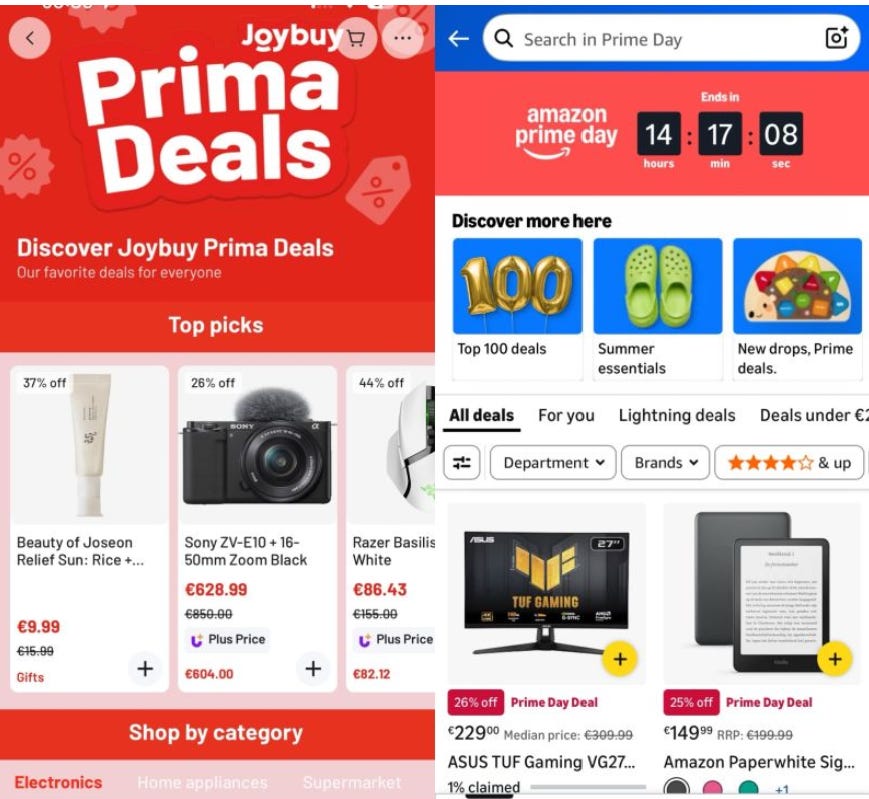
Remember Amazon Prime day? In the Netherlands Joybuy is now active and I have to say, I like then this “creativity” or counter from the Chinese. Amazon has “prime day” but Joybuy creates then “prima day” and “prima deals” means “good deals” in Dutch.
I am sure next year Joybuy comes up with something better. Chinese are very good at claiming promo’s, think only about “singles day” that is now expanding across the world.
Reminder to myself that I buy something from Joybuy to test! I used JD quite sometime when I lived in China but haven’t used joybuy here.
🇹🇷 Local advertising example Istanbul’s Grand Bazaar


Last week in Istanbul, scrolling google discover, I got served an ad for the Grand Bazaar. local business, targeting me as a tourist, in the moment. Well done. Google knows before anyone else when I’m thinking about traveling and exactly when I’ve arrived. More businesses should build on that.
But I think it can be even better. They got the who and when right, and the what wrong. the ad pushed food products from the bazaar. not my thing. What I would have paid for: order online, delivered to my hotel same day especially non-food. For example clothes or souvenirs. I can skip the haggling, skip the busy bazaar and travel there. That’s where I think a lot can be won. But still nice example of local advertising. I see so many opportuntities for companies. Wrote about it earlier on “WOW PASS” in South Korea. I think many people will never discover that product as it was so hidden online.
🧐Three models of cross-border e-commerce are forming?

Naver a South Korean e-commerce giant (I visited their offices, well the public part only when I was in South Korea) is investing heavily in crossborder agentic commerce via SAZO.
SAZO has developed a platform where AI agents automate key processes required for overseas purchases, including shipping fee and customs duty prediction, translation, local pricing, payment, and customs clearance. NAVER D2SF decided to invest in the team based on its ability to rapidly build a product for the global market and validate its business potential through transaction growth and partnerships across Korea and Japan.
SAZO addresses the information asymmetry and complex purchasing process in cross-border commerce through agentic AI. For overseas purchases, consumers often face uncertainty around final shipping costs and customs duties until the point of payment, while differences in language, currency, and customs regulations across countries create additional friction that limits conversion. SAZO predicts shipping fees, customs duties, and service charges with approximately 95% accuracy, while enabling AI agents to automate translation, local pricing, payment, customs clearance, and other transaction processes.
Which brings me to something I keep thinking about it seems to me like we have different CBE models in the world:
A western CBE model: built on marketplace compliance, GDPR, consumer protection regulation, and increasingly, friction. The EU just removed the VAT exemption on low-value imports. GPSR is adding product safety costs for marketplace sellers. The direction is more rules, more costs, more barriers for non-EU sellers coming in (and higher costs for EU consumers)
A Chinese CBE model: built on speed, volume, and vertical integration. The well known platforms, have compressed the cost of going global to very low, for Chinese sellers. The model is under pressure from tariffs and bans in the West, but it isn’t going away it’s just rerouting.
An emerging Asian model: so it appears, and this is where NAVER/SAZO fits. Korea, Japan, Thailand, Singapore are building outbound CBE infrastructure that is neither the compliance-heavy Western approach nor the ultra-low-cost Chinese one.
It’s more agent driven, more focused on reducing information asymmetry for both sellers and buyers, and built on corridors (Korea↔Japan, Southeast Asia↔Northeast Asia) rather than trying to go everywhere at once.
The interesting question for brands operating globally: which model do you architect around? Or how to use all of them Because increasingly, they don’t talk to each other. For m a very interesting topic.
🇳🇱 Coolblue PDP now detects device
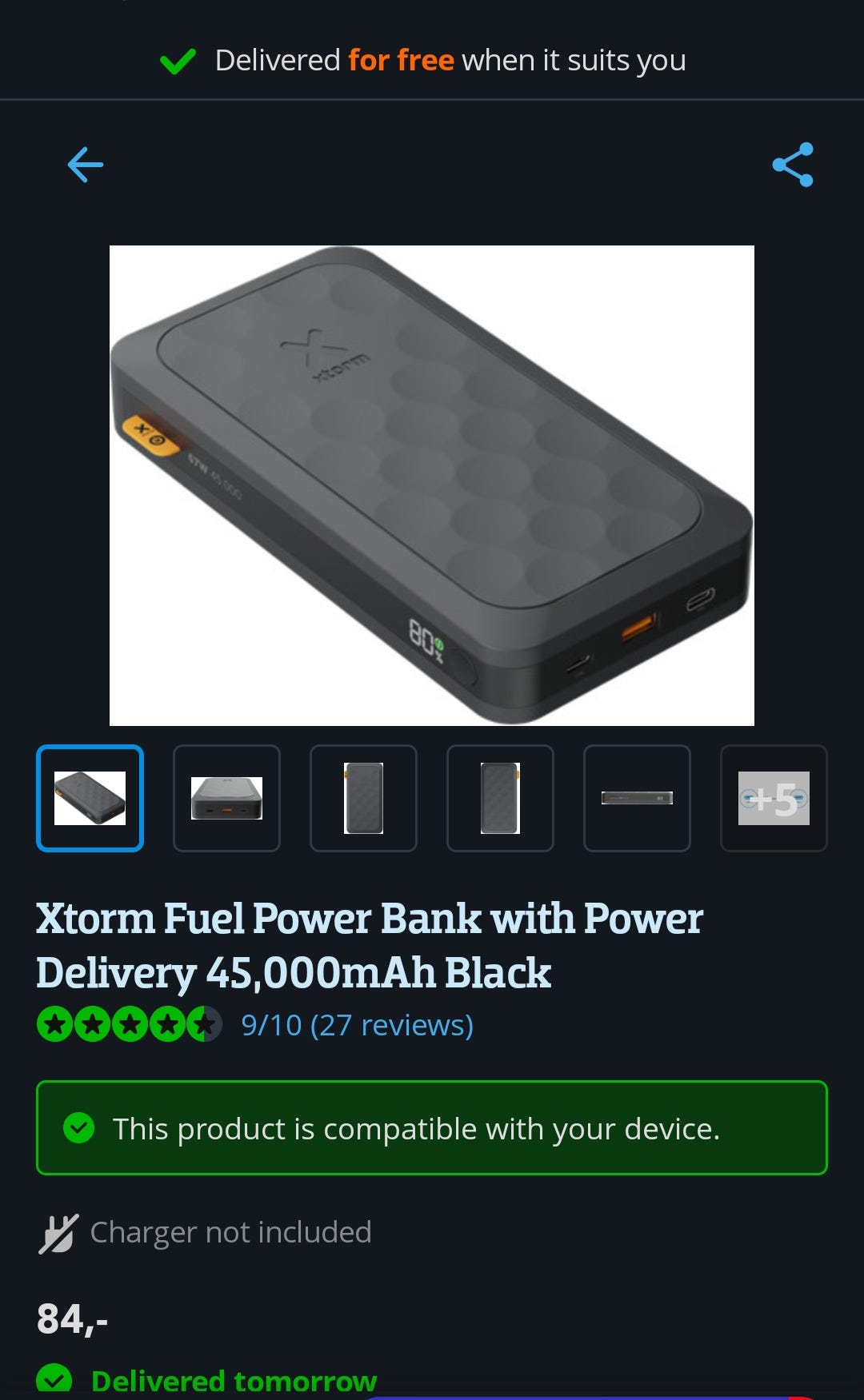
Just discovered this nice little feature on Coolblue’s PDP. Really nice and I am sure this helps conversion and customer satisfaction. I think they detect device and then show this notification “this product is compatible with your device”.
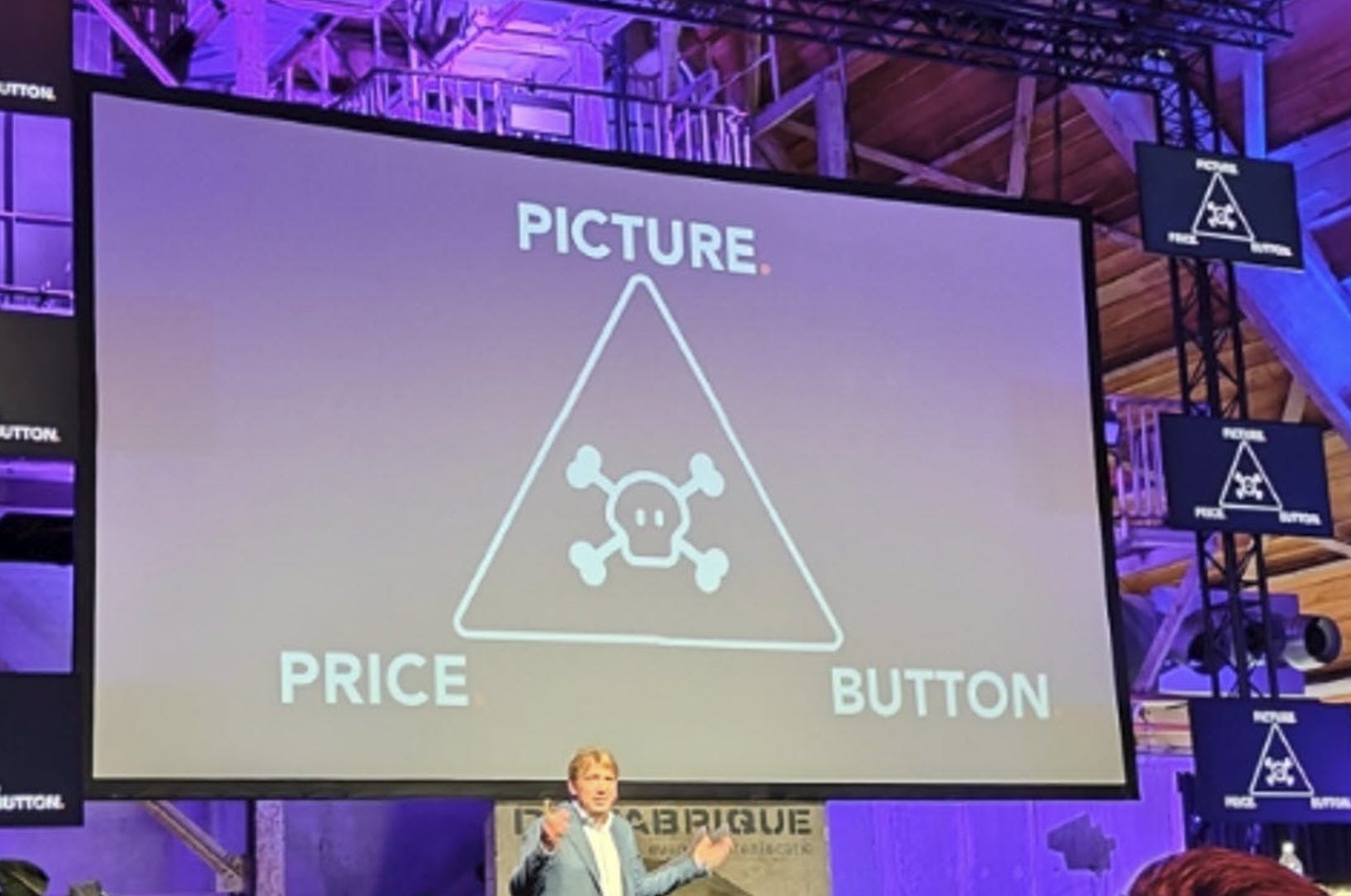
Simple but trust building and I haven’t seen that anywhere else yet. I think that’s part of their strategy to “break through the triangle of death”
Thanks for reading Crossborder Alex : Global Marketing & E-commerce! Subscribe for free to receive new posts and support my work.
Interested in more? Checkout my archive!
Or use my vibe coded search engine to find content tailored to you, I improved the search engine a bit. Let me know what you think.