
Morning! I am in Istanbul. Just traveling a bit. I happened, while walking in the city, to stumble upon an AI conference. To my surprise it was free, I could just smil, register and walk in! Most of it was in Turkish and although they had real time textual translation on screens of what was said, it wasn’t so easy to follow. I did watch a few presentations that were in English (or Chinglish😅), I will share some slides here below, for me these talk didn’t had much new insights, but I share them anyway, it might be valuable for readers and the slides are quite nice. It’s a talk from the Huawei country manager from Turkeye.
🇹🇷 Future of AI summit in Istanbul Huawei country manager explains AI


In summary what the guy told:
From big budgets to big ideas: traditionally, startups required high budgets to fund massive teams across marketing, engineering, HR, and finance. In the AI era, a single founder with a great idea can use AI agents to develop, simulate outcomes, and push products to market.
The one-person unicorn: the next billion-dollar company (unicorn) may be built by a team of one, powered by an "AI team" consisting of virtual product designers, developers, marketers, and analysts.
AI provides answers; Leaders provide meaning: While AI can offer data, options, and risk predictions, it lacks purpose, values, and courage. Leaders are essential to provide direction and take responsibility for the final choice.
The future decision stack: the decision-making process is evolving. AI will now handle analysis and scenario simulation, but Human Judgment and Responsible Decision-making remain at the core of the stack. Humans must own the decision, not outsource it to AI.
AI will not necessarily make everyone smarter; instead, it amplifies how you think. To succeed, individuals must master five critical skills:
Critical Thinking: To judge if an AI-generated answer is reliable.
Creativity: To ask new questions and frame new ideas.
Communication: To express complex ideas simply.
Leadership: To take action and move resources.
AI Collaboration: Knowing how to effectively work with and “interrogate” AI tools
The gap of adoption: There will be a significant gap between those who simply copy AI and those who use it to challenge their own views and find new resources.
Better together: Humans alone are limited by time and bias, while AI alone is limited by a lack of context and responsibility. The future belongs to human-AI collaboration, which results in better insight and superior decisions.
🇹🇷 Synthetic customers part II emptosight (TR)


Remember, when I wrote on “synthetic customers” that it is upcoming? It was in edition 142 (do watch that edition and video if you did not yet). Now at this conference in Istanbul there was also a “startup corner” so I visited that area of course -as always I like those areas-.
It happened to be there that there was a startup company that is starting this “synthetic customer” service in Europe.
So interesting, I spoke with the people behind it and got a quick demo. For example they demo-ed me a survey’s among the “synthetic users”.
The dataset currently used is “qumpara” as I understood mostly transactional data. But they do want to expand the dataset also to other areas. I would encourage that, I think the datasaet is now too limited for the use cases I have in my mind. It should include (anonymized) customer service data, maybe even transcripts of interviews with (superusers) on digital products (.f.e. an app) and behavorial data. Having said that, the demo I got was really promising. It’s available both in English and Turkish at the moment.
I really do think this synthetic customers is something that can help many company’s get more customer focused and ship faster better outcomes.
Details: https://www.linkedin.com/company/emptosight/posts/?feedView=all
🇸🇪 Klarna explains role of the new CMO (and I like it)
Yeah!
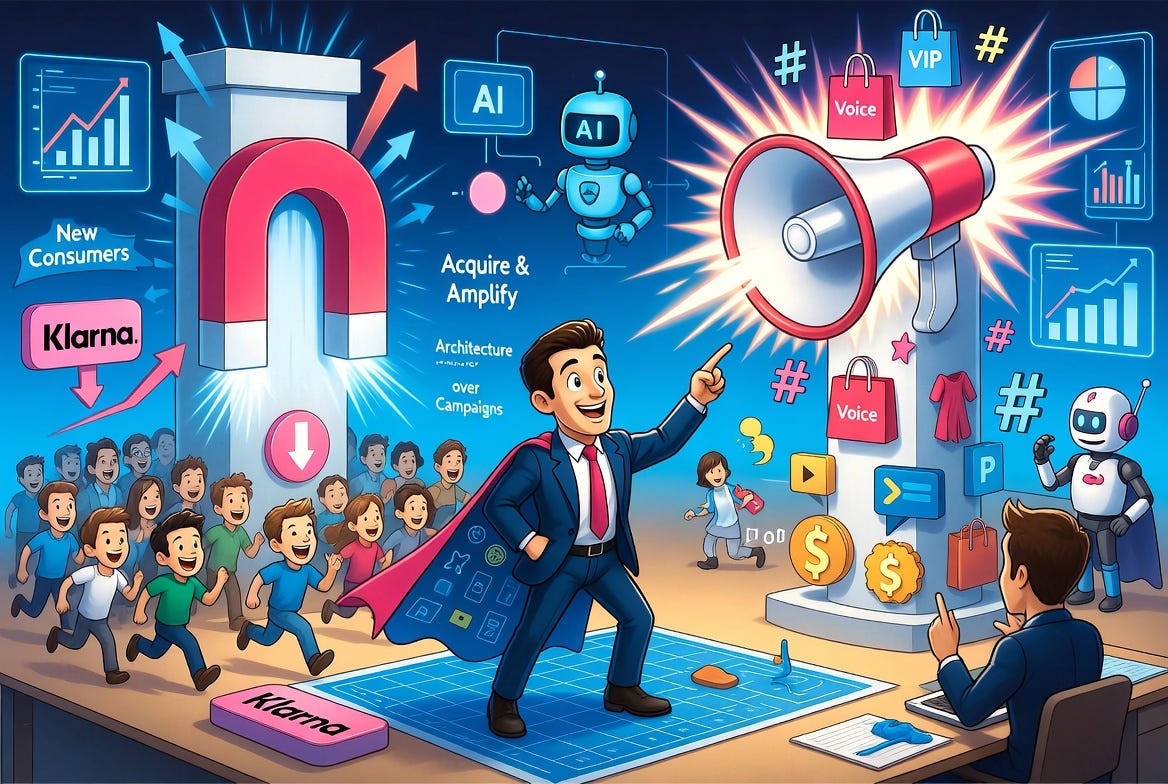
Check this out. Klarna explain how they think the role of the (chief) marketing manager will change. I think he is right. Not only because this fits fully “in my street”, but also because I know it from experience and at the same time I read more and more about it.
For years, marketing leaders have been judged by the campaigns they launched, the agencies they hired and the media budgets they controlled. David Sandström thinks that era is ending.
“The role has evolved way more into architecture, structure and infrastructure,” says the Klarna CMO. “How do you build this organization? How do the workflows work? How do AI and humans collaborate? What’s the structure for the data powering all of this? It’s way more architectural work than creative or media-buying work.”
So I think this is both useful information for managers but also for agency’s, as they can of course also fulfil such a role in certain cases.
It is a striking conclusion from someone who has lived through both worlds
Yet Sandström is equally clear that marketing alone cannot manufacture a brand. “I’m a big believer that the product builds the brand. Marketing makes people interested. It makes consumers want to understand more, download the app and try the payment methods. But it’s in the usage of the product that a brand is built.”
Yes and that’s why I already wrote so many times on “moments” or “outcomes” in digital products. 100% true I think.
“More humans need to spend time being creative and less on moving numbers and words between documents and platforms.”
Couldn’t agree more! There are still companies still that limit creativity and only move powerpoints (believe me I know).
Details:
https://www.thedrum.com/news/the-agency-monopoly-on-creativity-has-fallen-says-klarna-cmo
Unpaywalled but might be an annoying captcha for it but it does work: https://archive.is/fiID7
Now and combine this with this article from India:⬇️⬇️
🇮🇳 Zomato: nobody opens instagram to hear from a brand
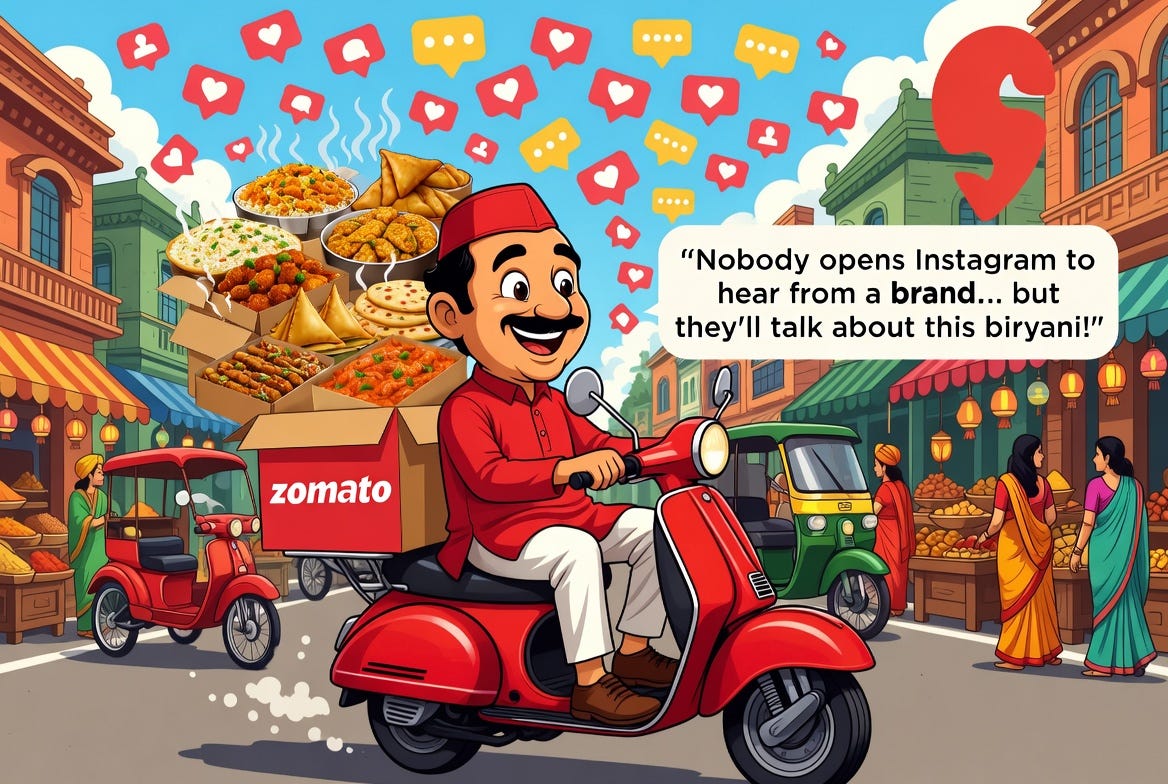
Zomato is a food delivery company from India but active in many more countries. But check this out (I agree also with this guy).
“Traditional advertising holds value only in how much conversation it now generates online. A print, an OOH, even a TVC matters only when it’s spoken about on social media,” Sawhney told Storyboard18. He believes marketers need to be clear about the role each piece of communication is expected to play. “And on digital, you need to have clarity. You’re either creating an ad or a piece of content. It cannot be both.”
This fits perfectly in the line of the article in “The drum” about the CMO, I shareed above. The future is so cool and really fits me, I think.😀
The company’s approach also extends to planning. “We don’t build annual marketing plans. Food delivery is too dynamic (read: exciting) to plan a year in advance.” Sawhney said Zomato works on shorter planning and execution cycles instead of annual marketing roadmaps.
The company focuses on two priorities, one is acquiring new consumers and the second is, creating share-of-voice peaks around category demand moments.
I think more companies should think this way if you want to take a leap frog.
Details:
🇹🇷 Pegasus: they are better at flying then emailing
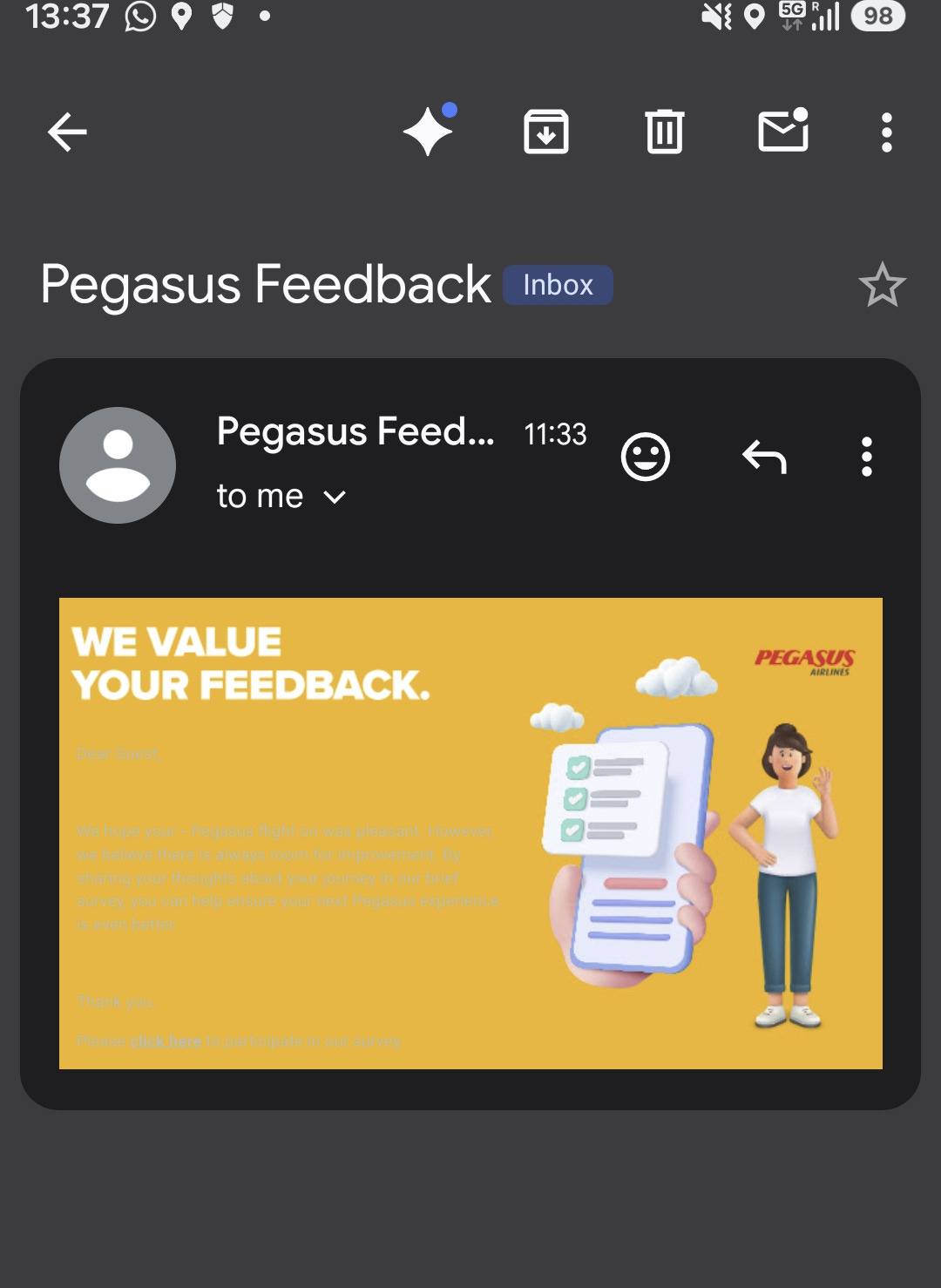
I flew with Pegasus Airlines to Istanbul. Nothing special to be honest. But then they send me this e-mail. OMG, really? It’s not readable at mobile. As a -wannabe- developer I use darkmode (and vertical screens) everywhere possible.😅
What I think happens here (at desktop its very well visible) is that automatic inversion happened. When an email app on your phone detects a dark interface setting, it may automatically flip your email's colors turning light backgrounds dark and dark text into light text.
However this is so easy to test and fix. From a professional design and development perspective, email marketing teams should be optimizing their emails for dark mode and test it in multiple clients. It’s very easy nowadays. Strange for an airline to have this not working.
🇯🇵 Japan a service culture explained
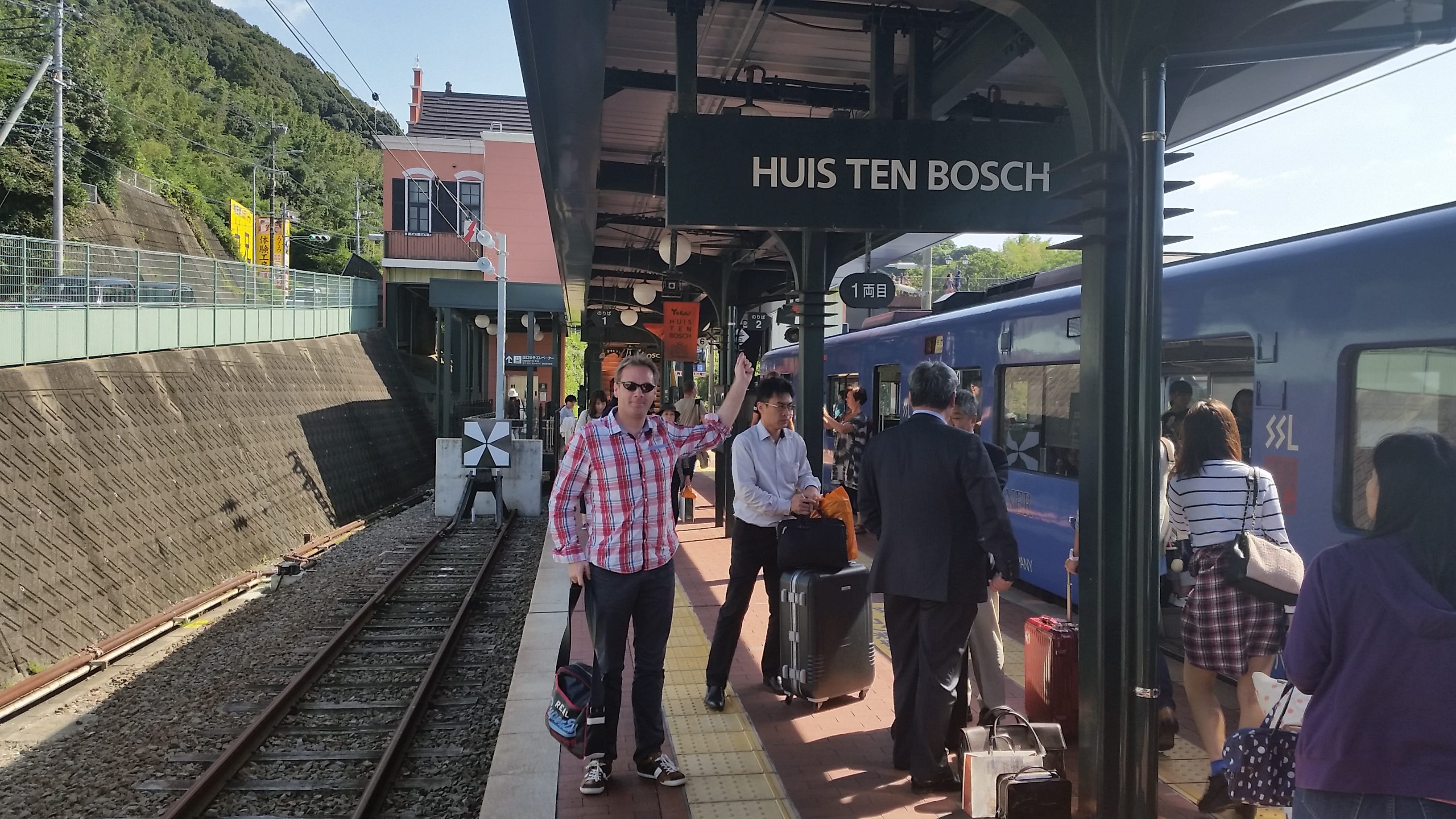
Before I started this substack, I wrote on Japan at LinkedIn this article can be found here. (if you haven’t read it please read and like it)☺️
I think Japanese service culture is very, very interesting especially the “Omotenashi” part of it: solve a problem before it occurs.
I think if we in the west, as product owners follow this philosophy we really make a difference in the products we build.
I found a great substack article on exactly what I think is interesting as well by Daniel Orenes Ferrandez. Do check that out it’s linked below.

And my earlier LinkedIn article: https://www.linkedin.com/pulse/retail-inspiration-japan-alex-baar-clhwf/
🖇️Linking done properly (with a model)
I have been listening to this talk. It’s all about links (yeah there is a lot to tell about links). This guy made an open sourced model for analyzing text and telling exactly where to link. Now unfortunately it’s model is only in English available (well the open source version). Still I think it’s valuable to watch the talk, just to learn how to think about linking, but also if you want to build such a model yourself you can train it on local languages.
Every link must have a clear and valid purpose. Petrovic suggests that a link should exist only to assist the reader. Valid reasons include:
Attribution & Proof: Substantiating a claim made in your text.
Expansion & Definition: Providing a deeper explanation or defining a term.
Identification & Reference: Directing the reader to an example or source.
Relationship & Promotion: Disclosing a connection or naturally promoting a helpful resource (e.g., a friend’s e-commerce site)
Bottom line his principle: link out generously to the best possible page on the internet for that specific context.
Even if you do not use the model, these link purposes might be worth remembering.
Very nicely done and I can imagine this is a great lead magnet for his agency!
Test it yourself via:
https://linkbert.com/
Hugging face models from DJAN: https://huggingface.co/dejanseo/models
😍Chloe vs History! Insanely cool 😎
Wow this is so insanely cool! This AI influencer digs into a niche: “history” and she really makes something of it. Look at this, it’s like time travel, you feel like you are there! Will this be the future of history teaching? Amazing! Checkout her channel (charactar created by Jonathan Laramy, a U.K.-based digital creator and history enthusiast). He creates Chloe vs History with Seedance 2.0 (video), Claude (script) and Nano Banana (artwork like charactars).
I am now only more convinced that it is very, very, very well possible to create really good performing AI advertisements with the tools mentioned above. I am convinced I can do that. Might be a bit time consuming but it’s a mix of creativity and understanding what make ads work and a learning loop, I think.
🔥The Intersection of technology & freedom
This substack is about crossborder e-commerce, retail and digital marketing but sometimes I make an exception to a much more important topic: freedom. Something that is under pressure.I suggest everyone to watch this talk from Pavel Durov the Telegram and Vkontakte founder.
Thanks for reading Crossborder Alex : Global Marketing & E-commerce! Subscribe for free to receive new posts and support my work.
Interested in more? Checkout my archive!
Or use my vibe coded search engine to find content tailored to you, I improved the search engine a bit. Let me know what you think.
Hello Alex, and thank you very much for mentioning my newsletter about Japanese Customer Service! I also enjoyed your LinkedIn article about Japanese retailers!