

🇫🇷 Zut Alors: France goes back to the 90s (and earlier)
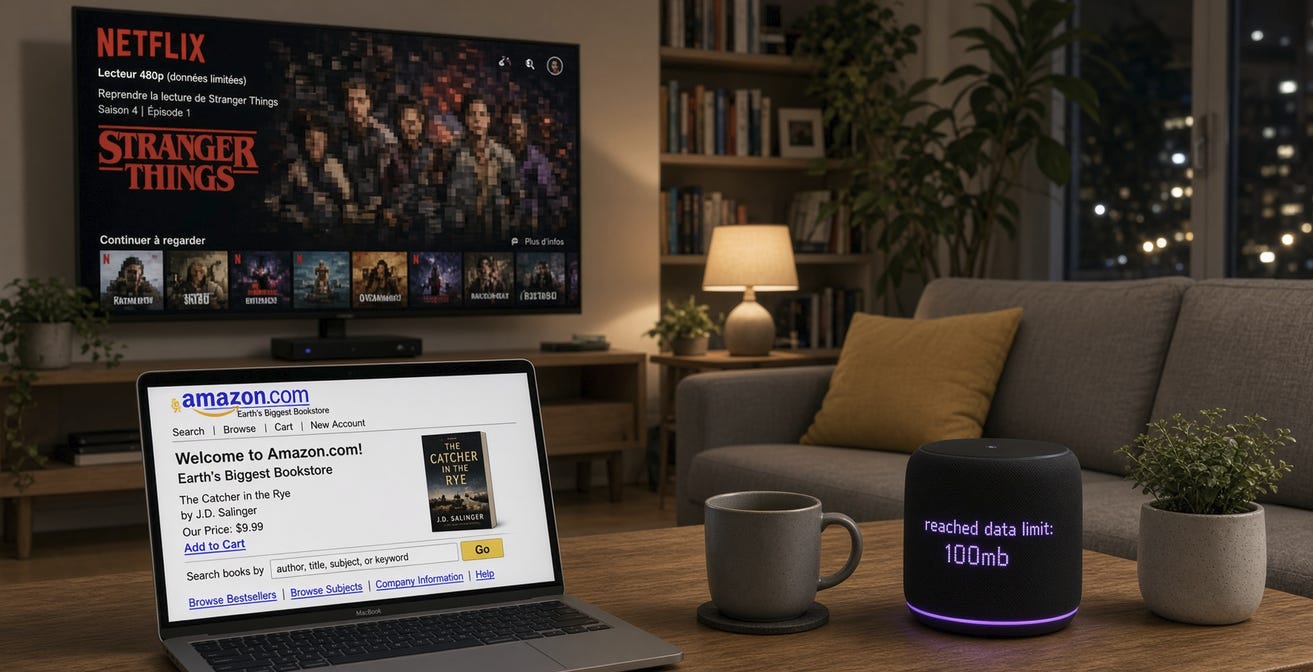
This might be a near future French living room. A whopping 480 pixel Netflix movie watching experience. An Amazon interface back to the basics and smart speakers that have data limits. France is proposing a “data tax”. It’s not law yet but a proposal.
The idea is they charge a €0.055 tax on every GB.
Here are a few examples of what this will now cost:
You watch a 2-hour Netflix movie in 4K? Up to 0.77 € in gross tax on the data transmitted.
You download a 150 GB video game? 8.25 €.
You retrieve 200 GB of personal photos stored on Google? 11 €.
You bring back 1 TB of your own files from Google Drive? 55 €.
You restore 2 TB of backups after a computer crash? 110 €.
So go start writing your “French user stories”: serve the french users lowest possible quality to save data.
Smart move in the AI age hahaa 😅Au revoir.
🛎️ Meta’s useful new ad types announced
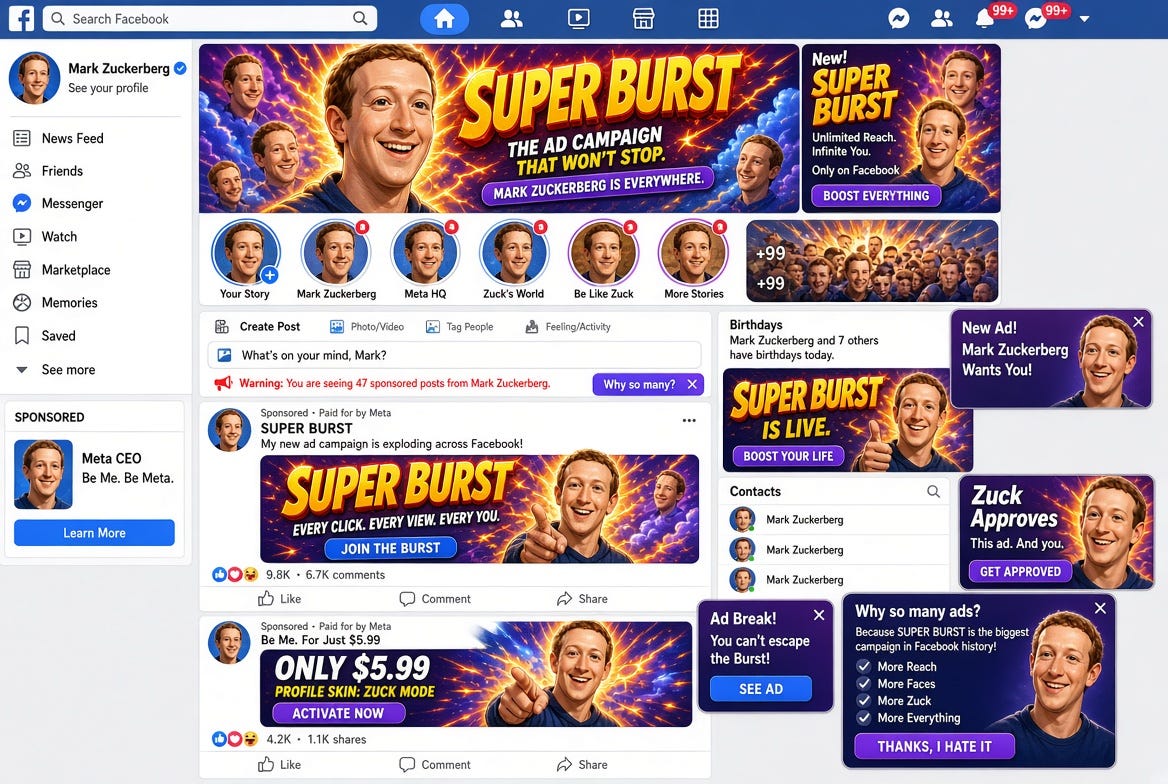
Yeah uncle Jon Loomer gives us an update on new ad types, meta announced (and some already can be used):
Meta Ads Super Burst: A high-impact product that allows brands to book 3- to 24-hour windows of guaranteed, massive reach across Facebook and Instagram. That’s cool isn’t it? its a bit like a “lightning strike” campaign I wrote in earlier newsletters. Can be helpful if you build categories (or brands) especially as it includes an option for category exclusivity, ensuring competitor ads do not run alongside yours during that window.
First impression ads: an ad that guarantees a brand’s ad is the very first sponsored post a user sees when opening their Facebook Feed on a given day. Also nice one, as you are at that moment still a little less “ad fatigue” and it’s a great way to show one time deals or show sense of urgency kind of ads.
Aggregrated view time: an ad performance and attention metric. Instead of evaluating isolated single views (like 2-second or 3-second video plays), it accumulates the total time a user spends engaging with a brand’s ads across an entire week. I think very very useful for deeper audience insights and smarter retargeting. It also further emphasizing the importance of video content built around multiple hooks. So if you record videos soon take this already with you in the briefings.
Checkout Jon’s video:
🔍mr Chris Long on leadership and SEO/AEO
Mr Chris Long a well known SEO expert, had a nice tweet or “X” not sure how you call it these days.
Take a look with me. His post made me think🧐.
I had to read it twice but I get his meaning.
His idea: if you had unlimited CMO budget, you’d build an “AEO pod”, a dream squad the following way:.
A director of SEO in the lead, plus PR, social, product, content ops and documentation, all sharing KPIs and a slack channel.
Now I like that idea but I think (but just forming thoughts now) it’s a bit too much SEO/managerial focused, I think. AI search isn’t a channel you can hand to one team.
It’s an outcome your whole company produces, whether you organise for it or not.
So Isn’t it better to organise around a question, not a function?
Pick one question you want to win, give it one owner, borrow a few hours a week from development, product and PR, add a small pre-approved budget and learn every week.
Chris writes:
Director Level SEO (Team Lead): They are the only team member that has the skillset to navigate the confluence content, technical + strategy that's needed. Most AI systems still ground from search. Bias but the only role that I think i qualified to lead the charge of teams.
Now that’s something for example I think I can do, but isn’t it better if more people in a team get also these skills? Does it not give better outcomes and isn’t that more future proof for a company? Do, we need another layer of managers? I don’t think so in many cases.
That’s more my idea, I think, but do read Chris’idea as it’s a nice starting point for thoughts on this.
Details:

🧐Book summary → Zero Click Marketing: a summary of the first 7 chapters


I bought this book: zero click marketing already weeks ago, and it was delivered now. It’s great. You get an audio, digital and printed version. Awesome. I started with the audio version for now and I am at chapter 7 currently. Every day when I bike I put it on and listen a few chapters.
Besides the very annoying political and social economic views of the author’s that are mixed with the valuable content in the book: it seems so far a really, really good book, tons of value. Just think the political views shouldn’t be in such a good business related book.
I will start summarize my learnings as from this week, things I want to remember or do something with. Here are these things from chapter 1-7:
The fastest growing ad spend is in ads nobody clicks: display, social and video work by being seen, not clicked (note to myself, check this). Platforms count a “view-through conversion” when someone saw an ad and later bought, even without clicking. That lets them claim sales from people who would have bought anyway, so the reported results look better than reality. The only way to find out what an ad really adds is to lower spend for a while and see whether sales actually drop.
Zero clicks, not zero influence: use Aaker’s pyramid (problem aware → brand aware → preference → loyalty, see picture in the gallery) to decide which audience state you want to change and pick tactics for that state. Real buyers don’t climb it step by step: they bounce like a pinball between feeds, friends, search, AI and stores, hitting dozens of touchpoints in random order before buying.
Analytics only sees the last one. “Direct” traffic hides much of the rest: in their tests, 100% of visits from TikTok, WhatsApp, Slack and Discord were recorded as direct, as were about 70% of AI visits. Those hidden AI visits converted at roughly 10%, versus 2.5% on averageThis one I really like because it amplifies a point I am making already for a long time and even enhances it, and I think every company should create a team to dive into this part: your audience is bigger than your buyers:
It falls into four groups: current customers, potential customers, potential amplifiers (journalists, niche writers, podcasters, creators, event organizers, even influential sources outside your field), and the broader community (people who follow your field but will never buy, and members who don’t post publicly but influence others privately).
Amplifiers almost never become customers, but they shape what your buyers see, trust and remember. If you only research buyers, you miss a large part of what drives demand, and you keep reaching only the people who already follow you. Exactly my point and I know from experience almost always ignored or forgotten, also by real expensive agency’s.Research four things, with the right methods: who they are (demographics and psychographics), what they do (behaviors), who and what influences them, and what they care about (topics, preferences, objections). Sources of influence are the most underused: fewer than 15% of marketers even try to find them. Treat those sources as a separate audience with their own motivations; pitching a journalist is nothing like selling to a buyer. Also consume the same media your audience does, to understand their world. Focus groups, post-purchase surveys and the highest-paid person’s opinion are poor sources. Passive data (clickstream, follower graphs) and well-designed surveys are good. Verify sources yourself rather than asking ChatGPT, and only research what you need for a decision.
Choose channels first, then specific influential sources within them, then tactics. Prioritize where audience attention overlaps with your team’s strengths. Messaging for organic channels should differ from sales messaging (the CFO message doesn’t spread). Four messaging goals: awareness, amplification, resonance, trust.
Stop putting most of the budget into whatever shows up in analytics, and invest at least as seriously in native content and other influence that doesn’t produce clicks.
Google is the finish line, not the source: search engines send about 75% of all trackable referrals, so search looks like your best channel. But around 30% of Google searches are navigational and about 50% are for brands people already know, so search mostly captures demand that was created elsewhere (feeds, friends, podcasts, AI). If you judge channels by who sent the last visit, you end up feeding search and cutting the channels that create demand. Growth in branded search and direct traffic is a better sign that your upstream marketing works.
Later more on the book, when I read or listened to more chapters. I think it’s a very useful book to use in strategy and content related sessions.
🧐Europe researches, the global south produces
This is quite fun. the new way of analyzing data. OpenAI just released usage data figures, and if you just upload it in any LLM, like I did it in Claude, you can just ask questions about it with any lens you like. I used the crossborder lens, and asked Claude to give find me “crossborder e-commerce and digital marketing insights”
It’s fun to do and learn, see if you can find hidden data gems or changing user behavior.
TIP: AI’s first read of these files sounds sure but needs checking. Ask it to show the rows it used for example, verify one number yourself, and/or use deep research and/or ask validation. Stay awake :)
Some findings I got out of it related to my crossborder e-commerce questions:
There isn’t one “AI shopper”. Looking at how countries use chatgpt for commerce, I (so Claude in this case) see different worlds:
In Europe, chatgpt is turning into a search engine. 27–30% of personal prompts are information and product questions, and that share keeps growing (France +5 points in two years (I wonder how long that remains with the GB tax (haha😅) ). in Brazil, Indonesia, Thailand and Nigeria it’s going the other way.
Emerging markets use AI as production capacity. About half of their work prompts are “do this for me” tasks, vs ~40–44% in Europe.
Who sells, who buys? I let Claude compare two types of work prompts. Selling prompts are things like “write a product description for my webshop“ or “make an instagram post for our new collection“. Buying prompts are things like “compare these three suppliers“ or “is €12 a fair price for this per unit?“.
In Brazil, for every buying prompt there are almost 4 selling prompts; in Nigeria 3.4. Belgium and France are much more balanced at 1.2–1.4 selling prompts per buying prompt.
The Netherlands stands out at 2.3, far more seller-minded than our neighbours. Still a trading nation after all?Buyers are arming themselves faster than sellers. Prompts about pricing goods almost doubled since early 2025, and negotiating and purchasing are up ~50%. creating marketing materials? Flat.
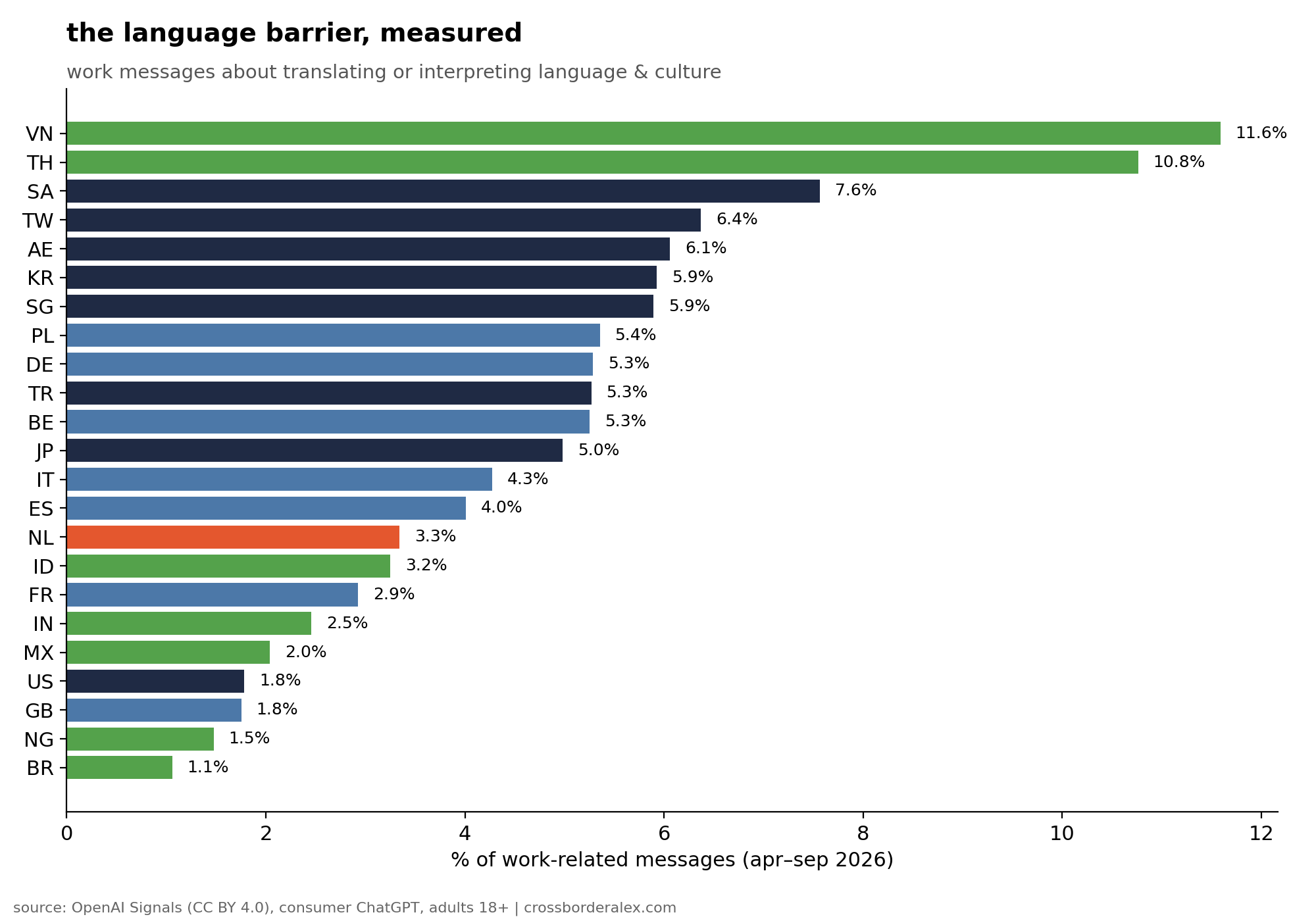
The language barrier: in Vietnam and Thailand 11–12% of work prompts are translation. in the US and UK it’s under 2%. that’s basically a map of who needs AI to sell to the West I guess.
AI use mirrors the economy, I think, Where growth comes from small sellers hunting for customers, like Brazil or Nigeria, AI becomes the copywriter that helps (internationally).
In Belgium or France, AI becomes a tool to compare, check prices and negotiate.
Try it yourself find the dataset here and ask anyting about it with your favorite LLM. I think also cool OpenAI does it like this, you can create your own press release or digital PR with it even, for your local niche.
https://openai.com/signals/data-download/
🌐Connected Apps connect your app to Google’s ecosystem (Gemini)
For everyone with a digital service and (retail) activities, this is an important announcement you cannot miss, so read on.
You can now build apps (using MCP) that can be used directly inside Google Search and Gemini. Google announced the Connected Apps Platform. When approved, users link your app once and can access their data and take actions in your service seamlessly from Google's products.
I share it here because I think it’s important to know early and try and test with it now. It also gives a glimpse in the near future, this can be huge, I think and I think Google also thinks so. So this is the time where you can leapfrog and learn from use cases like re-ordering groceries, reservations via agents and all the things that have written the past few years on helpful AI assistants.
Yeah Google (Sundar) said it himself:
“Search would be an agent manager, right, in which you’re doing a lot of things”.
This starts now. I think and the sooner you start testing and trying the more you learn and the more you leapfrog.
Details: https://blog.google/innovation-and-ai/technology/developers-tools/connected-apps-one-place
💡19 LinkedIn content distribution tips from Pierre worth a read


Ok, I do it again because it’s good and useful! Pierre made a great guide (again!) but this time on LinkedIN distribution and content strategy. Just go visit, the text combines great visuals you can use developing your own strategy such as: (and I copy paste a few):
Tip #7: Use posts to start conversations
For each post, identify 10 people who might benefit from the insights shared. Send it to them with a personal note without expecting anything in return (just help).
Tip #9: Set up your posting rituals (like your own TV show)
Make sure to publish every day at the exact same time (for example, 10am). People usually log in at the same time, so this creates a habit for them to read and like your post.
Tip #11: Republish after at least 3 months (but rewrite it slightly)
Look at your best-performing posts from more than 3 months ago. Change the hook, add a photo, and update at least 30% of the text.
Tip #12: Build a team-led content strategy
Pick at least 3 people from your team (start with the C-suite and then expand). Each of them publishes educational and personal brand content on their own topics.
Tip #15: Optimize for saves and dwell time (they drive reach)
The algorithm loves it when people save your posts and spend time on them (it triggers a quality signal). Create dense, high-value content and make it skimmable so people spend time on it and save it.
Go read all of Pierres newsletter ⬇️⬇️⬇️

🇮🇳 Search Central event in Bengaluru
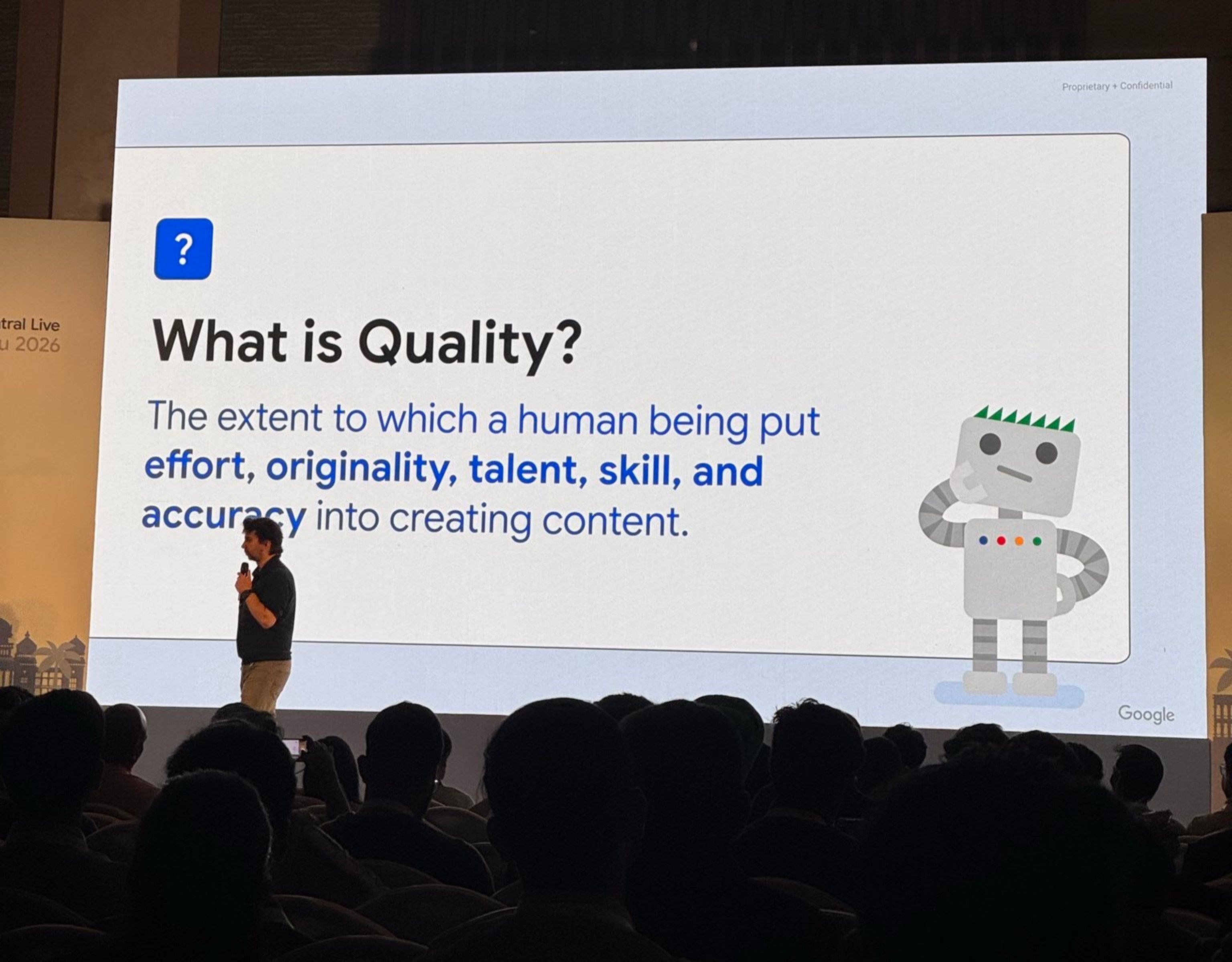
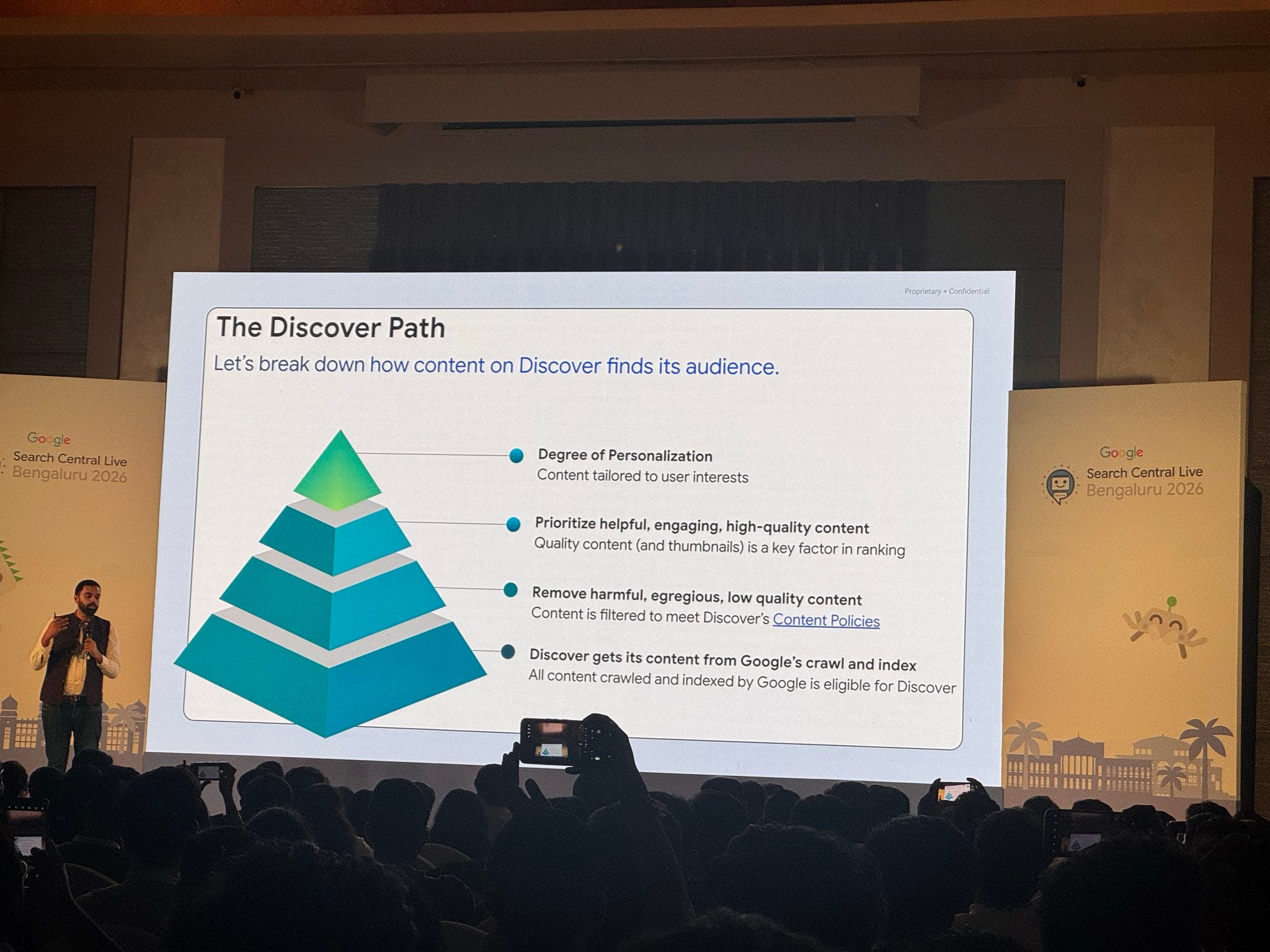
I have written it here many times, and I share this slide from a Bangalore SEO event, a slide from a Googler. We should focus on: yes, quality.
Nice visual of “how content get’s into “discover”, and believe me, many companies want to be in “discover” so take note of this slide:
Laste one is more on the crossborder topic:
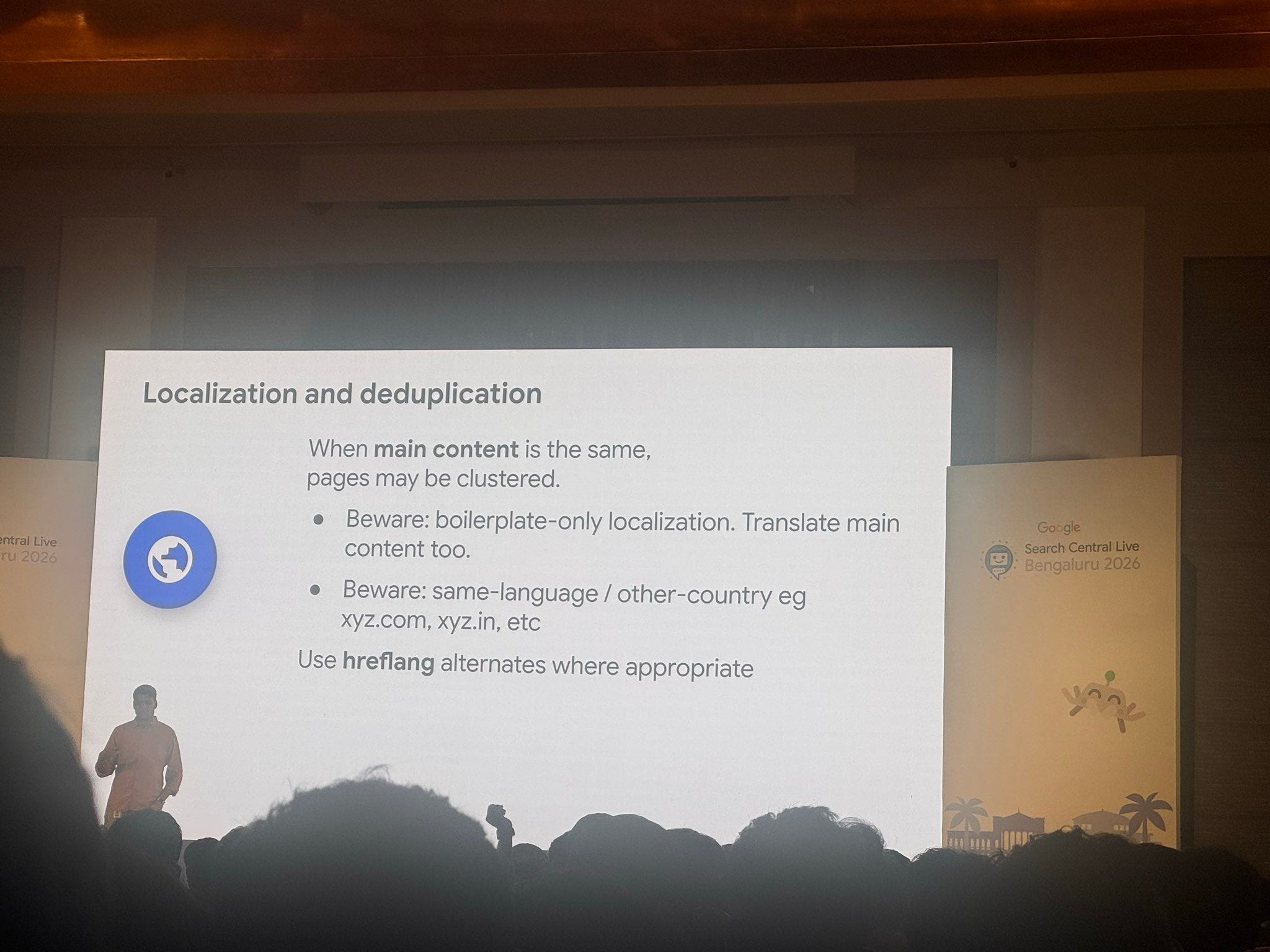
When Google detects that the main content across different URLs is identical or nearly identical, it groups (clusters) those pages together to avoid showing duplicate search results. Makes sense, but good to have this slide if you are in a crossborder project:
Thanks for reading Crossborder Alex : Global Marketing & E-commerce! Subscribe for free to receive new posts and support my work.
Interested in more? Checkout my archive!
Use my vibe coded search engine to find content tailored to you, I improved the search engine a bit. Let me know what you think.
Do you want to support me? Consider taking an American Express Card via this referer URL. It benefits us both and makes it possible for me to travel and share more on this substack. Thank you. American Express is -also in Europe- a great way to get travel perks but you really speed up the points and perks by referals.