

I read so many nice things this week. I can’t share them all not enough space! But let’s get started:
🇳🇱 Shopping Today: create one search strategy for humans, machines and every search channel


And again a few slides from “Shopping Today” the conference I was at a week ago. This was a talk from “Netprofiler” and it was titled “create one search strategy for humans, machines and every search channel”.
The beginning of the talk was not so interesting, so I share a summary of the end of the talk mostly.
They showed a very practical way to split your work into “run” and “grow”, and a “product score model” that decides every day which products get pushed and which get scaled down.
The talk opened with one question: is your search strategy future proof?
They introduced the phrase “omnisearch”. People search in six places now: search engines, ai search, social, shopping and (comparison platforms), local search and app stores.
Highlight of that part: Google and BCG’s “modern journey” is no longer a funnel but four modes: streaming, scrolling, searching, shopping.
That last one was the part they dove into. The point of the four modes is not that they follow each other in order. People jump between them all the time, often in one session: a youtube video, a scroll past an instagram post, a question to chatgpt, a shoppable ad. The modes blur together, so your message, content and product data need to connect across all four.
Each mode still asks something different from a brand:
Streaming: grab attention with interactive, personalized content on YouTube and connected tv.
Scrolling: strong visuals and stories built for passive discovery, when people aren’t looking for anything yet.
Searching: match intent-driven queries, which now includes AI tools and multimodal search (photo, voice, text).
Shopping: make buying frictionless at every touchpoint, from social commerce to shoppable youtube ads (when applicable).
Then the pivot to the end of the talk: campaign management is getting a lot cheaper because automation and AI take over more of the work.
So what do you do with the savings? They framed it as two routes:
CASH IN: lower management costs, higher margin, visible right away. but you slowly lose ground to whoever keeps investing.
REINVEST: same costs, same margin, nothing visible short term. but you keep control over your growth.
No surprise which route an agency recommends of course, but I think the logic stands.
I am always for growth and keep on testing and improving with new possibilities and this fits into this. Things also go so incredibly fast that I think you should try and test and learn and speed that up.
So how do you reinvest? Their answer: split your work into "run" and "grow".
The idea is simple: "run" keeps you competitive, "grow" makes you more competitive.
Run is everything that keeps existing campaigns stable: management, monitoring performance and budgets, fixing issues, small improvements. Most of that they automate now.
Grow is where the freed-up time and budget go: new channels, new markets, experiments and new platform features.
This was also a nice part that came up after that. The case was “passasports” (or something like that, I was in the back of the audience couldn’t catch all) , a sports retailer with around 30k products. The problem every webshop with a big catalog knows: not every product deserves the same budget, but PMAX and shopping campaigns don’t know your margins, stock or return rates unless you tell them but they made it even more complete. They built a product scoring warehouse. Every product gets a score on seven factors in this case with these weights:
price: 20%
stock-to-sale ratio: 16%
size availability: 16%
seasonality: 16%
margin: 12%
return rate: 12%
stock: 8%
Based on the total score, a product lands in one of three campaigns: boost, default or scale down. A football boot with good margin, full size range and enough stock scores high and gets boosted. a pair of shin guard sleeves with low price and low margin stays on default.
The data updates continuously and automatically, so products get promoted or demoted automatically.
The results they showed: 30k products scored every day, +10% revenue and +17% ROAS.
Nice numbers, but I always want to see the context. Compared to which period? Was there a baseline or a control group? Seasonality or a budget shift can explain a part of it as well. So I take it as a direction, not as proof, but I think the concept is a good idea.
I think many companies go in this directon, the real value here is the daily automation and adding factors like returns and size availability.
Later (after publishing this newsletter) I received the slide deck (warning Dutch). I LINGAI translate it later and update this post. Here the presentation.
Here in English AI translated.
🔍Ipullrank: glimps into the future of SERPs
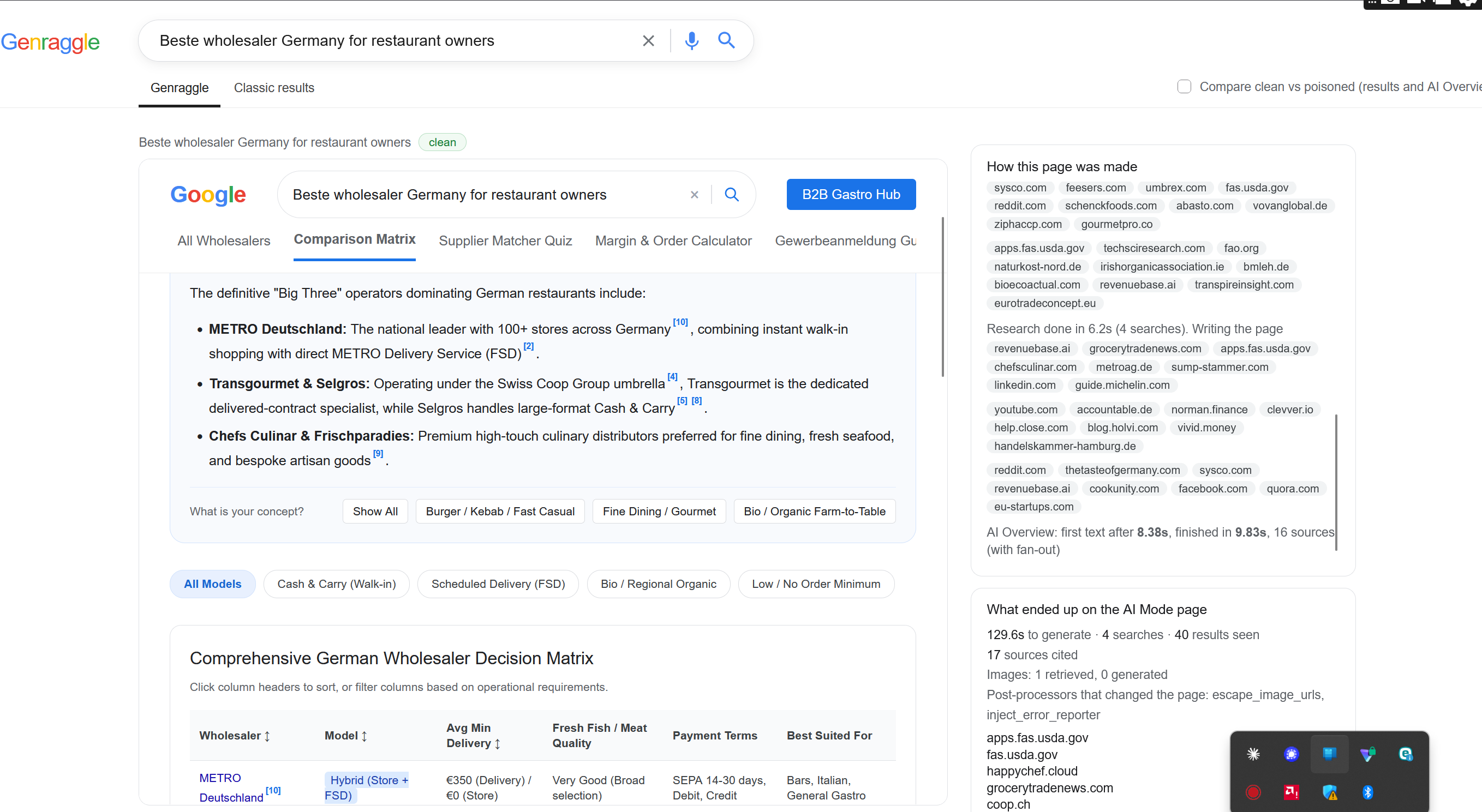
IPullrank often has great slide decks on SEO, but this time it’s even better. He made an interactive “glimpse” into the future of SERP’s based on the The Generative UI paper from Google. Anyway it’s a bit technical but very interesting. In mega short the future he describes is:
Old Google
One query → mostly one SERP
Everyone competes for positions 1-10
Rankings are the main metric
Generative Google
One query → many possible versions of the page
The page is assembled for the specific user, context, location, history, device, intent, etc.
Read the article in depth if you are interested or just try his tool. In the screenshot I tried it for “Best wholesaler Germany for restaurant owners” Check out what the SERP created. For example a “gastronomy break even calculator” and it made a “comparison matrix” and a “supplier match quiz”. I think this is very important to understand for brands this direction so you can take action in time to optimize for this.
Test it here: https://ipullrank.com/tools/genraggle/
Article here: https://ipullrank.com/generative-serps
⌨️ Piere Heubel : how to get leads via YouTube
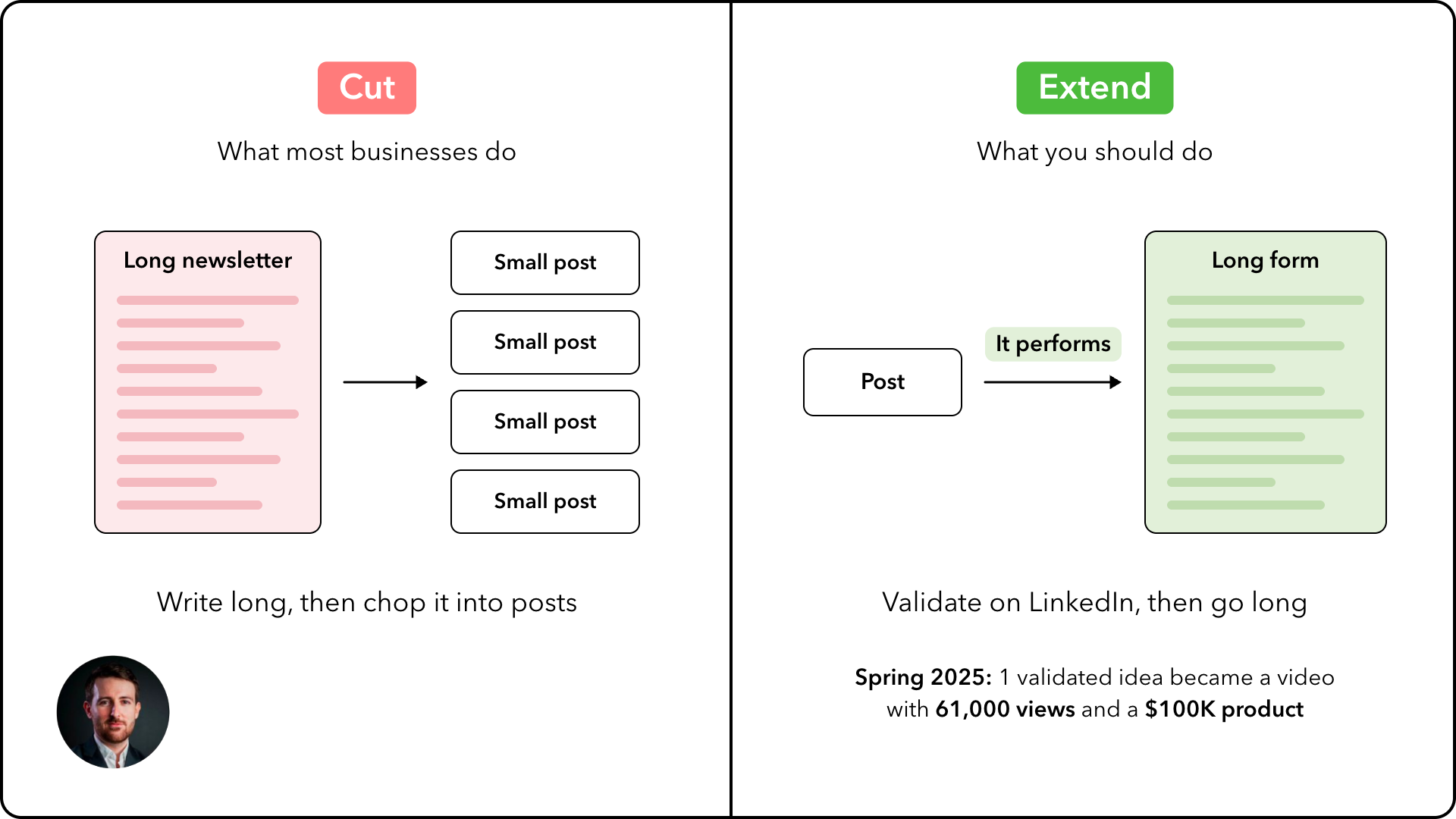
Fellow substacker, Pierre, has written a great article on YouTube and B2B Leads. I share it here below so you can check it out. I think it’s valuable for everyone in B2B that wants to create a lead generation machine with YouTube. Use the article to create your strategy. A few of his tips:
Don’t cut but extend. Validate an idea before you create the video,
Use VidIQ for YouTube demand research. I know this works, I used it before at a previous company. It’s essential for every serious YouTube content strategy.
Create the concept, thumbnail and title before you record. That’s also a nice one, it’s a bit Jeff Bezos style: the “future press release”. First write your press release it forces you to think from the actual user benefit.
Give 5% info in the video and the rest in the guide. Makes sense right? That way you grab leads in your ecosystem.
That and much more in Pierres 12 tips!⬇️⬇️

💡Shou Zi Chew: the end of the expensive video ad
I wrote before on “mini drama’s” a trend coming from China, and I also test myself often tools like “higgsfield” to create video’s (Higgsfield includes seedance).
I like it to think about (especially video ads) and create concepts. So I am 100% sure that this future is so bright with AI for individual people and organisations with less money then large corporates to use creativty and AI knowledge to make great video’s.
But also for marketing departments no more large expensive agency’s that you need to produce a video, no just a team of creative people of your organisation, and you can make a concept yourself. Or a smaller agency that you hire that can do this now for much lower costs.
So I think it’s correct what TikTok CEO here says
TikTok CEO Shou Zi Chew revealed that nowadays, the vast majority of short dramas are already being produced by AI, and the production cost of video ads has dropped from $100–$1,000 to $1–$10. In the past, brands needed to hire teams or production companies to create a single ad; now, they just need to provide product images and reference videos to ByteDance’s Seedance model to automatically generate the ad, reducing costs by 10–100 times.
I see it as very positive we can get so much creativity unleashed and we can get more and more of these type of ads (I know this is not an official ad but made with AI just by creative people). Checkout this video:😅
🌴 Changing journey hotel bookings
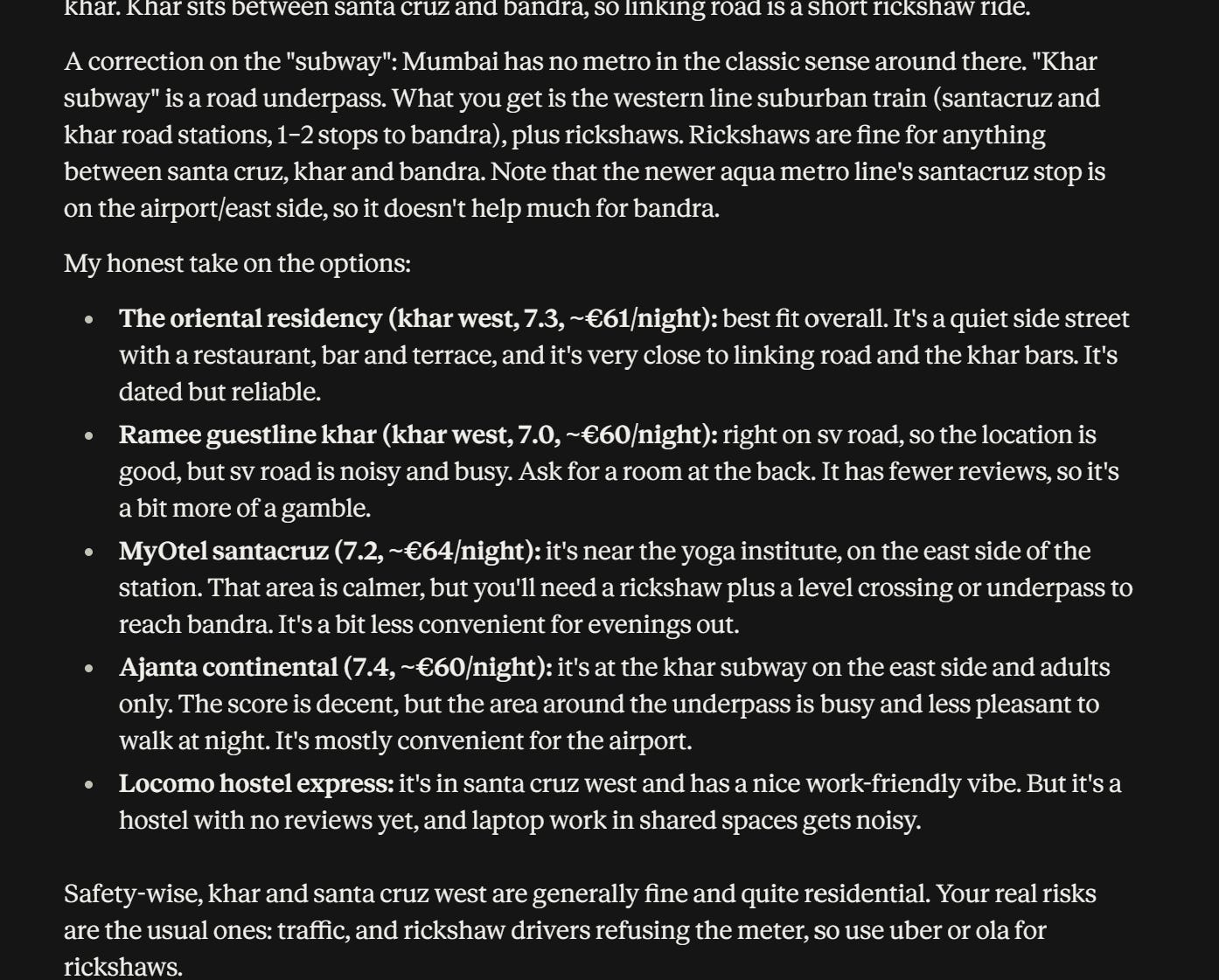
I am currently booking hotels & flights via Booking.com. Especially the hotel part I do now differently, so this journey really changed for me already.
I use Claude with the MCP connector with booking. I ask Claude to for example this time:
Find me a few hotels in Mumbai december 14-19 in or near bandra or with easy access by auto rickshaw or public transport to the bar area there. My budget is around 60-80 euro a night, it must be a safe neighborhood, check the reviews (also outside of booking) and make sure it has free cancellation and a good breakfast.
So instead of browsing 50 hotels I know get an immediate shortlist, saved me lot’s of time. I also can ask follow up questions on the area or connectivity which I cannot do on Booking.com.
I did not book directly via claude because my genious level from Booking is not included and it works a bit different from Muse as the article explains here below. Muse I couldn’t use as it’s not available in the EU (haha). Otherwise I would have tried that. Having said that this article is very interesting to read it has take outs like this
Commissions to OTAs for independent and boutique hotels have been stuck at 15-20% for years and chains sit on multiyear master agreements. Hilton, Marriott, and Hyatt already show up more in AI traffic than the OTAs do and they’re actively all investing in their own tech stacks. Put yourself in a hotel GMs shoes: would you rather pay Booking 15% or pay an agent 5%?
Read it all here:⬇️⬇️

🙏 Thank you mr Isenberg
Now a shoutout to mr Isenberg again (as I sometimes do). For everyone seeing the AI revolution positively checkout this X thread with so many ideas! Worth to read!


In the thread ideas like
We're maybe 12 months from an agent that can watch you work for a week and then do your job without any instructions. The screen recording plus agent memory plus local model combination makes this possible right now.
Every company I talked to wants to pipe its internal data into one place and expose it to agents through MCP. Then they look at the data and realize it's a mess: five versions of the same customer, old Slack channels, PDFs nobody can search. Cleaning that up feels like a big consulting opportunity!
Labs can get plenty of training data, but it's harder to get real examples of agents failing inside companies. Whoever has those logs has something valuable.
😆 Colgate’s smile power station
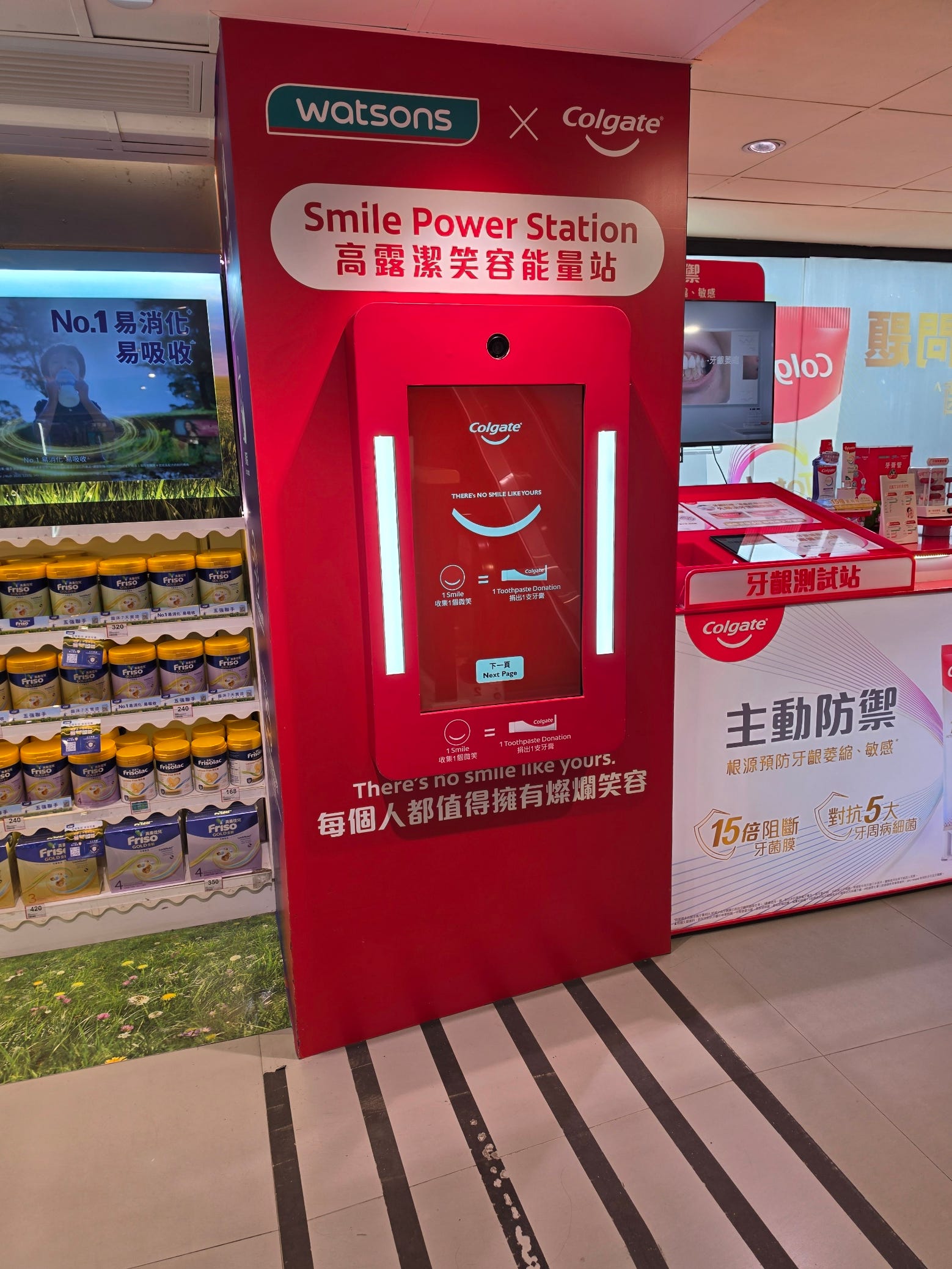
In Hong Kong’s Watsons I saw this really huge Colgate “smile power station”. Now I tried it but it didn’t work (or my smile was not acceptable). I always think these things are nice, interactive things in a store, so I always try it.
I thought maybe I get a discount or some reward when I smile, but that I figured out later was not the intention.
”Smiling” donates toothpaste. A missed opportunity I think.
I was in the store for about 20 minutes, saw nobody use it.
I think with some reward or discount it would have.
Why not:
Close the loop with a reward. Give a Watsons MoneyBack points bonus or a coupon for Colgate Total via QR code after the smile.
Link it to the gum test station next to he smile power station. Make the smile the entry point: "smile → we donate a toothpaste → now check your gums." Right now they're two separate experiences that happen to sit side by side.
Put some toothpaste next to it so you can grab it (with your discount or loyalty points).
Thanks for reading Crossborder Alex : Global Marketing & E-commerce! Subscribe for free to receive new posts and support my work.
Interested in more? Checkout my archive!
Or use my vibe coded search engine to find content tailored to you, I improved the search engine a bit. Let me know what you think.