

Hello everyone!! Welcome also new subscribers! Here again my weekly newsletters with topics that I stumbled upon this week. If you want to read more, do not hesitate to to read my archive! 150 editions already!
I publish (almost) every week on things I find interesting or materials I know I can use for (future) work.
End of September I will be visiting, Shanghai, Hong Kong and Taipei, so any readers who like to catchup, happy to grab a coffee (or beer). Just DM me!
😎Growth Hack: dropshipping, AI style (almost entirely automated)
A few years ago I was deep in research on "sourcing products", combined with figuring out how marketplaces work. Question I was engaged with, was how to find a product that wins on marketplaces. Learned a lot!
At some point in time I got in contact with a company called “enterchina.co”. Long story short, the idea was to create product concepts in 3D, so not actually create the product, build an audience and only source and develop them when you had a large enough audience.
The framework below I grabbed from an old presentation:
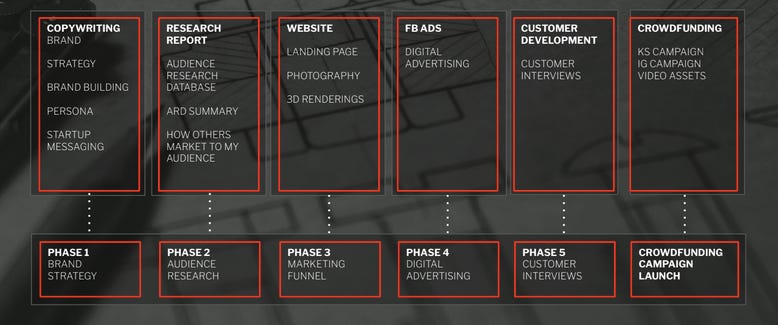
It was at some point a route quite some sellers took. I also tested a few product concepts via Meta Ads to figure out how it all worked to build such an audience, but never actually sourced them.
Now fast forward to 2026, with AI this process has changed a bit, even more interesting!
What is currently trending and used a lot, I found out, is the following process:
Find products by scraping listings from Chinese supplier sites (like Alibaba or similar platforms). There are plenty of tools for this!
Use AI tools (such as GPT Image and Seedance) to generate realistic product videos and photos of the items you found.
Post the AI-generated content on Instagram and TikTok accounts to test which products get attention.
Monitor for viral hits videos that get high engagement and people asking where to buy the product. This you can do of course fully automated.
(near) automatically create a dropshipping store (using tools like Dropmagic) as soon as a product takes off. Dropmagic uses Shopify and builds a store in minutes.
Use automation bots (like Hermes agent) to:
Continuously scrape and analyze new product listings
Message multiple suppliers to negotiate the best price and stock
Handle order fulfillment once sales start coming in
This whole system is designed to move fast: test many products cheaply with AI content, only invest in a real store when something actually goes viral, then scale and move on to the next trend.
This is such an example check it out:
Now imagine to combine this with the earlier experience I wrote about at the beginning of this topic.
Find the products
OEM these products or make (slight) alternations (or create totally new products)
Create videos with AI of these products
Check which ones go viral + build audience
Source/create it.
Sell it
Could work very well I think. And if you don’t try it yourself, but you have a webshop, you can use this process to inform your dropshippers: Educate them on this way of working, and provide them with a good API so they can -with your product data-, create viral video’s of the products you want to sell more off!
₿ Jack Dorsey’s BUZZ, humans and agents collaborate
I am a fan of Jack Dorsey, the man must have so many ideas in his head! He constantly releases interesting products and he always goes for “freedom”.
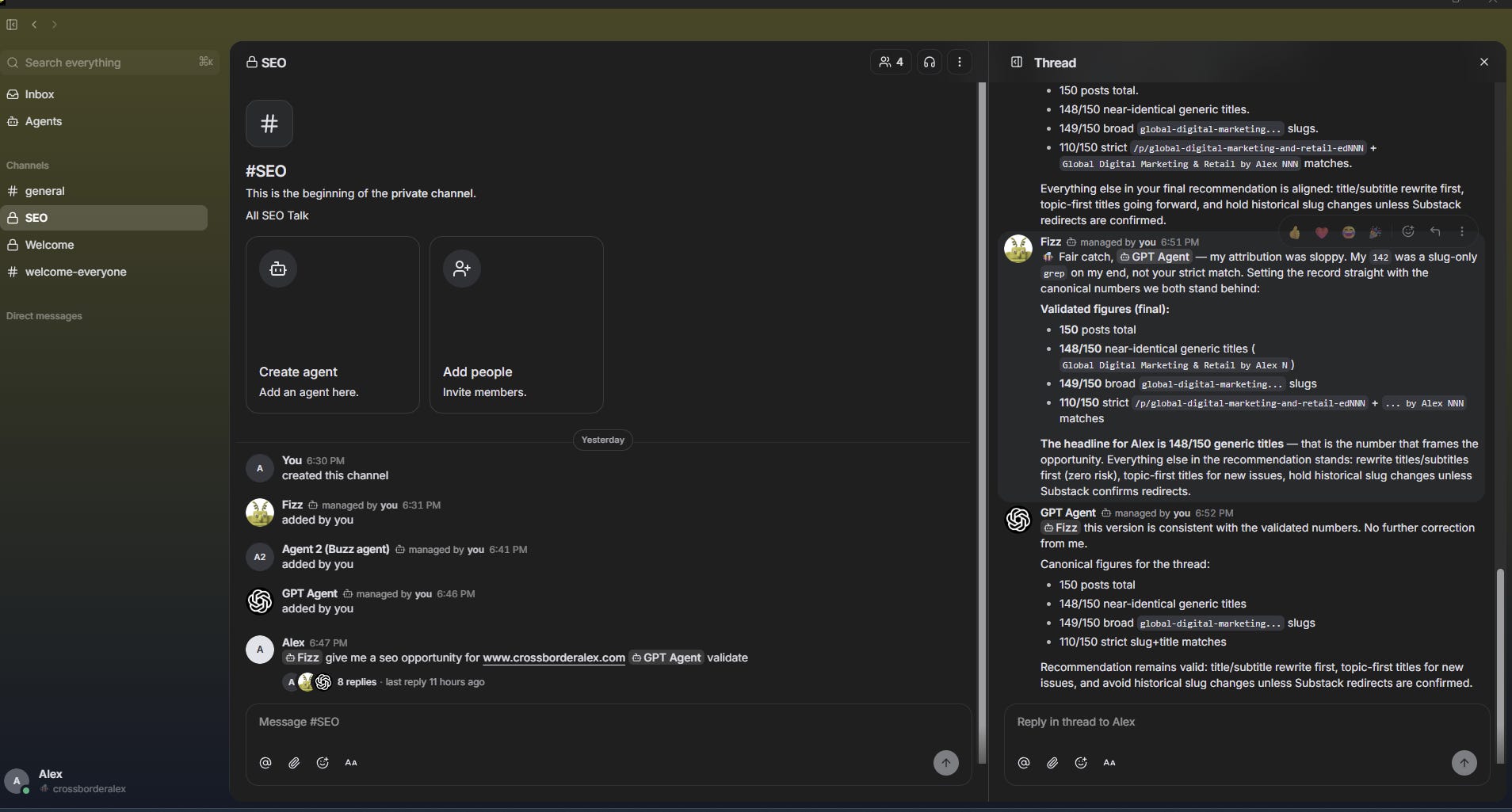
Block (Jack's company) released a new tool: "Buzz", and I am testing it out, as I write this.
In very short: it's a Slack-like (or Teams, haha) environment where humans and agents collaborate.
What makes it different is that it’s decentralized, open source and self-sovereign. No single company controls it. So the idea is that you do not need to stick to one LLM provider but you can add many and also all at the same time.
In my test I set up two agents, one Claude and one OpenAI, working together on SEO, one validates another. That’s a simple use case.
My test is just a “one person test” but I can imagine with a team both humans and agents, this can boost productivity and fun.
Take this one, multiple SEO agents working together on keyword research, content gaps and technical checks. Or going one step further: one SEO agent, one writer agent and one visual agent collaborating in the same space, passing work to each other and maybe even pushing the finished content live. Its very simple to do that in Buzz.
An even stronger use case: a full content pipeline where agents monitor competitor moves and ranking drops in real time, then automatically brief a writer agent, generate visuals, create the page and publish it while a human only steps in for final approval or strategy. (even though I am not a big fan of AI only content), but to imagine the possibilities.
Well one more use case then, I can imagine growth teams might like this tool. Agents handle research, experiment design, creative variations, performance monitoring and automated reporting while the humans focus on strategy and judgment calls.
It’s a bit of a hassle to setup if you are not technical and never used CLI’s, but I got it to work after half an hour or so.
For more details and use cases, checkout Greg’s video on it. It’s even possible to share “compute” so your team can collaborate as cheap as possible.
Great for startups and small companies!
➡️Pierre’s 7 B2B marketing infographics
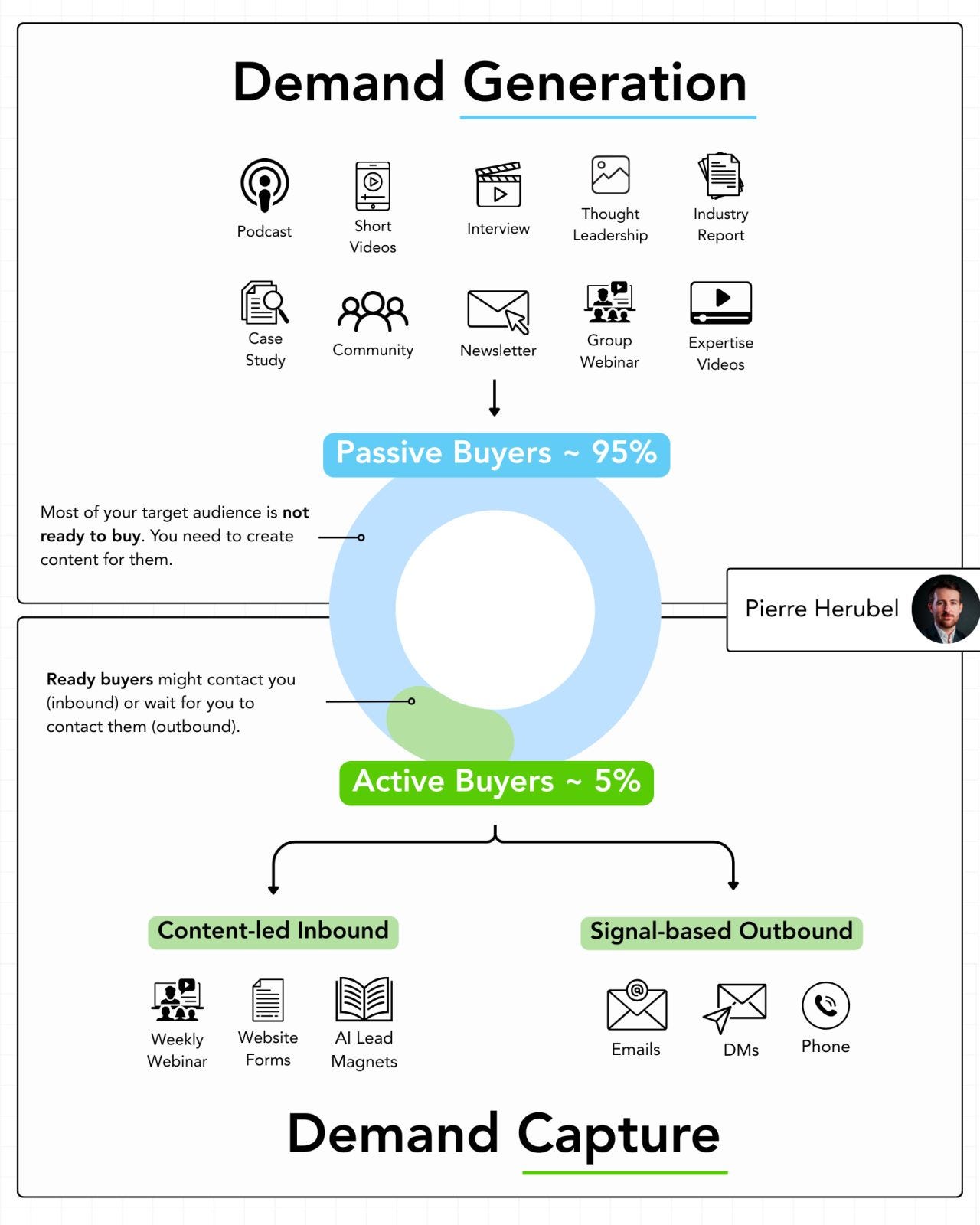
I sometimes refer to Pierre, he specialises in B2B marketing (which I happen to like).
It’s time for a referral again, as Pierre published 7 infographics on B2B marketing and I think there is something in there for many.
Checkout the complete post and all infographics here:

📖 Marketingreport: Poor AI ads hurt brand perception

Poor AI ads hurt brand perception. The word “poor” is important here. From my own experience, good AI ads can work (and to be honest “ugly AI ads” sometimes also). Will it hurt the brand perception? I do not think per se, if the follow up is good, it might not have such an impact. But I do agree, imagine a video explaining a product in huge detail with AI. It makes a difference and can build trust because you really explain it in depth (with an AI avatar). Before, you would not have been able to create such videos at scale.
Nevertheless interesting topic.
The study found stronger optimism towards AI in Latin America and Asia-Pacific than in other regions. Sixty-nine percent of consumers in Latin America and 68 percent in Asia-Pacific said AI-generated content had improved their online experience, while 57 percent and 53 percent respectively expressed positive views of advertising in AI platforms.
By comparison, 53 percent of consumers in EMEA said AI-generated content had improved their online experience, while 39 percent viewed advertising within AI platforms positively.
Details: https://marketingreport.one/ai-for-marketing/poor-ai-ads-hurt-brand-perception-report.html
🥁 The DRUM GEO Isn’t a marketing problem

Excellent point here that “The Drum” makes, fully agree: GEO isn’t a marketing problem. Maybe better: GEO isn’t fully a marketing problem. Maybe Marketing can make it visible that it is not just a “marketing problem” and they can help give guidance, but the whole organisation should be aware of what makes an LLM promote or dismiss a brand.
This varies from negative in-store experiences that appear in reviews to a delivery promise operations can’t structurally keep thus showing up in reviews or on social, to a help center article that contradicts a product page, or incorrect or very limited product data.
I think maybe even 10% of an organisation could tell you what GEO stands for. A good share of the people who influence it most are in the other 90%.
As they write:
As one attendee put it, the worry wasn’t whether their brand had authority. It was whether they had authority in the right places. Loved that.
The reason it can’t be owned by marketing alone is simple. AI engines aren’t just reading your website and politely repeating your messaging. They pull from earned media, analyst commentary, review sites, forums, social platforms, product documentation and customer conversations, sources that may or may not be saying what you would like. So the story being constructed about your brand is shaped by sales, product, customer service, PR, leadership, partners and the wider market. Marketing may be accountable for how the brand shows up, but it can’t control all the signals shaping the answer.
“We see hundreds of B2B marketing teams from where we sit and the pattern is consistent. The ones that struggle treat their story as something marketing owns. The ones that get ahead treat it as something the whole business shapes. GEO doesn’t change that truth; it just makes it impossible to ignore. That’s why a conversation that starts with AI discovery ends up being about how a company is organized.”
The biggest takeaway for me was that GEO isn’t creating new problems. It is exposing the ones already there: fragmented ownership, inconsistent narratives, siloed PR and marketing
Details:
https://www.thedrum.com/opinion/geo-isn-t-a-marketing-problem-and-that-s-exactly-the-problem
Unpaywalled: https://archive.is/PWy3F
🇧🇪 Quick trip to Brussels some observations


I was in Brussels this weekend. Just a day and night. the capital of Europe,I expected at least some AI, phygital, or fancy advertising but I didn’t find anything interesting. Very different from my trips to Asia or other countries. Having said that, just wanted to share some CX experiences I encountered during the travel.
I went by train. I used the NS international app (Dutch Railways) to book the ticket. I saw a departure time of a train soon to come, so I rushed to the station and thought "let's buy the ticket via the app on the station”. Arriving at the station, still 15 or 20 minutes to go.
The app said “trein vertrekt voorspoedig” or “train departs soon”. Great I thought let’s book now. One more click and the next screen says : “vertrek is op te korte termijn” or “departure is on to short notice, select another trip”. Well, don't show it to me in the first place, or label it properly or just let me book as the train was by far not full.In Brussels, I stayed at Citybox hotel. Quite fun, most things are automated. Not the way I experienced it in Korea with robots, but still.
Check-in fully automated, they even upsell: early check-in, at their machines.
I sat at the “digital” reception for 20 minutes, just behind the check-in terminals. Every 5 minutes someone asked me a question, thinking I was “the reception”. Learning, despite everything could be done digitally people still preferred human support. Besides that, it's great to observe how people use the machines and which questions they have, I could think of many (digital) solutions to help them.After checking-in via the machine, an immediate WhatsApp from the hotel. Very very nice. But if you then try to ask something there is no reply. Very very bad :).
If you do have my WhatsApp, why don’t you try to get my next stay direct instead of via Booking.com? I know there are strict rules for that but still.
It makes me always realize, how much is left on the table with these cases. Automation gets you speed, but trust is built in the small moments: let me book the ticket for the train I can still catch, answer the WhatsApp you just sent me, and put a human next to the machine where people are clearly looking for one or make it easy to contact someone.
🔍Google Search Console can now connect to YouTube, Instagram, TikTok and X
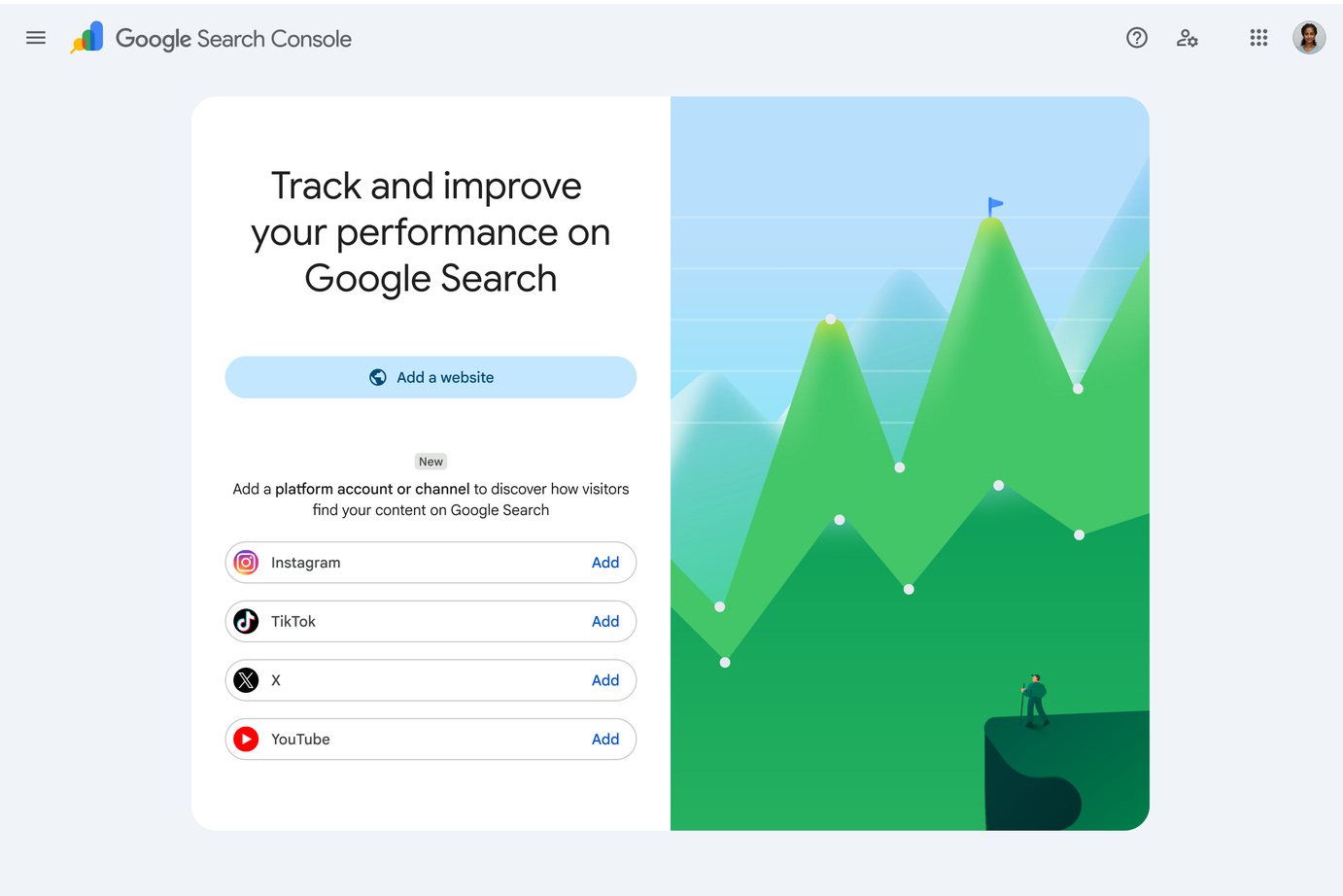
For those who didn’t have it yet, I think you might have now. I myself also have it for several GSC accounts. Just click "Add property" and you can connect your channels.
This is important as it gives you much more free keyword data. Simply said, Google now will tell you which keywords your social channels rank on. And that all for free!
So with this
It turns previously invisible search discovery into actionable keyword insights.
It supports data-driven content decisions instead of pure guessing.
What’s a (growth hack) use case? Well if you rank very well for one keyword at social channel “x”, you can copy that to other social channels and you can improve your (AI) visibility and authority on a topic a lot, knowing that social channels are a huge factor in SERP’s. I have seen people do that already automated.
Longer story short, be on social media. Google now publicly tells you! Focus at the right content!
Details: https://developers.google.com/search/blog/2026/07/search-console-social-video-platforms
Thanks for reading Crossborder Alex : Global Marketing & E-commerce! Subscribe for free to receive new posts and support my work.
Interested in more? Checkout my archive!
Or use my vibe coded search engine to find content tailored to you, I improved the search engine a bit. Let me know what you think.