

💸Stripe Sessions: Why the battle for agentic commerce isn’t about AI→ it’s about who owns the payment credentials
I like watching keynotes. It helps me being creative, see where things are heading. The Stripe keynote does an excellent job on that. So many product updates in it, I didn’t count them but appearantly there were 288!!
Worth a watch. The highlights for me:
There’s a huge huge amount of new companies started in 2026! Largely because of AI. That’s nice a lot of innovation boosters I think.
Link Agent Wallet the big announcement and releated to the heading of this post. You can now grant agents the ability to pay with Link's agent wallet, while maintaining control via spending approvals and full purchase visibility.
So what is happening there:
Until now, AI helped you decide what to buy. A human still clicked pay. That’s the part that’s changing. The broader trend is that the purchase itself is becoming automated an agent buys on your behalf, within rules you set upfront. Spending cap, approved categories, specific merchants. You just get the receipt. Stripe demonstrated this with two agents performing a real value exchange (one building/selling, one buying) autonomously.
The bigger point isn’t about Stripe specifically. It’s that the question for any commerce business is shifting from “can the customer find and buy from us” to “can the agent.” Structured product data, machine-readable catalogs, showing up in the right places that’s where the real work is. The payment rail is almost secondary.
We’re early. But the direction is clear. Although even stripe acknowledged they do not know when agentic payments will take off, but they re-assured with Stripe you are ready for it.
Stripe Console. It’s an AI assistant built directly into your Stripe Dashboard. You ask it a business question in plain English “why did my conversion drop this week?” and it investigates across your data and gives you a structured answer. But it also acts. You can tell it to create a product, issue a refund, pull a report and it does it, asking you to confirm before anything consequential happens.
Checkout Studio and how it handles A/B testing. They demo-ed (is that a word?) setting up a test for Pix, Brazil’s instant payment method just by asking. No engineering ticket, no manual experiment setup. The system runs the test, tracks statistical significance automatically, and tells you whether adding a local payment method actually lifts conversion. For anyone selling cross-border, this is great.
For in-store and restaurant experiences: Stripe announced the Reader T600 a countertop payment terminal with an eight-inch screen that can run custom apps. Not to be confused with those ordering tablets you tap through at the table (common in Asia, and increasingly in NL too). This one sits at checkout. But the idea is similar that screen isn't dead space anymore. At the moment you pay, it can show your loyalty points, suggest an add-on, or prompt you to sign up for a membership.
Remember Libra? Meta’s attempt to build its own payment and crypto ecosystem? It got a lot of drawback, never launched.Now Meta takes a different route, with Stripe.
The Stripe x Meta integration announced at Sessions does something simple but meaningful: checkout happens inside the Facebook ad. The gap between discovery and purchase, where most conversions die, closes.
But here’s the implication that doesn’t get talked about enough, I think: this makes Meta’s algorithm more important, not less. If the purchase now happens inside the feed, then getting your product in front of the right person at the right moment becomes super important.
That means understanding how Meta rewards content engagement signals, creative quality and diversity, audience fit, bidding strategy becomes a direct revenue lever, not just a media-buying exercise.
In a way, this deepens the dependency on Meta rather than solving it. Worth realizing.🧐
🐦🔥B2B Emerce Digital: Plieger & it's digital transformation


Yesterday I was at this conference: Emerce B2B Digital in Rotterdam (thanks Grijs Vroom for the tickets). I like Rotterdam more and more, it really has a big city vibe. I think the only city in Netherlands that has that. One of the presentations was on “Digital transformation” and the experiences of “Jeroen Heydendael” at Plieger. I know Plieger, seemed like a company I could work at, so years ago I applied for a job there, I think maybe even this interview was with the presenter.
Plieger is a Dutch wholesale company specializing in plumbing, heating, sanitary and installation products. Founded in 1918, family business, over 100 years old, 61 locations across the Netherlands and the largest player in the sanitary category in the country. Very traditional, very B2B, their customers are mostly installers and plumbers.
Anyway, I share here the slides and some short bullets. I didn’t have the best position in the audience but I hope you can read the slides, the English text of the slides is visible in the lower left corner on the slides.
Jeroen started with a call to identify professional mistakes you are making right now that will seem obvious in hindsight. Digital transformation often fails because leaders ignore intuitive red flags. Jeroen challenges the audience to confront these "known" issues today rather than waiting for them to become future regrets.
While boards focus on revenue and margins, the real impact comes from "oh shit" costs like logistics, stock issues, and poor webshop search. Identifying these hidden costs is the first step in a realistic digital strategy.
Digital teams (the “oat milk cappuccino” people ) often face a culture clash with traditional staff and must work hard to earn their trust. I fully agree to this, and while I am certainly not of the oatmilke people, I do work in tech teams but I always try to find alignment and connection with the people outside the tech teams. Jeroen also explained that: the "rough" reality is that traditional workers often view digital hires from companies like Bol.com or Coolblue with skepticism. To earn respect, digital teams must actually learn the core business understanding the specific "toilets and bathrooms" they sell rather than staying isolated in their tech bubble
Shifting focus from raw revenue to “Profit per FTE” reveals the true efficiency of digital channels over traditional ones. Because humans have a natural performance maximum, digital tools must be used to create “superhumans” who can handle higher volumes. This metric forces the company to see that even with high licensing costs, a digital-first approach is far more sustainable.
Middle management is often the bottleneck of transformation and must be forced to adopt a digital mindset or be replaced. Jeroen argued that while you must help operational staff, you have to be "harder" on middle management. They should be "augmented" by digital KPIs, and if they refuse to adapt, they must be given different roles or let go to ensure the company’s survival.
Leaders should not be afraid of “hard interventions,” including layoffs and reorganisations, to clear the path for digital growth. Transformation often moves too slowly because leaders are “soft,” but the speaker highlights that sometimes the entire management or marketing team must be “swept out” to break through stagnation. Making these hard choices is a matter of principle: it ensures the remaining business can actually survive and provide jobs in a digital future.
On paper, physical stores showed significantly higher gross margins than the webshop,. This is partly because customers often order low-margin, big-ticket items like central heating boilers online, while they visit physical stores for high-margin “last minute” items like screws and piping. The speaker pointed out that the high gross margin of the 65 physical stores was deceptive because it didn’t account for massive overhead: mortgages, rent, maintenance, local stock, and the complex logistics required to keep those 65 locations running.
Once all these costs were factored in and the metric was shifted to profit per full-time employee (FTE), the result flipped,. The webshop and app were actually revealed to be twice as profitable per employee as the physical stores.
I thought a very nice presentation, well done, great slides a real story!
🤖B2B Emerce Digital: Marcus: top using AI as a content tool. Start building a system


There was also a presentation from the startup/scale up “Marcus” they have about 16 customers now the presenter told us. The core idea is: The core idea: stop stacking tools, start building a system.
Their platform runs on what they call a Brand Vault: a central repository where you dump everything that makes your brand yours: tone of voice, audience profile, competitive landscape, content guidelines, visual identity, business context, because your brand context lives in the vault (stored as structured files), Marcus isn’t locked to a single AI model. GPT, Claude, Gemini it doesn’t matter. Your context travels with you. You’re model-independent by design.
Technically I don’t think it’s superdifficult, you can build it yourself, but these services are very convenient and I am sure for many companies very valuable if you get a service ready to use so easily.
I was also later that week in some e-commerce/AI talks and people kept on talking on this tool/initiative this means it resonated and there is a market for it. Well done!
Now, there’s not enough space to write down the complete talk. Some short notes:
You can assemble your own expert panel: pick 2 to 6 specialists from a library of 54+ AI personas spanning leadership, strategy, creative, execution, and what they call "Maestros" (yes, including Steve Jobs and Simon Sinek). Feed them your brief, and they don't just respond individually, they debate each other, push back, and synthesize a verdict.
You know the posts on LinkedIN you sometimes see the speaker started. Five emojis in the opening line. That’s what happens when you prompt AI with zero context. Marcus claims and apparently tested with real engagement data that because the Brand Vault feeds your actual tone of voice, audience profile and content guidelines into every output, the AI stops defaulting to its training data patterns and starts writing like you. The difference isn’t the model. It’s the context. (true of course).
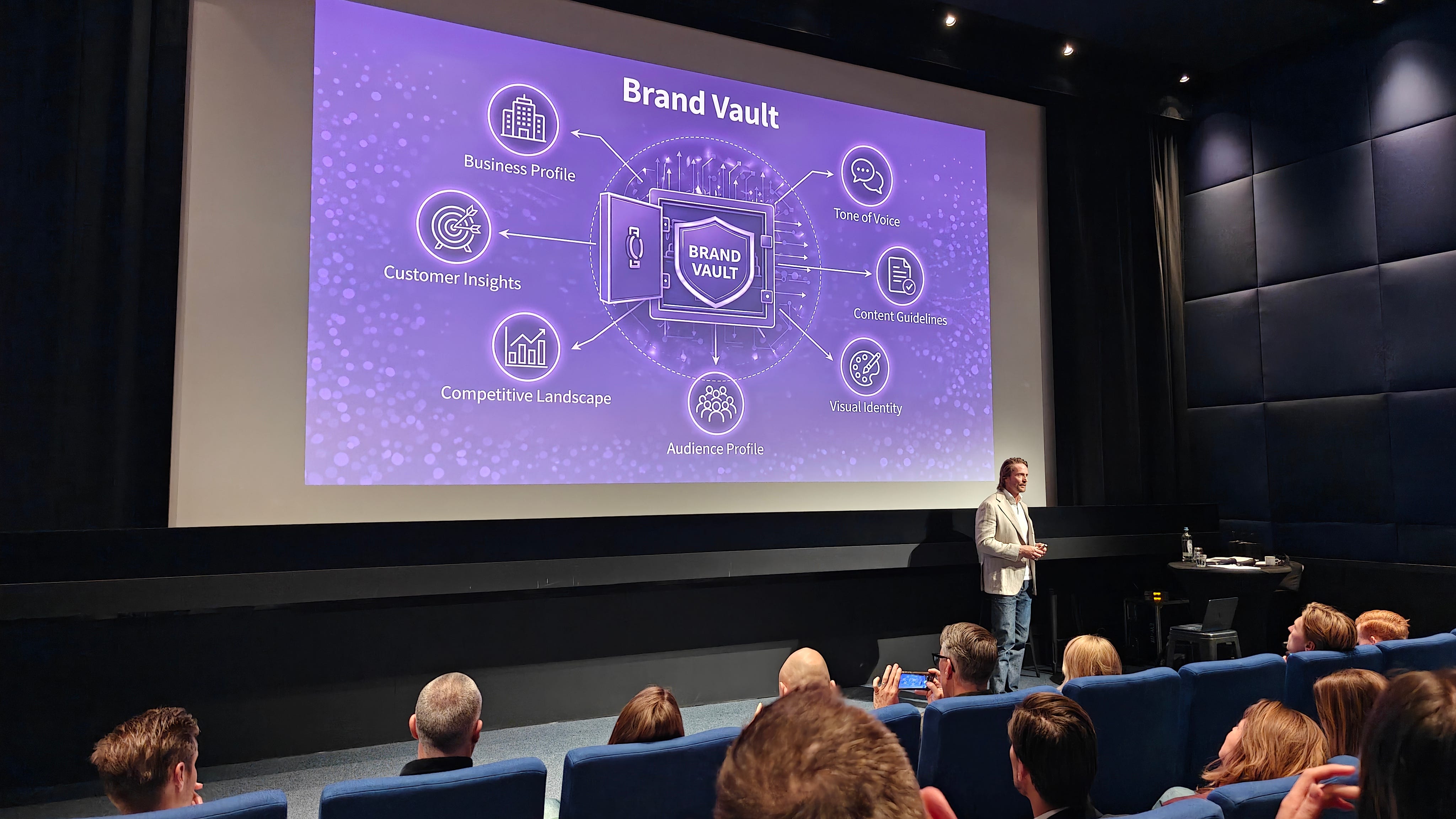
The presenter presented very nicely, a real sales guy but in the very good way, I could resonate with almost everything he told, even with his story of falling in love with ChatGPT first, then Gemini, now Claude😅.Right Bob? 😅
You can even create a free Brand Vault so you can see how it works:
Details: https://marcus.agency/
🔍SEO week: Stop organizing around channels
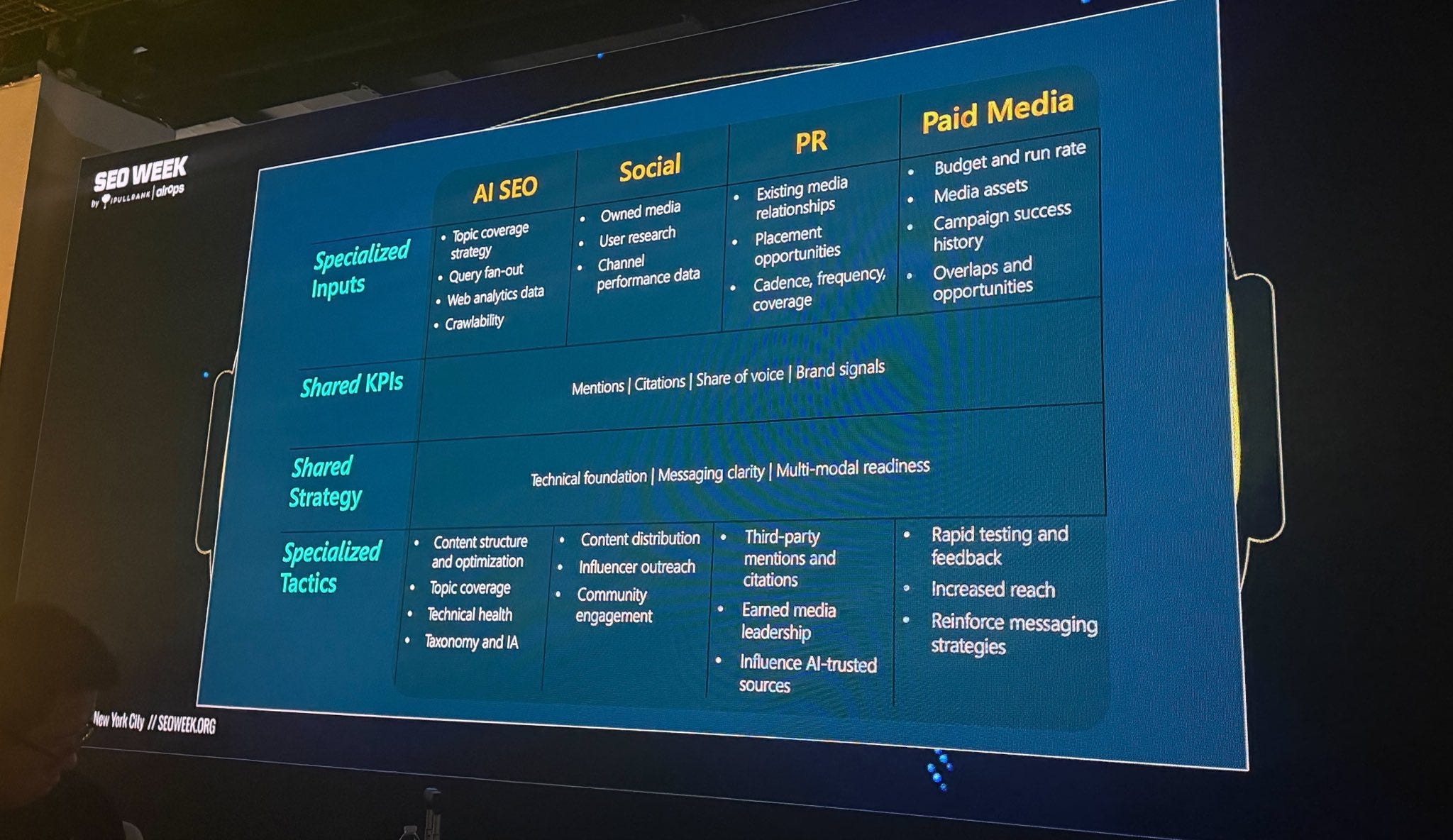
I found this slide from SEOWEEK, I think I fully agree: The future of marketing is a cross functional strategy where everyone cares about the same KPIs. Fewer silos. More connection.
A slide that might be worth sharing or to use in many organisations.
Thanks for reading Crossborder Alex : Global Marketing & E-commerce! Subscribe for free to receive new posts and support my work.
Interested in more? Checkout my archive!
Or use my vibe coded search engine to find content tailored to you
Thanks for reading Crossborder Alex : Global Marketing & E-commerce! Subscribe for free to receive new posts and support my work.