

Goodmorning!! Past week I was traveling but also at many conferences. Let me share a few things here for your convenience. I try to summarize it in short (difficult).
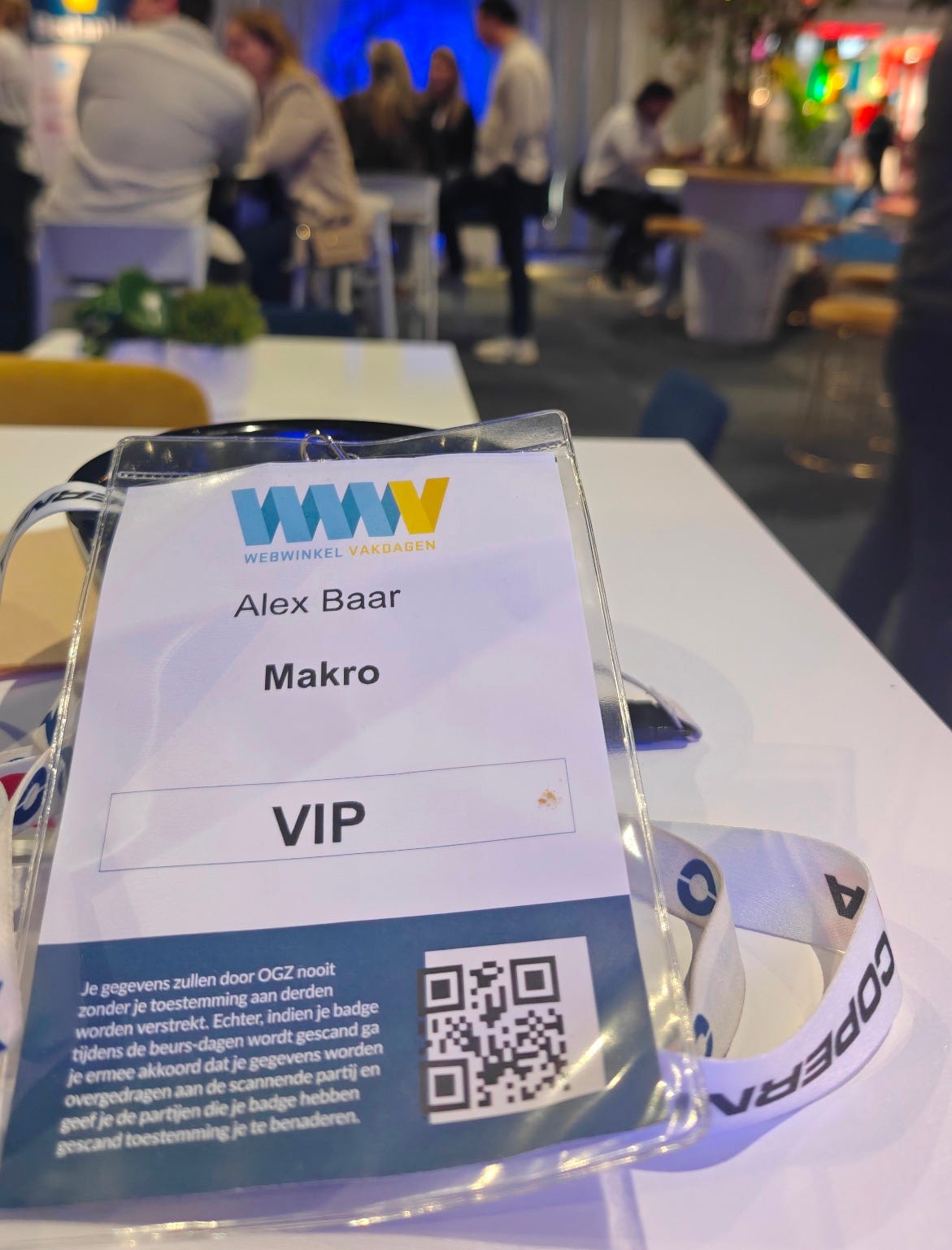
A thank you to “thuiswinkel.org” for providing me with a VIP pass and the conferences.
🇳🇱 Otrium & Talpa on audio advertising via a product feed


First, let me share here a few slides of a presentation I went to at the “WebWinkelVakdagen”. It’s about audio advertising. A company called “Otrium” shared their experiences in audio advertising and moving budget from performance marketing to “performance branding” a trend that continious and I wrote about many times before on my substack.
I really liked the part in the presentation where they explained, you can now use a “product feed” to personalize the audio advertising experience. By connecting their live product feed to their audio production, they can now generate audio ads in real-time. If a specific sneaker sells out, the AI-driven system automatically stops that ad and swaps it for a trending product, ensuring that every “Sonic” impression is 100% relevant and up-to-date.
Something that might also be worth remembering is the question “how does your brand sound”? The speaker notes that while 100% of marketers have clear guidelines for their visual brand identity, very few have actually thought about how their brand sounds and almost no one wrote that down. This is increasingly important.
A few bullets with takeouts and the slides in the pictures above.
The Performance Marketing "Glass Ceiling": By 2024, Otrium found that their performance marketing had reached a limit where every additional euro spent no longer yielded the same return. Costs for CPCs and CPMs had increased by approximately 11% year-over-year, meaning the same budget resulted in less reach.
Over-reliance on Lower Funnel: Approximately 97% of Otrium's spend was concentrated in the lower funnel, focusing on direct conversions and capturing existing demand rather than creating it. This limited their reach to only the 5% of the audience currently in the market.
Strategic Shift to Audio: To break through the growth ceiling, Otrium shifted 20% of its budget to radio, digital audio, and digital out-of-home. The goal was to move from "demand harvesting" to "demand creation" by reaching the 95% of the market not yet ready to buy.
The company utilized AI voice cloning of a real voice actor to create relevant, cost-effective ad variations. This allowed them to dynamically update the final five seconds of a radio spot to reflect real-time offers or specific product categories without needing a voice actor to return to the studio.
Otrium implemented Billy Grace to centralize their marketing data and overcome the resource limitations of a small team. This allowed them to finally gain a comprehensive view of the customer journey across both web and app, which had previously been difficult to track. Crucially, they could see the impact of their marketing not just per channel, but the incremental value of specific advertisements (such as Pinterest and YouTube ads) and audio campaigns down to the individual promotion level.
With these insights, the team could directly measure an incremental Return on Ad Spend (iROAS) of over €6 for their upper and mid-funnel activities. This data was essential for justifying the larger branding investments to their CEO and, as it proved the strategy was successfully reaching entirely new customer groups instead of just targeting the same 5% of audiences already in the market.
Very nice presentation, I hope you can also use some of the takeouts.
✈️ TUI: what if your biggest competitor is NOT a company?


TUI, the well known, travel company also gave a presentation via Suzanne Goos from TUI NL. What stood out for me was their opening slide where they said: “Our new competitor is not a company but an algorithm”. Everything they do is focused on to be where there customers are and increasingly these are LLM’s.
I thought it was a solid presentation highlighting the right angles (especially technology and trust). Sometimes it was a bit too much "high over” and some aspects were clicked on too shortly in my opinion but I summarize my takeouts here below:
Technology is fundamentally changing commerce by shifting its role from a simple tool to a factor that determines customer decision making.
To remain relevant, TUI focuses on three strategic pillars: Reputation, Relationship, and Reintegration: Reputation is now a differentiator based on building trust with customers, algorithms, and the broader ecosystem through reliable data.
The "Predict" Era: We are now entering a phase where customers stop searching and start asking questions (e.g., via AI). In this world, an algorithm determines visibility and recommendations, making it a "predict" world where technology anticipates behavior.
Trust is no longer just about the customer's perception of the brand but also about trust from algorithms.
To be recommended by AI systems, an organization must provide reliable data, consistent content, and high product quality (reviews)
TUI is moving from purely performance-driven marketing to building emotional brand preference through rebranding (mainly via controlling and optimizing the whole journeys.
The goal is a seamless omnichannel journey where online, social, and retail channels are fully integrated. (ah yeah that’s what I said :)
In a world dominated by platforms, TUI sees value in controlling the entire customer journey, from inspiration to the actual experience at the destination.
By connecting distribution, data, and their own products (like planes and hotels), they reduce dependency on external platforms and can better influence the "share of search"
This is nice: They use AI persons actively already today! They are very open that it is an AI person, and that differs from others, many companies don’t tell that. Seems to work very well. Here details on Lena the Explorer.
Besides “Lena” (social media), TUI introduced “Lisa”, an AI assistant in travel agencies who handles intake conversations to collect data and reduce waiting times for customers.
Nice presentation, Suzanne ended also with a pretty cool video from where TUI is heading, but that one I could not find anywhere online. So stay tuned and follow TUI, there might be nice things coming up!
🍻 A story from Heineken on AI, acceptation of digital tools and some new concepts.


Yeah let’s talk about beer! I also visited a presentation from Heineken and that one was truly crossborder😀🚀 Sorry for the bad pictures, I didn’t had the best position in the large hall and also I could not upload all of them because substack only allows 9 images per gallery.
The speaker explained that Heinken is creating "Pull" demand: While Heineken generates over €30 billion in turnover through B2B channels like supermarkets and bars, they invest more than €1 billion in marketing directly to consumers. The goal of this direct communication is to create a "pull" effect, generating the consumer demand that then drives sales for their B2B customers.
Shifting focus to the end of the chain: Traditionally, Heineken focused on its direct B2B customers (the first links in the chain), but the speaker argues that the "real value" is at the back end of the chain: understanding the shoppers, consumers, and the market categories.
Supporting B2B partners with B2C Insights: By understanding the end consumer better, Heineken aims to help its direct customers such as the "pub on the corner" better understand their own guests and shoppers to optimize their business.
The speaker also explained some innovations like: "Beer as a Service" (BaaS😅): A model where customers pay per glass tapped rather than per keg, allowing Heineken to manage logistics and stock more efficiently.
Image recognition: Customers in Mexico take photos of their fridges; Heineken uses AI to verify if products are stocked according to the "picture of success" and offers discounts for compliance. They always start small in the beginning they realised that their customers send the same picture every day, then they made it mandatory to put a date post it on the fridge. Small steps was the main message, small steps to acceptation of AI and digitization.
Modern POS systems: Heineken has partnered with Apple to create an iOS-based iPOS system that is easy for temporary staff to use and provides deep category insights for bar owners. Its so easy he told us that staff can use it at their OWN phone and no explanation or tutorials are needed.
Brewery optimization: Nearly 8,000 machines in breweries are connected to a data platform to optimise production and learn from global performance.
AI-Driven sales: In Mexico, sales representatives use AI tools to determine which outlets to visit and what specific products to pitch based on data, rather than following a fixed route.
The speaker noted that the greatest resistance to these changes was actually internal, coming from the sales representatives themselve.
Fear of job loss: Initially, sales reps were very resistant because they feared that AI and digital tools would eliminate their jobs.
From “Order Takers” to “Consultants”: To address this, Heineken promised not to cut jobs and instead reframed the role of the sales rep. They moved from being transactional “order takers” to becoming “business consultants”. In this new role, reps use data to help bar and shop owners understand their own categories and grow their businesses.
AI-Guided sales: Instead of following a random route, reps in Mexico now use AI tools that tell them exactly which outlets to visit first based on sales opportunities or the need to fix a customer relationship (like “drinking a cup of coffee” to mend a previous stock issue).
Assisted orders: Many customers were initially reluctant to use the new e-commerce apps. To bridge this gap, sales reps would initially help the customers place their orders through the platform, a process known as “assisted orders”.
Incentivising direct use: Over time, Heineken introduced loyalty programs. Customers who placed orders themselves rather than relying on a rep’s assistance earned points that could be traded for merchandise or other rewards.
❤️ A smartwatch as POS reducing transaction costs
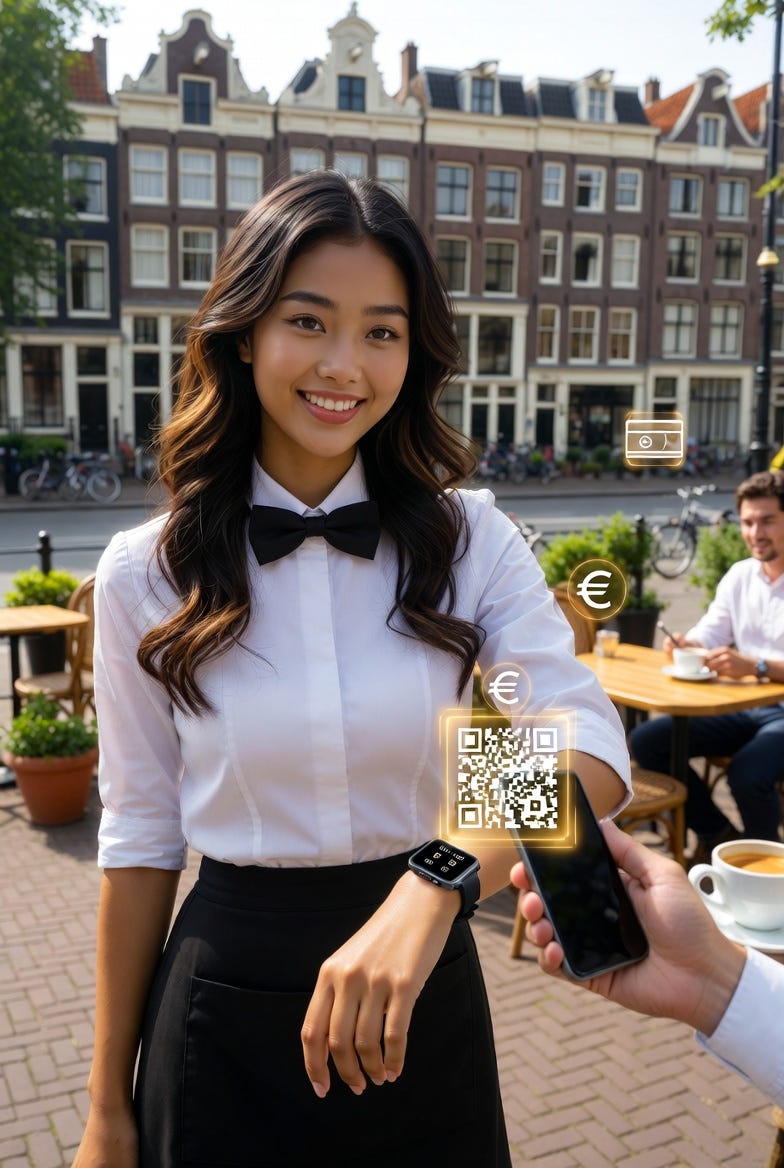
Pretty cool!
So soon we scan the watch of a waiter/waitress to pay? Competition to Visa/Mastercard and massive POS terminals.
Your smartwatch is becoming a POS terminal, and it’s bypassing Visa & Mastercard entirely.
Huawei and YowPay just launched a smartwatch-based payment app powered by open banking.
The app turns a Huawei smartwatch into a payment terminal, enabling merchants to accept instant Sepa payments directly on their wrist.
Customers scan a dynamic QR code generated on the watch face using the camera of their Smartphone, bypassing traditional card schemes and, says Yowpay, reducing transaction fees.
https://www.fintechfutures.com/paytech/huawei-and-yowpay-bring-sepa-pos-payment-acceptance-to-smartwatches
https://www.linkedin.com/posts/marcelvanoost_your-smartwatch-is-becoming-a-pos-terminal-activity-7442883707931238400-XxfN/
That’s it for today. Thank you for reading.
Slowly I am considering new opportunities (also international):
Contact me via LinkedIN → https://www.linkedin.com/m/in/alexbaar/
Checkout my archive of previous newsletters if you want to read more :