

Goodmorning everyone! Here is your weekly newsletter on global marketing & retail. All topics I like personally. I hope you enjoy reading it (again). Thank you!
🇰🇵 North Korea a glimpse into their e-commerce ecosystem
As many I am fascinated by North Korea. I have been visiting the border area’s, both on the South Korean side an the Chinese side. The South Korean side is heavily guarded but on the Chinese side (I went to Dandong), is much more relaxed. You can buy North Korean beer, North Korean money and cigarettes and you can dance with North Korean restaurant staff. Yeah, that’s really possible. Below you see me dancing in a North Korean restaurant (with all North Korean staff). North Korean food & drinks and two times a performance, where guests can join, like I did.
The Youtube channel “In the Kimdom😅” made a video on e-commerce in North Korea! It gives us a glimpse on what is happening in North Korea and I think it’s very nice to watch for all of us crossborder e-commerce fans. Some higlights:
What “Manmul Sang” is (” hint: North Korea’s Amazon”): Launched in 2015, this platform offers roughly 30,000 products, ranging from housewares to electronics. It’s a strictly a domestic-only catalog. Check it out yourself:
The Okriu Platform: Originally a food delivery service for the famous Okryuguan restaurant, it evolved into a centralised marketplace for approximately 600 products.
It explains the closed ecosystem: These platforms are only accessible via Kwangmyong, North Korea’s internal intranet. This “walled garden” uses numeric IPs and is completely sealed off from the global internet.
Learn about the sate run courier system: for official e-commerce, the governments operate a nationwide logistics system using motorbikes for short-distance food delivery and vans for larger goods.
The video also has a chapter on payments such as systems like prepaid cards (Narae and Koryo) or local-currency cards. The Ulim (Echo) mobile system allows users to pay via QR codes at registers.
Go watch the video crossborder fans!
🌎International SEO Technical how to deal with multi domain sites


Brodie has a good “tweet” or X on international SEO on the topic XML sitemaps/GSC. Brodie writes on multi-domain international expansions and problems that can occur if you do not set this up correct.
The important part is understanding why groups of pages are being flagged, and whether an action should be taken. An action isn’t always required.
Details in his X post:


🔍What AI Means for Brands: how to stay visible, relevant, and chosen


This is truly a great deck, again from Aleyda and I share it because it’s very usable for e-commerce strategy. Things constantly change and this is a very actual document that you can and should use in your strategy or for your clients.
Complete deck:
https://speakerdeck.com/aleyda/what-ai-means-for-brands-how-to-stay-visible-relevant-and-chosen
☇Amazon still rules product discovery but for how long?
Now onto Amazon. The article I’m referring to below argues that Amazon still dominates “product discovery”, but they add an important nuance: for now. Cracks seems to be appearing with the rise of AI search, social commerce, and agent-driven shopping. I can imagine that but Amazon’s fundamentals are of course really strong especially, reviews, pricing, and the prime ecosystem reinforce its grip on discovery and conversion.
Many people don’t know but Amazon’s Vine Programme I think is a really smart idea. So far I have never read or saw any company who copied or adapted that idea. Basically Amazon Vine provides free products in exchange for reviews and thus sets the basics for product discovery.
I’ve seen disruption before in a much less glamorous category: carpets. Out of nowhere, a newcomer (Volero) entered the market with a focus on discoverability, filtering, and a smooth buying experience. They made ordering a carpet online simple and even enjoyable. And by doing that, they disrupted the industry in a small way, but still….
Amazon, “the biggest startup in the world,” operates on a completely different scale, of course. But the pattern is interesting. If you run a marketplace yourself, especially in a niche, there’s a lot to take from this. Discoverability can still be reinvented, and dominant players don’t stay untouchable forever. Let’s see how this plays out.
Details:
https://www.practicalecommerce.com/amazon-rules-product-discovery-for-now
Same topic, different source. Also product discovery & Amazon. I list these recommendations here as it can help sellers improve their listings and discoverability useful information also if you are an agency.
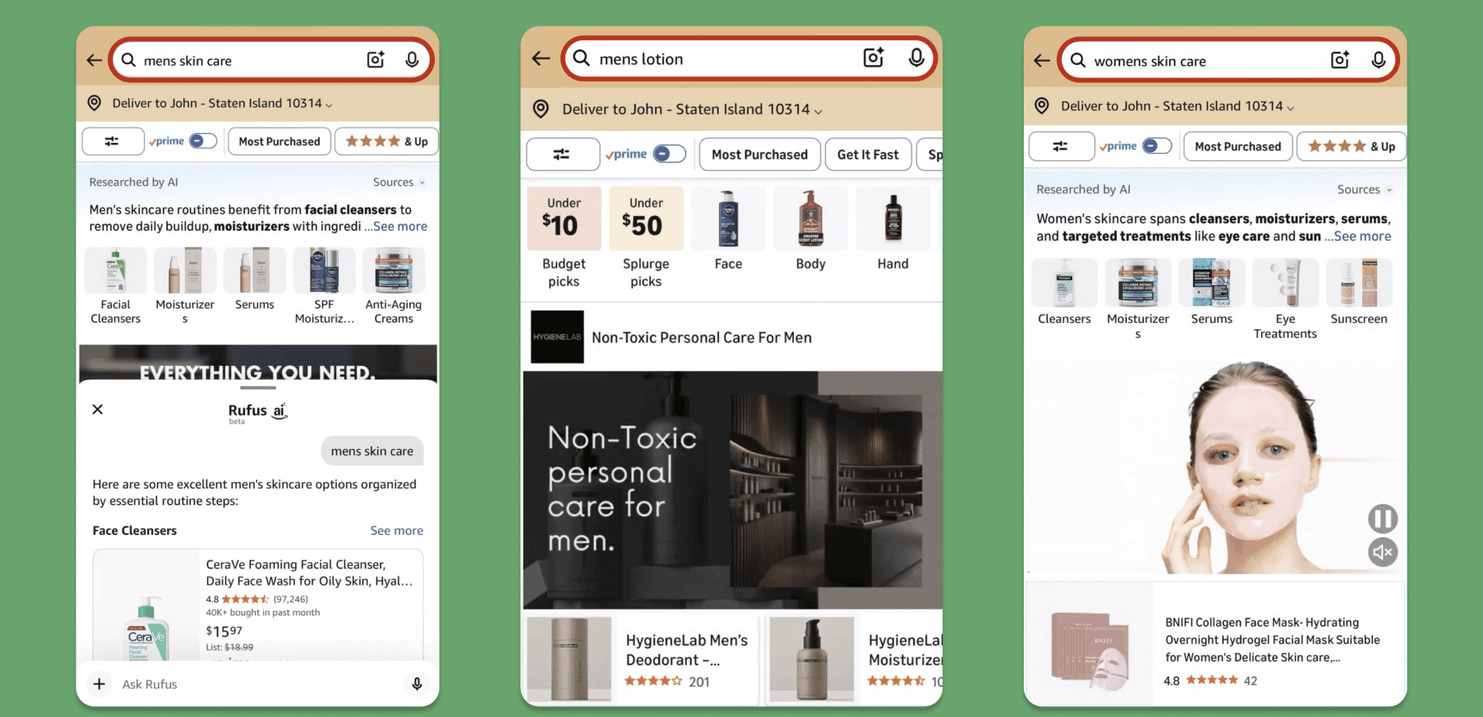
Specific searches such as "men’s lotion" display regular product grids, while broader queries like "men’s skin care" prompt Rufus to curate and label products as “Researched by AI.” This helps identify shoppers' purchase-ready versus research intents.
What this means for brands:
Broad terms are no longer just a ranking battle: Inclusion in AI-curated routines matters more than position.
Product role clarity is critical: If your listing doesn’t clearly state where it fits in a routine, Rufus decides for you.
Assets must explain usage and order: Images and copy need to communicate how and when the product is used.
Discovery is shifting to routines: Brands must think beyond single ASINs and position products within complete workflows.
👍Revolut: keeps on innovating
I love this mindset! Everyone copies innovation the only way to stay ahead is to innovate faster / innovate more exactly as Revolut does.


Thanks for reading, liking and subscribing, it means a lot to me! Hope you liked it. Slowly I am considering new opportunities (also international):
Contact me via LinkedIN → https://www.linkedin.com/m/in/alexbaar/
Checkout my archive of previous newsletters if you want to read more :