

Goodmorning my friends! I hope you all enjoyed Christmas! On to the new year. Looking forward! Hope to make some nice one man retail trips again in 2026.
Let’s start:
🇺🇸 AI’s impact on shopping journey’s, 1000 respondents research
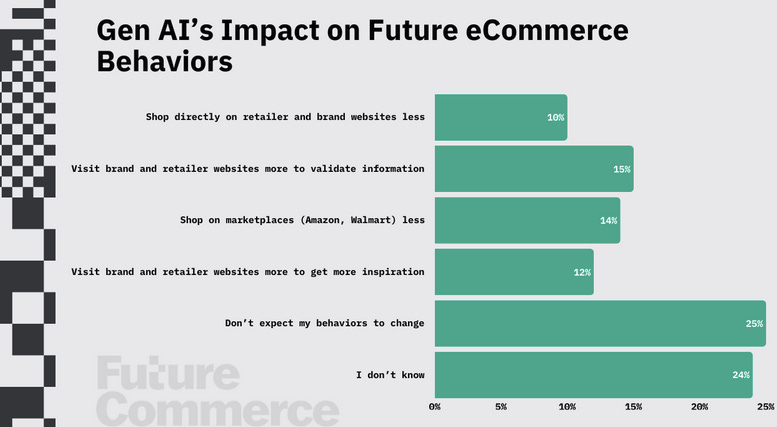
Research came out, 1000 US consumers were asked how they use AI and shop. I think important to follow these kind of topics, so you can know which direction it is going and have a first mover advantage.
Let’s take a look:
AI is primarily a top-of-funnel tool; 77% of consumers prefer to click through to a merchant's website to finish a purchase rather than buying directly within the AI platform. Now I wonder if it remains that way, but for now very interesting, so it’s still very very important to create/maintain a great shopping platform and brand.
Price is a major motivator, with 57% of consumers stating they are "sick of hunting for deals" and want AI to handle price comparisons for them. This of course makes sense. That’s why I think (and I wrote on that earlier), more and more AI will hunt your deals and not only cross platforms but also inside platforms by giving context aware discounts.
Loyalty is being redefined by utility, as 31% of all shoppers (and 40% of Gen Z) would buy from an unfamiliar brand if an AI platform surfaced a better deal. This makes also sense, people might (although it might not always be true) trust AI more, so it’s easier to switch. Because of this I think it is also very important to make sure all your structured data is top notch and you also build a strong online brand presence.
Physical retail faces a significant challenge, with 30% of consumers saying they expect to visit brick-and-mortar stores less often due to AI planning their shopping. This one I did not see coming but it can make sense. However I think AI can also help to get people to stores. As we often see in Asia (like JD malls in China or “Community malls in Thailand) giving more reasons to visit malls or shopping areas might counter this. In case of NL (and some other European countries) the extremely high parking tarrifs should also be removed/lowered.
Checkout the full report here:
🇮🇳 India: private AI teaching groups booming

Sometimes testing or setting up something doesn’t require a lot. Take these Indian teachers for example, instead of setting up courses at Udemy for example they simply create Facebook and WhatsApp groups. Much simpler and also much closer to their target group.
I think this is valid in many cases. If you source products you can easily test it before you buy, via communities or advertising. If you want to create a movement you start at facebook or meetup.
“The biggest misconception is that small business owners in developing countries will be the last to adopt AI. I’m seeing the opposite,” said Dutt. “They are adopting it first because for them, even a small improvement in efficiency makes a big difference.”
I think that’s true, I have seen that also in China where the large tech giangs specially focuse on barrier free entry to AI for “papa and mama stores” for example.
“People assume AI education must look like a computer science degree, but most small business owners and freelancers need only 5% of that — the part that saves time or brings revenue,” he said. “These low-cost tutors are making AI less intimidating and more practical. It suggests that AI adoption in developing economies is happening bottom-up, not top-down.”
To me, that’s a good thing, innovation often thrives when it happens bottom-up, We’re seeing this play out in places like India and China, where small businesses and freelancers are leaping ahead with practical, low-cost AI uses. In Europe, though, adoption feels more top-down and cautious, shaped by regulations and enterprise led initiatives. I believe more in the bottom up version. That’s why I think it would be great if European companies for example embrace more AI initiatives, let people spend 10 or 20% of their time on AI initiatives, try and learn locally.
Details:
https://restofworld.org/2025/indian-tutors-ai-skills/
🧪Meta Andromeda Strategy: A Systematic Framework for Creative Testing and Scaling
I like to read and see how you can tweak or beat or get the best out of an algoritm. I wrote about it earlier, Meta’s AndroMeda. I think many organisations are not ready for this or busy with it, but you can take a huge advantage. This video also dives into that. I think the video has a bit too much self promotion but still it is in line with what I read elsewhere. My takeouts:
Messaging now controls targeting: In the modern "post-Andromeda" landscape, targeting is no longer effectively controlled at the adset level; instead, the messaging within your creative determines who sees your ads, making granular adset targeting an archaic practice.
Prioritise messaging diversification: You should launch with 25–30 totally unique creative assets that provide different reasons for a customer to convert, rather than just swapping hooks on the same video body.
The "one size fits all" copy strategy: To keep the process manageable, use the same five headlines and five pieces of body copy across all 30 ads; these should be written broadly enough to apply to every creative
Discard the belief that every ad needs reach: It is an outdated belief that every creative deserves distribution; it is normal for one to three ads to receive all the reach while the others get little to no spend.
Utilise a simplified campaign structure: The sources recommend a cold campaign containing three specific adset stacks: a broad stack, an interest stack, and a lookalike stack, all containing the same 25–30 ads.
Test then scale using ABO: Use Ad Set Budget Optimization (ABO) to control distribution during the testing phase, identify the 1–3 winners, and scale them until you hit a performance limit.
Identifying the "spending ceiling": When scaling, you will eventually hit a ceiling where costs rise and results drop; at this point, you should reduce the spend back to that stable "foundational" level. The duplication and extraction process: Once you hit a ceiling, duplicate the adset and remove the winners that received the reach, keeping the ads that received no distribution so they can be tested again in a new environment.
The quality control filter: If your winning ads bring in results but the leads are of poor quality, treat them as losers; duplicate the adset, remove the high-reach "bad" performers, and shift your messaging.
Keep creative "on the side": You must constantly have a backlog of prepared ads ready to go so that you can relaunch or replace creatives immediately without waiting 24–48 hours for filming and editing.
Disable AI creative features: To maintain control, turn off almost all "Advantage+" AI creative enhancements, such as site links, though the feature that highlights positive comments is considered beneficial
Take a look at the video for all details. More on AndroMeda in earlier posts I wrote:
https://www.crossborderalex.com/p/global-digital-marketing-and-retail-ed115
And
https://www.crossborderalex.com/p/global-digital-marketing-and-retail-ed106
🇰🇷 🇹🇷 Korea: How One K-Pop star got 25 containers of Turkish chocolate to South Korea

I have been to Korea, really liked it there, but I have never really understood the K-Pop phenomenan. Well except “Gangnam style”😅. But read this story how a K-Pop star’s social post resulted in 25 containers of chocolate to South Korea:
A Korean taxi driver in Seoul (referred to as “ahjussi” in Taehyung’s live, confirming he’s likely Korean, not Turkish as some mistranslated sources claim) gave Kim Taehyung (BTS’s V) a Christmas gift of chestnut-flavored Tuvana Turkish chocolate during a ride on December 22, 2025.
Taehyung, impressed, immediately went live on Weverse (Weverse is a global fandom platform) for about 3 minutes to show it off and express his delight, calling it “Turkish chocolate” with a smile.
This casual endorsement went viral among fans, causing Tuvana’s stocks to sell out in Korea within seconds (reported as 13 seconds in some outlets), with massive demand spiking online and in stores.
The Korean distributor then urgently ordered 25 containers from the Turkish producer, Tayaş Gida, to restock and meet the export surge, leading to millions in sales for the brand.
0 budget, huge effect by just making quality chocolates (and a little K-Pop luck)
Want to know more about South Korea? Do read my newsletter(s) on that topic

📈SEO : Exploding topics: find out what is searched for in the (near) future

Now this is also something that can pay off, I think if you spend some amount of time weekly in analysing trends. There are tools for it available but you can also build it yourself with N8N for example.
A while ago I spoke a guy who worked for a large retailer in the Netherlands. They sourced products from SE Asia (especially clothes) and at the moment they sourced it they use AI to already create the product listing as complete as possible, even thought it might still take months before the product is actually in the stores an available online. But this approach gave this company the advantage to already create demand an SEO authority.
Exploding topics is something similar but with a little more research.
Basically it changes SEO from waiting until people start Googling for a keyword to start ranking “now” when hardly anyone searches for it yet.
You can use this for products but of course also for services and especially events. It comes down to:
Identify emerging topics before they become popular
Use Google Trends, Exploding Topics, AnswerThePublic, or Keyword Tool Dominator to spot rising interest.
Look at related searches that are growing but still have very low volume (e.g., 10–100 searches/month).
Watch Reddit, TikTok, Twitter/X, industry forums, and product review sites for early buzz.
Create content for those low-volume, future-popular terms
Write in depth guides, comparisons, listicles, or “ultimate” resources targeting those early stage keywords.
Make the content extremely helpful and comprehensive so Google sees it as the best answer even when volume is tiny.
Optimize aggressively for those terms
Use the exact keyword in title, H1, URL, first paragraph, and naturally throughout.
Build internal links from your high-authority pages to these new pages.
Monitor and double down
Track rankings and traffic weekly using tools like Ahrefs, Semrush, or Google Search Console.
When you see the search volume starting to climb (even from 50 → 500 searches/month), publish more related content, update the original page, and push harder for backlinks.
By the time the keyword hits 5,000–10,000 searches/month, you’re already #1–3 and competitors are playing catch up.
Search engine land dives into it including some examples read via the link ⬇️.
https://searchengineland.com/build-search-visibility-before-demand-exists-466516
😅Time for a laugh: how not to design a logo
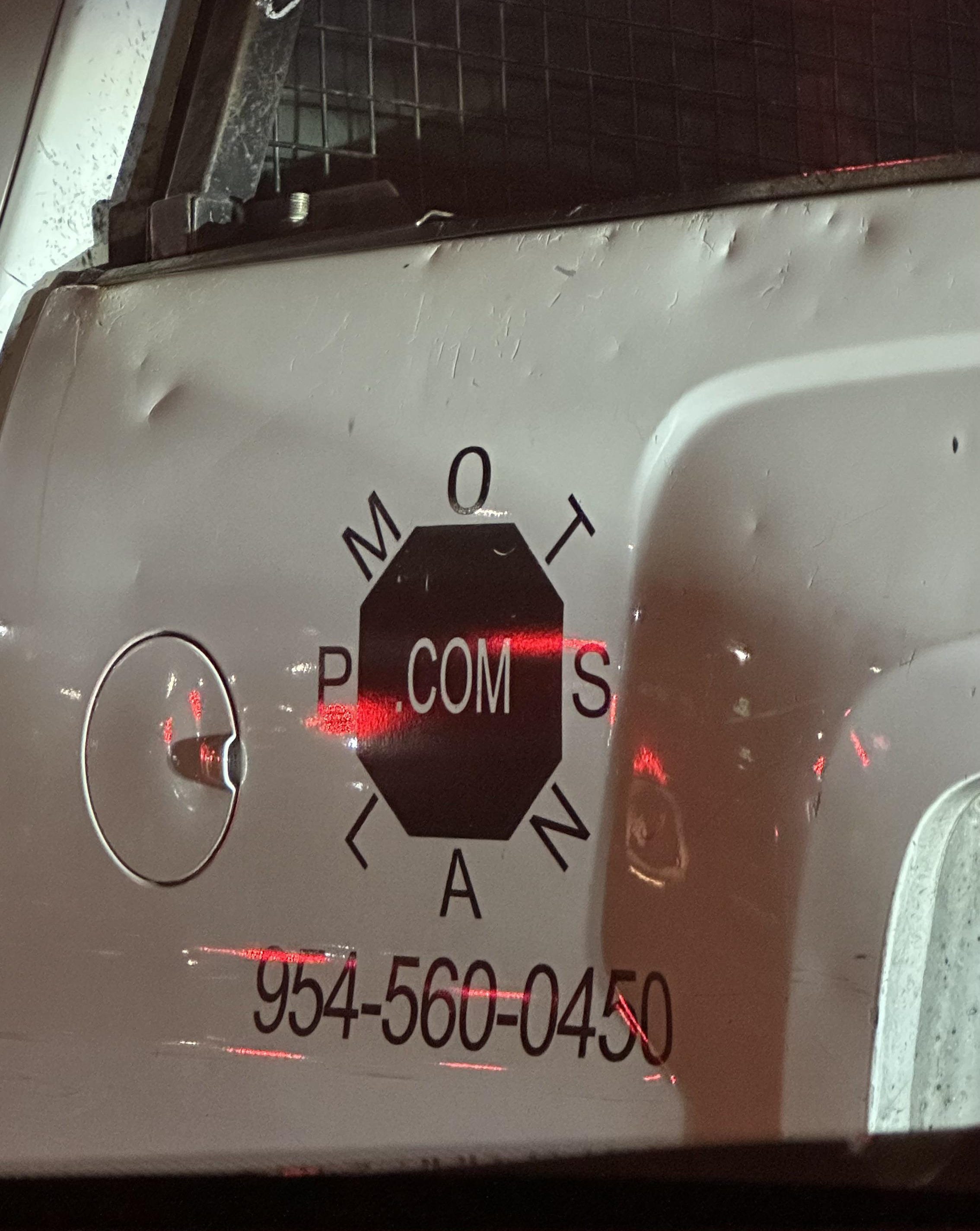
Haha, this one is “remarkable”. Take a look at this logo. This company’s URL can be any combination of these letters.😅😅. Good luck figuring that out when the car drives past you.
🎨App UX in 2025 but also useful in 2026

It’s almost 2026, so we can do a quick look backwards. 🔙. I found this article/publications on apps an UX in 2025. I think it’s a good article but it lacks screenshots, very strange for a topic on UX by the way.
Nevertheless I do recommend to read it if you are into app development and design, as it does explain best practices, that I think are quite good.
For me most interesting are these two (but the article has much more, so do read it).
Unlike agencies that create pretty mockups, Groto ships AI interfaces that drive measurable business outcomes. So how I read it not features, outcomes, agents that give an outcome. But also:
“AI task breakdowns that show progress”
Instead of a spinner, show steps like: Analyzing → Drafting → Checking → Ready to review. This reduces uncertainty and drop-off.“Clear undo paths for every AI decision”
Let users revert: Undo, restore previous version, view changes, edit before applying. This increases trust and willingness to proceed.“Progressive disclosure”
Show only what’s needed right now; reveal advanced settings later. Example: start with “Generate draft,” then optionally reveal tone, length, constraints, sources, etc.
Task-first navigation hierarchy
Shrink headers, elevate primary actions, use dynamic islands for status updates. iA Writer and Arc Search demonstrate how reducing navigation chrome improves task focus.
Apps like iA Writer and Arc Search show that reducing navigation chrome dramatically improves focus and completion.
Most apps still waste mobile screen space with large headers, permanent navigation, and UI users already understand. Task-first design flips this: content and actions come first, UI comes second.
What actually works (and is easy to copy, I think or to test):
Collapse headers on scroll to give content more space
Make one action visually dominant per screen
Replace full-screen loaders with inline status pills
Hide navigation until users signal they need it
Treat UI as temporary, not permanent
Why this matters
On mobile, every pixel counts. Less UI friction means faster browsing, easier comparison, and higher completion, especially in search-heavy, AI-assisted, and decision driven flows like retail.
The key question isn’t “what should we show?” but:
“What is the user trying to do right now, and what can we remove?”
Details:
https://www.letsgroto.com/blog/top-10-best-app-designs-in-2025-ux-ideas-from-ai-driven-products
Thank you!!
Thank you so much for reading, liking and subscribing! I wish you all a great day and hope you liked this edition.
Alex

🫡Open to new opportunities
Thanks for reading, liking and subscribing, it means a lot to me! Hope you liked it. Slowly I am considering new opportunities (also international):
Contact me via LinkedIN → https://www.linkedin.com/m/in/alexbaar/
Checkout my archive of previous newsletters if you want to read more :